Nuit Blanche 2018. Danse avec les arbres – Saint-Merry

Imagine Saint-Merry on Saturday, October 6th. A procession of trees hanging in the nave and a carpet of leaves. Daniel Van de Velde, sculptor, writes to the community of the Pastoral Center and presents himself through his work.

These are trees, but not as you are used to seeing them. Eighteen trees fell after a storm, segmented, recessed, of which only the last growth rings remain, their most recent memory. They are suspended in the nave or placed on the floor of the church, a musical creation celebrates them. They are on a carpet of soft leaves walking. Trees in majesty, such as recumbent, not kings of stone to honor, but subjects of nature to protect.

This work will remain visible during the day, for a week.

The tree is a recurring subject in the exhibitions of Saint-Merry, which we remember in 2010, “Forests” of Eva Jospin or previously  or finally the summer exhibition 2013 , but, in 2018, the tree will dialogue with the whole architecture.

Jean Deuzemes

Source: Nuit Blanche 2018. Danse avec les arbres – Saint-Merry

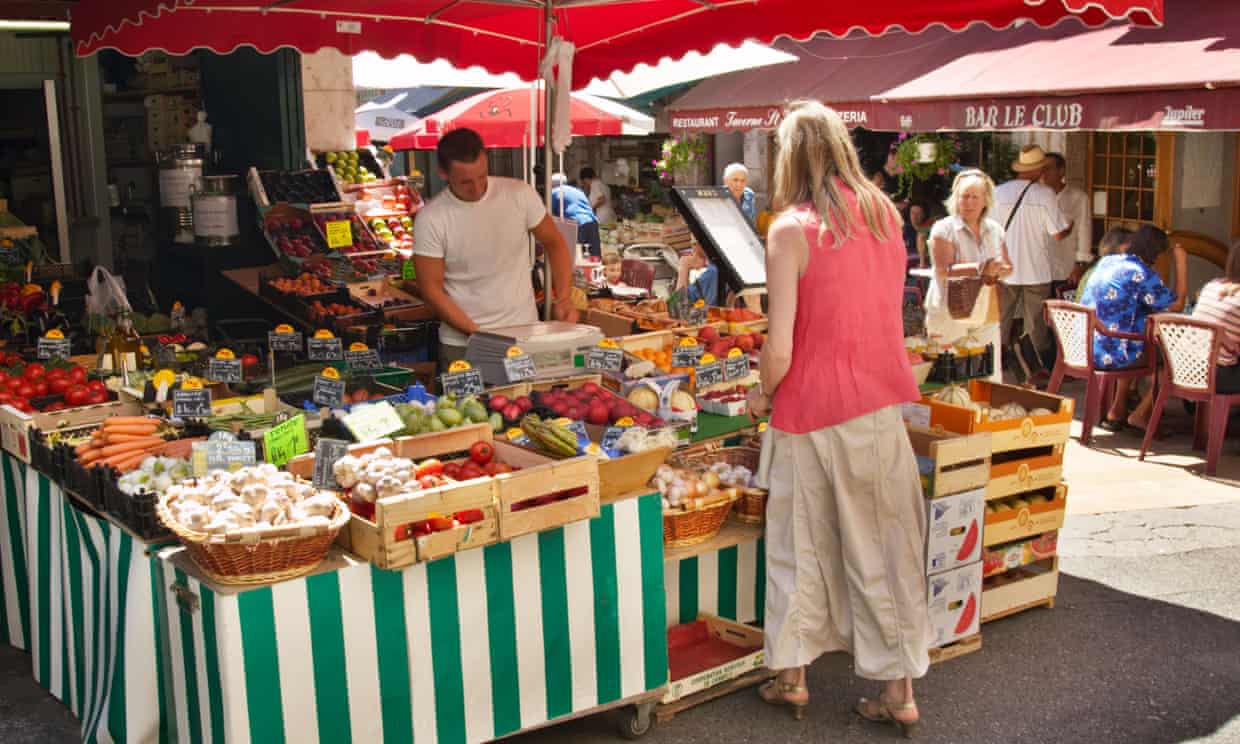
The cliche is French food is better than ours. The trouble is, it’s true 

I am, by nature, suspicious of food cliches. I don’t think Grandma’s cooking was always better. Certainly, my grandmother’s wasn’t. She hadn’t met a packet she couldn’t open and regarded the notion that she should cook from scratch as a calculated insult. Likewise, the good old days were nowhere near as good as now: choice was limited, quality was poor and “abundance” was a word for spelling competitions, not a descriptive term to be applied to food stocks.

I have long bridled at the insistence that the food cultures of our European neighbours are so much better than ours. It ignores the realities of history. Yes, trying to find a good meal in Britain outside the home (and inside it, for that matter) immediately after the second world war was as tricky as finding an honest banker in London’s Square Mile. Then again, during that war we industrialised food production to help fight a war of national survival, losing purchase on both cookery traditions and kitchen skills.

It seems all it takes to soothe me is a good selection of cheeses and a recently picked fig

And what’s so good about those robust food cultures anyway? They tend to be inward-looking and small-minded. Two weeks in Tuscany sounds like a fabulous idea. Then the reality slides in, like ink seeping slowly across blotting paper: day after day of the same bloody pasta dishes, the same rustic salads and anything for dessert as long as it’s tira-sodding-misu or something “inventive” involving pears and almonds. By day five, what you wouldn’t do for a bit of Thai food doesn’t bear thinking about. We eat more widely and thrillingly in Britain specifically because of the weakness of our indigenous food culture [ . . . ]

Continue at THE GUARDIAN: The cliche is French food is better than ours. The trouble is, it’s true | Food | The Guardian

11 French Words You Should Know to Sound like a Fluent French Speaker – Frenchly

In honor of la rentrée, France’s return to school and also normalcy, you should make a learning goal of your own:

In honor of la rentrée, France’s return to school and also normalcy, you should make a learning goal of your own: speak French like a real French person. None of this “qu’est-ce que c’est que ça?” stuff, you’re going to say “c’est quoi?” like a normal Gaulle. Here are 11 words and phrases you absolutely need to know for speaking French without sounding like a textbook, as spoken and defined by our French Morning coworkers in the office. Refresh you mind with our lists of words from February,  March, April, May, June, July, and August, then dig in. There’s no time to learn French like la rentrée!

1. Ça fait du bien

A very French phrase, “ça fait du bien” [sa fay do bee-en] means “it feels good” or “it does you good.” It’s often used in reference to things that are good for your health / wellness / general being. For example, “ça fait du bien de faire de l’exercice” (it’s feels good to get some exercise) or “ça fait du bien de prendre les vacances” (it does you good to take some vacation).

2. Gros

An adjective meaning fat, “gros” [gro] is also a slang term for “friend.” Think of it as being the same thing as bro. Next time you see your French friend, greet him like this: “salut gros, ça va?”

3. Ah ouais?

“Ah ouais?” [ah whey] is an exclamation that basically means “really?” (in an interested way, not in an indignant way). Because “ouais” is an elongated, dramatized version of “oui,” it translates to “ah yeeees?” If a friend tells you your ex-boyfriend posted on Facebook that he’s engaged, you’ll probably say “ah ouais?” Keep in mind, if you say “ah ouuuuaaais,” dragging out the wheyyy part without raising your voice at the end, it means “yes, of course.”

4. Kiffer

An excellent French slang verb, kiffer [keef-ay] means to like or love something or someone a lot. Je kiffe les croissants de Maison Kayser (I really like Maison Kayser croissants). Maxime kiffe Shania Twain (Maxime loves Shania Twain). Il la kiffe grave (he loves her so much). You can also use it for “has a crush on.” Jessica kiffe Benjamin Pavard (Jessica has a crush on Benjamin Pavard).

5. Tu déconnes

Using the verb “déconner” [day-cone-ay] which means messing around, you can tell someone “you’re kidding” with “tu déconnes.” You can use it when you’re incredulous about something, or when you’re indignant, like “you’ve got to be kidding me.” In the popular song “Djadja” by Aya Nakamura, she tells off an acquaintance for claiming they slept together: “Putain, mais tu déconnes / c’est pas comme ça qu’on fait les choses” (Damn, but you’ve got to be kidding me / that’s now how we do things.”

6. Justement

Another one of those French words that’s ubiquitous but you don’t know what it means. “Justement” [joost-mahn] is like “exactly” or “rightly.” If your coworker is arguing that the best time to visit France is in the fall and you agree with him, you can respond, “justement, tous les touristes sont partis.” You cannot, however, say “justement” on its own as an exclamation. It has to start a sentence.

Continue reading at 11 French Words You Should Know to Sound like a Fluent French Speaker – Frenchly

Colette was one of world’s first ‘liberated’ women…

Head of the Centre d’études Colette tells Samantha David why 21st-century women still need irrepressible and provocative role models like the writer, more than 60 years after she died, to show that anything is possible

More than 60 years after her death, Colette (1873-1954) remains one of France’s most famous female writers, a source of fascination and joy.

Her books, many of which borrowed generously from her own life, are still popular, while a biopic of her life, ‘Colette’ starring Keira Knightley and Dominic West, had its premiere at the Sundance Festival – and has been slated for a limited release in the US in September 2018, before reaching Europe in early 2019.

Born in the provincial backwater of Saint-Sauveur-en-Puisaye (Yonne, Bourgogne) Sidonie-Gabrielle Colette received a remarkably thorough education for a young woman of that era, going to school from the age of six until she was 17.

Colette, her sister and two brothers enjoyed a tranquil, happy childhood; her mother, fiercely feminist and atheist, adored her and taught her literature, while her father taught her the basics of journalism.

Her parents had been quite well off but their fortunes dwindled and by 1891 the family had to move out of their comfortable home into a smaller house in Châtillon-sur-Loing, where Colette met notorious libertine Henry Gauthier-Villars – commonly known as ‘Willy’. [ . . . ]

Continue THE CONNEXION: Colette was one of world’s first ‘liberated’ women…

Tens of Thousands in France March Against Climate Change 

(PARIS) — More than 18,000 people marched Saturday in Paris as part of an international mobilization to show popular support for urgent measures to combat climate change in advance of a San Francisco summit.Crowds overflowed a plaza in front of City Hall before marching east to the Place de la Republique, carrying an urgent message that it’s up to the public to put global warming at the top of the political agenda.

“Planet in Danger,” read some banners.Activists around the world encouraged “Rise for Climate” protests before the summit taking place Sept.12-Sept. 14. California’s governor proposed the event after President Donald Trump vowed to pull the U.S. out of a landmark 2015 climate accord.The international agreement was negotiated in France, and the French capital’s march was more successful than ones held Saturday in other French cities or elsewhere in Europe [ . . . ]

Continue at TIME: Tens of Thousands in France March Against Climate Change | Time