In the footsteps of Laetitia Dosch 

Actress Laetitia Dosch makes an appointment with Karine Vasarino for a night stroll in Lausanne. The Franco-Swiss actress lived in the Vaudois capital between 2003 and 2008.

Sur les pas d’une actrice aux multiples facettes. Sur scène, elle propose des spectacles qui expérimentent les limites. Chauffeuse de salle, animale, elle tourne actuellement avec “Hate”, pièce dans laquelle elle joue nue avec un cheval.Personnalité atypique, l’étiquette de dingue de service lui a longtemps collé à la peau. Mais depuis sa nomination aux César pour son rôle dans “Jeune femme” (Caméra d’or à Cannes en 2017), Laetitia Dosch découvre le côté paillettes et glamour de son métier.Elle sera prochainement dans “Nos batailles” avec Romain Duris. Mais la belle rousse qui se trouvait moche à l’adolescence ne se considère pas comme une star.Laetitia Dosch donne rendez-vous à Karine Vasarino pour une balade nocturne à Lausanne. L’actrice franco-suisse a vécu dans la capitale vaudoise entre 2003 et 2008.

LISTEN TO THE PODACST at: In the footsteps of Laetitia Dosch – rts.ch – Culture

Laetitia Dosch : la belle et la bête

It may be a story of skin, porous membrane between oneself and the world. The skin that Laetitia Dosch has diaphanous, like most redheads, but that’s not the reason why this delicate, almost transparent envelope seems to work as a sensor. Rather a matter of sensitivity, obviously. On this evening of June, the young woman vibrates with all her being , under the big pines of the Domaine d’O, in Montpellier, at the exit of the representation of Hate  : a creation of which she signs the text and the staging, in which she plays, and which, after Lausanne and Montpellier, arrives at Nanterre, where it is not necessary to miss it .

The show is in his image: a total singularity. The beautiful, out of a painting Botticelli, plays, skin against leather, with the beast. In this case a horse named Corazon (“heart”, in Spanish), with a gray trout dress. They are both naked, which is more noticeable at home than at home. It would seem that Laetitia Dosch does not do anything like another, from the beginning.

“I’ve always been the weird of the family,” she says. Its heterogeneous environment and Catholic ultratraditionnel 8 th arrondissement of Paris. “At the same time, my family was strange, in its way, we lived with my grandparents, uncles and aunts, and in the middle of animals, alive or dead. At home there were two parallel worlds: the adult ones, and the animals and me. But it’s good that I have fallen in the ” cathos ” , like that, I could not reproduce any scheme, “she says with this light humor, falsely naive, which characterizes it.

Squeaky Spirit

It is indeed in her private Catholic high school, however, that she discovers the theater, which saves her from a lonely and mute adolescence. And it is in the theater that she plunges, with lost body, she who appears today as one of the muses of the young French auteur cinema. With an eclecticism, a curiosity, an originality that make him make the difference between very different forms, which nevertheless still marks his identity.

She played Shakespeare alongside Eric Ruf, the boss of the Comédie-Française, or under the direction of the director Mélanie Leray, while ferreting into the much more experimental and performative world of choreographers Marco Berrettini and La Ribot. And she wrote her first show, Laetitia makes a fart … , parody of stand-up, where she plays a humorist a little weak, who makes jokes about the old, the Jews and the Blacks. Laetitia Dosch does not mind having a squeaky mind. [ . . . ]

9 Best Chilled Red Wines for Your Wedding 

chilled wineChilled red wine is officially a thing.
If you’re like most of us, you probably prefer your red wine room temperature, not chilled. But unless you’ve tried it straight from the fridge, you might be surprised to learn that some red wines are meant to be sipped this way—seriously! In fact, chilled red wines are officially a “thing” and are catching on more and more.

“It‘s a common belief that red wines should be served at room temperature, but unless the room is a pantry or cellar where it is normally cool and dark, most of our rooms are far too warm,” explains Benita Johnson, sommelier and owner at The Vine Wine Club. “Ideally, wine (all wine except sparkling should be served somewhere 52 and 55 degrees for tasting, but when we are simply enjoying a glass of vino, we typically aren’t looking for the specific flavor profile and nuanced characteristics of wine—we just want it to taste good.” Of course, personal preference reigns, so when choosing wines for your wedding, the most important consideration to make is the menu [ . . . ]

If you are open to and interested in trying out some chilled red wines for your big day, here are the ones that are trending and palate-pleasing, according to sommeliers.

Contine at BRIDES: 9 Best Chilled Red Wines for Your Wedding | Brides

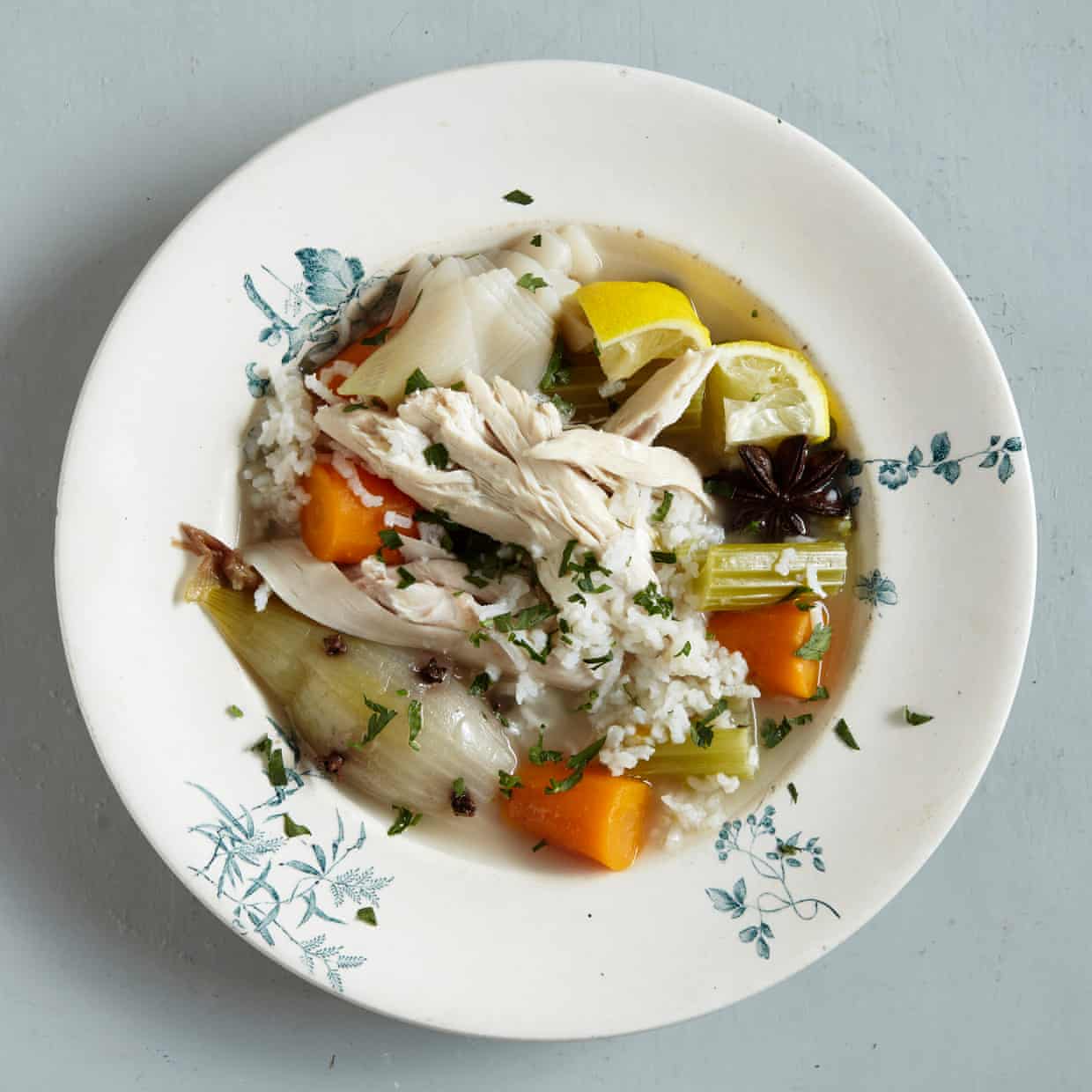
Four classic French recipes, from beef bourguignon to cassoule 


French recipes Four hearty traditional dishes that owe more to the farmhouse kitchen than to haute cuisine, including poule au pot and duck à l’orange

Poule au pot (pictured above)

The story goes that France’s King Henry IV declared that every family in France should have the means to eat chicken every Sunday, and from this, the poule-au-pot was born.

Poule-au-pot is chicken simmered in water with vegetables and aromatics. The broth can either be served separately or with the chicken and vegetables. A spent hen – a chicken bred to lay eggs – is traditional for this dish. Tougher and more gamey-tasting than chicken bred for meat, such a hen would require a longer simmering time than is indicated below, at least two hours, to become tender.

Prep 15 min
Cook 1 hr 30 min
Serves 4

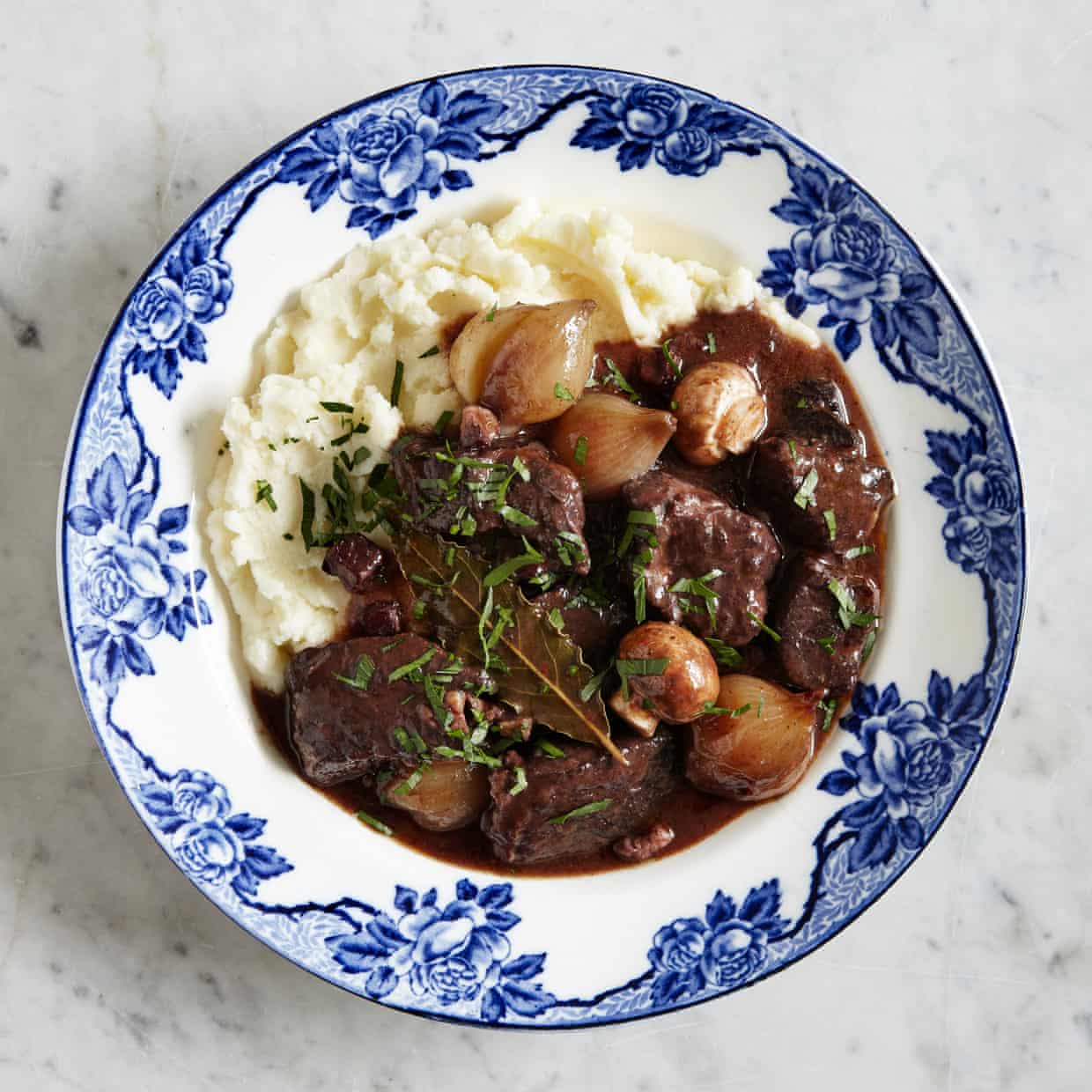
Beef bourguignon

Prep 15 min
Cook 2 hr 25 min
Serves 4

1 tbsp lard or oil
450g beef chuck or top round steak, not too lean, cut into large cubes
6 small onions, or shallots, peeled
150g lardons or streaky bacon, diced
1 tbsp flour
1 garlic clove, peeled 
1 bottle red wine, ideally a light red burgundy or red hermitage
1 tbsp tomato puree
1 bouquet garni – thyme, bay leaf and parsley tied in a bunch with string so it can be easily removed before serving
Salt and black pepper
12 small mushrooms
Parsley, leaves picked and chopped

Heat the lard or oil in a large pan on a high flame and fry the meat until browned on all sides, then add the onions and fry until those are also browned.

Meanwhile, in another pan, sweat the bacon in some oil or lard for a few minutes [ . . . ]

More recipes at THE GUARDIAN: Four classic French recipes, from beef bourguignon to cassoulet | Food | The Guardian

Two by Two

A London exhibition of work by famous artistic couples reveals the tensions of partnership

The pioneering modernists of the first half of the 20th century are most often hailed for their individual genius. A new exhibition shifts this perception by focusing instead on artistic couples. “Modern Couples: Art, Intimacy and the Avant Garde,” which opens at the Barbican Art Gallery in London on Oct. 10, examines the output of 40 such couples whose lives became indelibly linked through love and art. The exhibition features some of the leading artists of the 20th century, including sculptors Auguste Rodin and Camille Claudel, painters Frida Kahlo and Diego Rivera, and photographers Man Ray and Lee Miller.

The exhibition “is really making an argument that developments in modern art often resulted from a creative dialogue which was very often within the couple,” says Jane Alison, one of the show’s four curators. These developments included modernist movements such as Tactilism, a genre of mixed-media installations, which was developed by the Italian couple Benedetta Cappa and Filippo Tommaso Marinetti; and Rayism, a style of abstract art, created by the Russian couple Natalia Goncharova and Mikhail Larionov.

“We wanted to show that desire has a centrality within the avant-garde and modernity,” Ms. Alison says. “There is an undercurrent of sexuality infusing many of the art works which expresses this intimate access to the other.” The theme of sexual desire is starkly apparent in the work of artists like Claudel, who mined Indian literature for her terra-cotta studies of “Sakountala,” (1886) depicting a couple in a sinuous embrace. In his long-gestating installation “Étant donnés” (1946-1966), Marcel Duchamp made a cast of the body of his lover, the Brazilian sculptor Maria Martins, and the nude photographs Man Ray took of Miller pointed toward a new form of corporeal abstraction.

Robert Delaunay’s ‘Circular Forms: Sun No. 2’ (1912-13)
Robert Delaunay’s ‘Circular Forms: Sun No. 2’ (1912-13) PHOTO: CENTRE POMPIDOU, MNAM-CCI, DIST. RMN-GRAND PALAIS/JACQUES FAUJOUR

Altogether there are over 300 works of art on display in “Modern Couples,” by artists from Europe, Russia, the U.S. and South America. The exhibition also features numerous photographs and letters that attest to the artistic complicity many of these couples enjoyed. Alexander Lavrentiev, a lecturer in design and photography in Moscow who contributed a biographical essay in the exhibition catalog, recalls reading a letter that his grandfather, the influential Russian painter and graphic designer Alexander Rodchenko, wrote to his artist wife Varvara Stepanova during World War II. “My grandfather had returned to Moscow from the Urals, where my grandmother had to stay on,” says Mr. Lavrentiev. “He wrote that he couldn’t work because he found it difficult to live without her and that she was his engine.”

Mr. Lavrentiev likened his grandparents’ relationship to that of the French abstract painter couple Sonia and Robert Delaunay, whose experiments in “color rhythms” were in constant dialogue with one another. “There was a trend of equality which had begun,” he says. “My grandmother became a textile designer in the 1920s but only after fighting for her position in a print shop, which had always been a male-dominated field.”

Ms. Alison says that one of the aims of the exhibition is to “give due recognition to the women artists in the duos whose work has been unjustly marginalized.” She points to the example of the Hungarian photographer László Moholy-Nagy’s wife Lucia Moholy, who is largely unknown today. “She was the one who had trained to be a photographer, and it was in her darkroom that the couple experimented with the photograms which have shaped the way we view the Bauhaus today,” Ms. Alison says. These pictures produced with photosensitive materials, but without a camera, expanded the Bauhaus’s vision of photography as a way of imagining new worlds.

There are very few cases in the exhibition, however, where the female partner eventually outshines her male counterpart, as with Kahlo and Rivera. The Mexican couple, who painted each other for 25 years, were on an equal artistic footing for much of their lives, but Kahlo’s posthumous reputation has grown to be far greater. More typical are artistic couples where the woman saw her career almost entirely eclipsed by her partner. This was certainly the case with Claudel, whose sanity floundered when she tried to break away from the influence of her lover and mentor Rodin.

The same thing happened to Dora Maar, whose confidence Ms. Alison says was shaken when her lover Pablo Picasso persuaded her to abandon photography, where her real talent lay, and take up painting, with inauspicious results. One of Maar’s photographs in the exhibition, “Picasso en Minotaure,” captures her ambivalent feelings toward the Spanish artist’s machismo by shooting him in a pair of tight swimming trunks holding aloft a bull’s skull. “Modern Couples” makes clear that, for many women artists, being part of a creative pair involved obstacles men never had to face.

Dora Maar’s ‘Picasso en Minotaure, Mougins’ (1937)
Dora Maar’s ‘Picasso en Minotaure, Mougins’ (1937) PHOTO: CENTRE POMPIDOU, MNAM-CCI, DIST. RMN-GRAND PALAIS/PHILIPPE MIGEAT

Source WALL STREET JOURNAL: Two by Two – WSJ