A Few Favorite French Christmas Traditions

By Catherine Rickman

Christmastime is all about pomp and circumstance and tradition, and who does tradition better than the meticulous French? In this video from France-based New Zealander Rosie (AKA Not Even French, currently back in NZ for quarantine), you’ll get to explore a few of the fun habits the French have picked up over several hundred Decembers.

Some things are similar, like Santa Claus or Père Noël, but did you know about his spooky brother, Père Fouettard? How about what a papillote is? Or what French children leave out for Santa instead of stockings? Rosie touches on things like the religious remnants of Catholic France, like the popularity of calendriers de l’avent or the handmade santons in a crèche, or nativity scene. She covers Réveillon, the great Christmas Eve feast (more on that here), and mentions the delicious Treize Desserts popular in Provence. And we’ll help fill in her gaps on knowledge of French Christmas songs in this list.

So whether you’re spending Christmas in France, or just dreaming of the vitrines at the Galeries Lafayette, enjoy this little sampler of French holiday customs this season.

Source: A Few Favorite French Christmas Traditions – Frenchly

Camille Claudel: The Famous Sculptor Who Changed The History Of Art

Camille Claudel a French sculptor who broke moulds for women in art. Claudel “The Age of Maturity” legend whose achievement has left a lasting legacy and universally acknowledged as a great sculptor in her own right. 

By Sindhu Shivdas

Throughout history, there has been a famous sculptor who has withstood the test of time. Perhaps they are valued for their ability to create highly realistic figures or maybe they are prized for their willingness to push boundaries and defy expectations. Camille Claudel is one of the names that stood the test of time.

Bio:

Playing in two dimensions is easy enough, but what truly separates the women from the girls? Maybe it’s when you give up your easel for a tool belt and get to work with hammer and chisel. Such a sculptor was Camille a unique artist deeply involved in creating and constantly trying to open new doors.

Camille Claudel was born in 1864 in Fere-en-Tardenois, France. The French sculptor who defied gender based restrictions to pursue her art, She did her art studies at the Academie Colarossi in Paris, one of the handful of progressive art schools that accepted women students. Sculptor Alfred Boucher one of the most celebrated French sculptor of the late 19th century took Claudel under his wing and became her mentor for over three years, before moving to Florence.

Under Boucher’s guidance, she rented a workshop in 1882 with other young women sculptors including English sculptor Lipscomb. Claudel recognition for artistic talents came retrospectively and she is also remembered for her dramatic relationship with renowned sculptor Auguste Rodin. A major turning point in Claudel’s professional and personnel life occurred in the autumn of 1882, when Alfred Boucher left paris for Italy and asked his friend, the renowned sculptor Auguste Rodin, to take over supervising Claudel’s studio.

Being Rodin’s only female student, Claudel quickly proved her talents through contributions to some of Rodin’s most monumental works, including the hands and feet of several figures in The Gates of Hell. Working with Rodin she became romantically involved with him.

Camille Claudel and Auguste Rodin Passionate Love Affair

Claudel and Rodin shared a connection beyond sculpture, and by 1882 the pair was engaged in love affair.  Rodin was a married person got infactuated with Claudel’s style and encouraged her to exhibit and sell her works. He also used Claudel as a model for both individual portraits and anatomical elements on larger works, such as La Pensee and The kiss.

Since there was gender-based discrimination which was rife in the art world, Claudel couldn’t release some of her daring sculpture ideas and she turned to Rodin to collaborate with her in order to get them made. And this instead made Rodin to receive credit for her ideas. This led to the breakdown of their long-term relationship and Claudel struggled to gain recognition of her own.

Camille Fighting For Recognition

Although continued to be productive through the first several years of the 20th century, the loss of Rodin’s public endorsement made her to struggled to find support. And moreover commisions of her work were scant due to her highly individual style which did not suit conserative tastes at the time, which paved her to mental illness and poverty. Continue reading “Camille Claudel: The Famous Sculptor Who Changed The History Of Art”

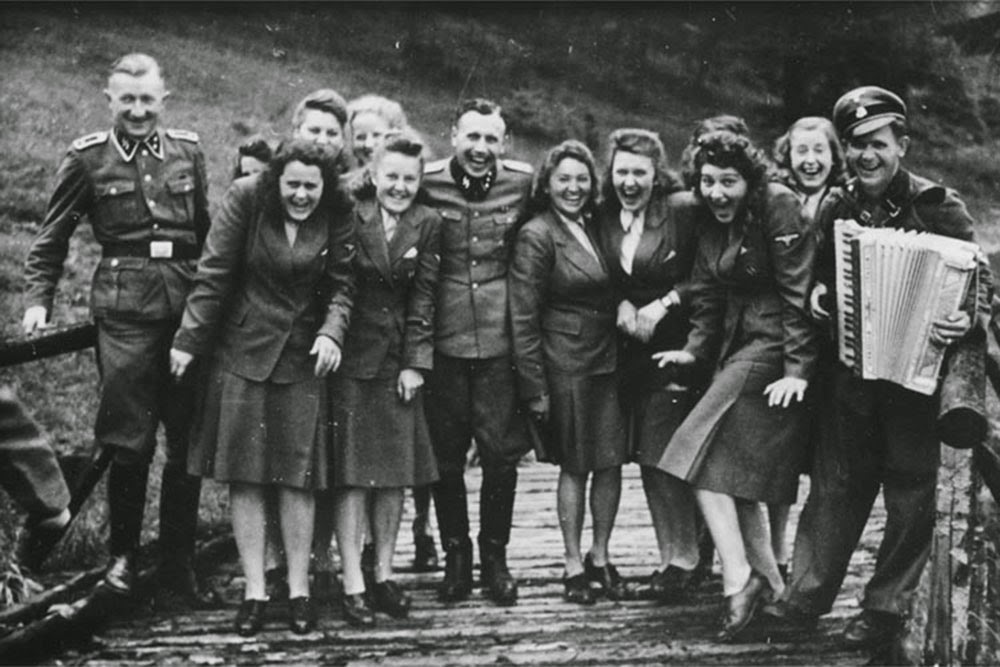
Laughing at Auschwitz – SS auxiliaries poses at a resort for Auschwitz personnel, 1942

The photos show the officers of the Auschwitz relaxing and enjoying themselves, as countless people were being murdered and cremated at the death camp.

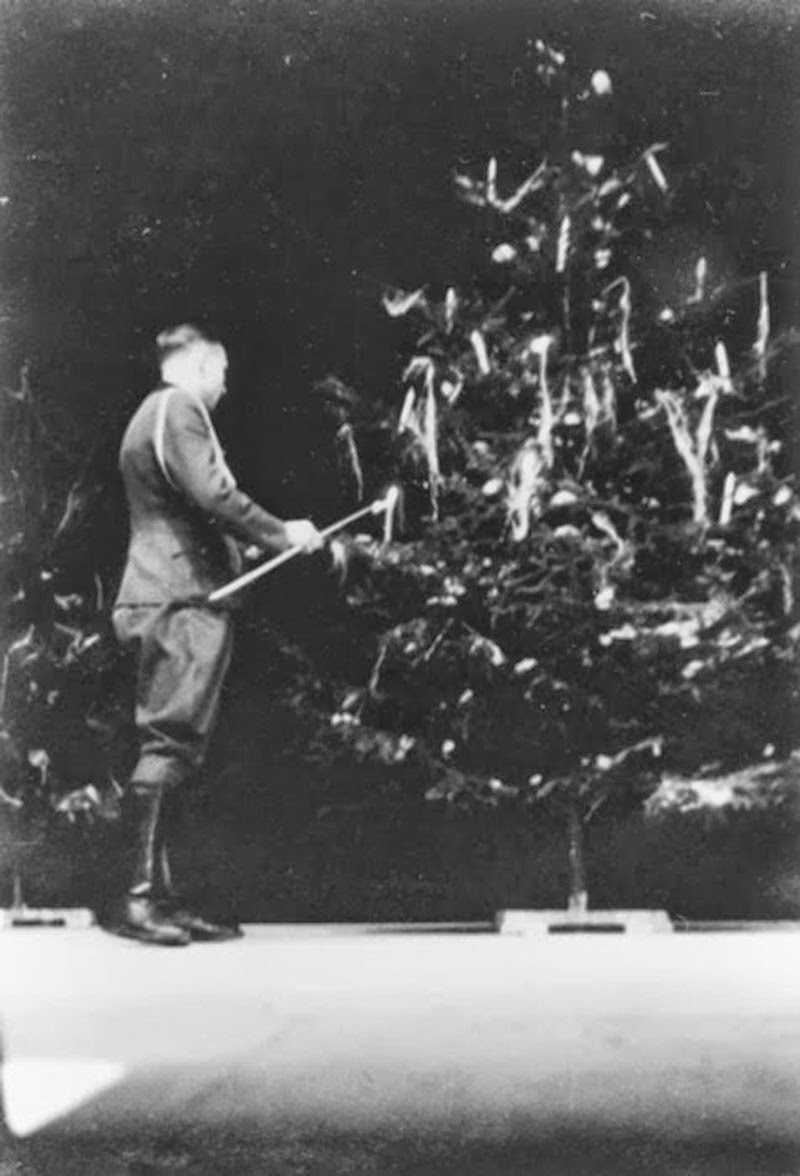
These photos were taken between May and December 1944, and they show the officers and guards of the Auschwitz relaxing and enjoying themselves — as countless people were being murdered and cremated at the nearby death camp. In some of the photos, SS officers can be seen singing. In others they are hunting and in another a man can be seen decorating a Christmas tree in what could only be described as a holiday in hell. The album also contains eight photos of Josef Mengele — some of the very few existing snapshots taken of the concentration camp’s notorious doctor during the time he spent there.

The images are significant because there are few photos available today of the “social life” of the SS officers who were responsible for the mass murder at Auschwitz. These are the first leisure time photos of the concentration camp’s SS officers to be discovered, though similar images do exist for other camps, including Sachsenhausen, Dachau and Buchenwald.

The album belonged to Karl Höcker, the adjutant to the final camp commandant at Auschwitz, Richard Baer. Höcker took the pictures as personal keepsakes. Prior to its liberation by the Allies, Höcker fled Auschwitz. After the war, he worked for years, unrecognized, in a bank. But in 1963 he was forced to answer to charges for his role at Auschwitz at a trial in Frankfurt. In his closing words in the trial, Höcker claimed: “I had no possibility in any way to influence the events and I neither wanted them to happen nor took part in them. I didn’t harm anyone and no one died at Auschwitz because of me”. In the end, though, he was convicted on charges of aiding and abetting the murders of 1,000 Jews and was sentenced to seven years in prison. He was released after serving five years. In 2000, he died at the age of 88.

The photos were made public by the United States National Holocaust Museum in Washington. The museum obtained the photos from a retired US Army intelligence officer, who came across the album in an apartment in Frankfurt and has now given them to the museum. “These unique photographs vividly illustrate the contented world they enjoyed while overseeing a world of unimaginable suffering”, museum director Sara Bloomfield said in a statement. “They offer an important perspective on the psychology of those perpetrating genocide”. The director of the museum’s photographic reference collection, Judith Cohen, said there are no photos depicting anything abhorrent, “and that’s precisely what makes them so horrible”.

Christmas 1944: Karl Höcker lights the candles of a Christmas tree.

Christmas 1944: Karl Höcker lights the candles of a Christmas tree.


See all photos at: Laughing at Auschwitz – SS auxiliaries poses at a resort for Auschwitz personnel, 1942 – Rare Historical Photos

Joyeux Noël from Notre Dame Cathedral

Sous les auspices de l’Église de Paris représentée par Monseigneur Michel Aupetit, archevêque de Paris la Maîtrise Notre-Dame de Paris donnera un concert de Noël dirigé par Henri Chalet, son directeur, dans la cathédrale Notre-Dame de Paris. Ce concert événement, diffusé sur France 2 et KTO se déroulera dans le strict respect des normes sanitaires en cours et réunira 20 chanteurs du choeur d’adultes de la Maîtrise, accompagnés par Yves Castagnet à l’orgue positif (instrument loué pour l’occasion), ainsi que par 2 solistes: Julie Fuchs (soprano) et Gautier Capuçon (violoncelle).