
“FOLK” by Nolwenn Leroy: “Nostalgia is what characterizes me”

Nolwenn Leroy has chosen to collect in an album all his Madeleines of Proust. These folk songs of the 70s she loves since childhood. A tribute to the French artists who inspired him, such as Nino Ferrer, Jacques Higelin or Francis Cabrel. Thirteen times that make up “Folk”.”
I like to dive back into my memories, into this music of the past, which makes it easier to face the present, which is sometimes difficult,” explains Nolwenn Leroy on the 19/20 stage of France 3 Paris-Ile-de-France. An assumed nostalgia, almost a trademark. “Nostalgia is what characterizes me,” she explains. Her powerful yet gentle voice pays tribute to those French songs that have rocked her younger years and still follow her.
Songs that do good
Folk, Nolwenn Leroy fell in when she was small. And as with her Brittany is never far away, she reminds that in France one of the pioneers of this musical genre is none other than Alan Stivell. This project is a bit of a continuation of his work on the album “Bretonne”. “These are songs that have the power to warm the soul and the heart, songs that do good.” Among the titles on offer, Nino Ferrer’s “La Rua Madureira”, “Diabolo-mint” by Yves Simon, “I loved you, I love you, and I will love you” by Francis Cabrel, or ” So Far Away From LA “by Nicolas Peyrac. Nolwenn Leroy will return on stage from March to discover “Folk” to the public.
Source: “FOLK” by Nolwenn Leroy: “Nostalgia is what characterizes
Fêter Noël ?
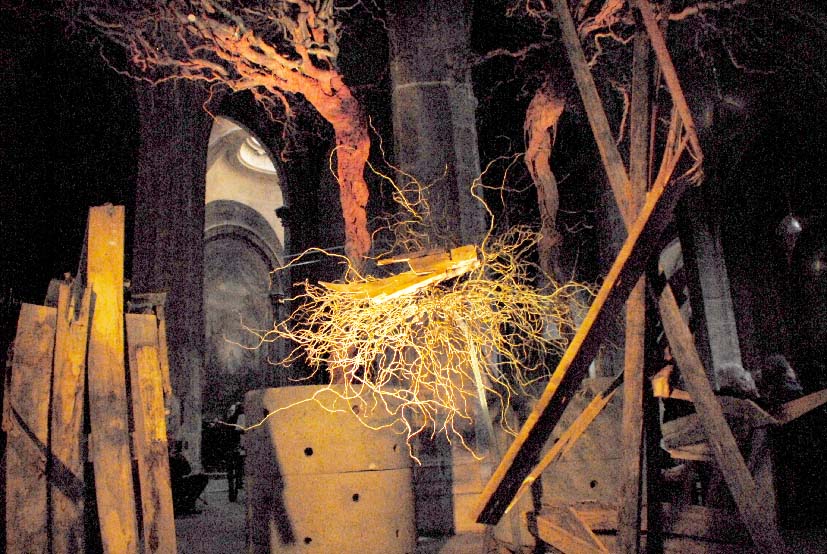
Sunday December 2, 2018, early morning, I found! says Jacques Noyer, former bishop of Amiens. I have found what the Church of France should say about this month-end insurrection we know.
She should announce that we will not celebrate Christmas this year. December 25 will be a day like any other. Nothing in the churches: no office, no nursery, no children. We will return to ordinary Sundays because Advent will not take place.
She will say that our people are not in a state of mind that allows them to celebrate Christmas. The cry of despair that runs through it is incompatible with the mystery of Christmas, with the hope of Advent, with the welcome of a foreign child.
I may be old-fashioned but I remember the Christmas of my childhood. It was not just the end of the month that was difficult. But at Christmas we forgot everything to rejoice in what we had. The most modest families were left with the little they had. In the night, the poor felt rich from the roof over their heads, the improved meal of their plate, the extra log that heated the house and especially the chance to have a dad, a mom, brothers and sisters who loved him. [ . . . ]
Continue at SAINT MERRY: Fêter Noël ?
‘Yellow Vest’ protests: Nearly 1,400 detained in new day of unrest in France
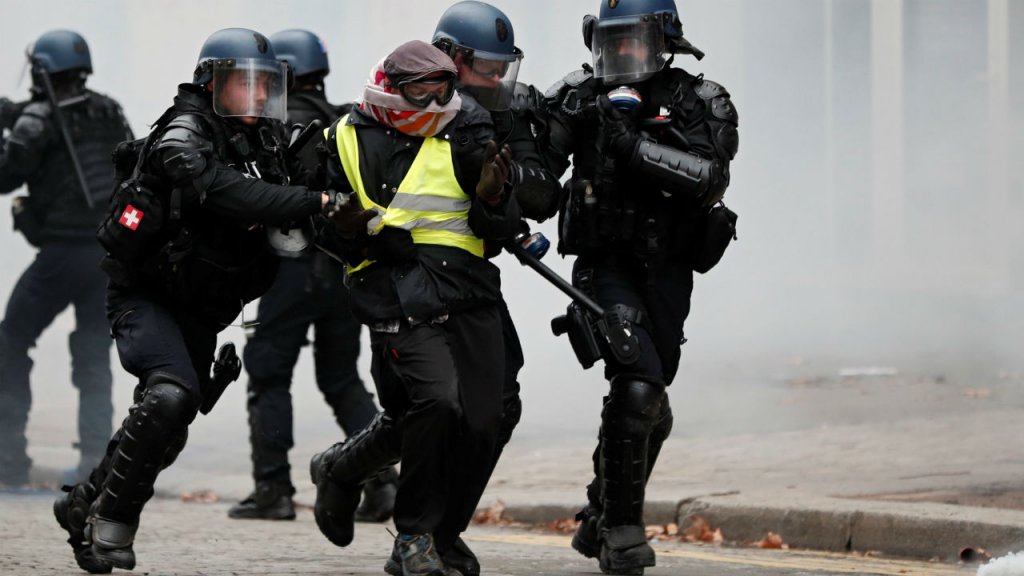
- Businesses, museums and other attractions in the French capital had shuttered on Saturday in anticipation of the violent new clashes during the critical Christmas shopping season.
- French Interior Minister Christophe Castaner said 125,000 demonstrators had taken to the streets across the country, including 10,000 in Paris.
- Paris and other French cities including Bordeaux, Lyon and Toulouse saw significant clashes between protesters and police.
- About 120 protesters and 20 law enforcement officials were injured nationwide, the interior minister said.
- Nearly 1,400 people were arrested.French PM Edouard Philippe called for dialogue and said President Emmanuel Macron would soon be proposing measures to “nourish” that dialogue and rebuild national unity.
Source: ‘Yellow Vest’ protests: Nearly 1,400 detained in new day of unrest in France
Interview: Katel: “Something of the order of the life force”

Seven months ago, we did not know what voyage we were embarking on. We were pleased to accept Katel’s invitation to a residence at Les Trois Baudets where she was preparing to present her new songs. And then, once there, we had been seized. By the scenic device, the grace of the vocal harmonies, the particular construction of the pieces and the quest for perfection that underlay the whole. We had long kept these songs in mind without being able to listen to them again. When the album itself came to us later, accompanied by a long and exciting note of intent , everything came together in one go. The first plays of Élégie took us far, far away. Much more than expected, even in the light of this intense scenic experience.
We had already, in a recent concert, launched an informal request for an interview that Katel had immediately accepted. But once the album heard – received full force, could we say – it became even more obvious. There were so many questions to ask to try to identify what is behind these eleven pieces, and even in their silences. For seven months, one step at a time, we have witnessed the blossoming of something magnificent and almost intimidating.
GOOGLE TRANSLATION OF INTERVIEW FOLLOWS
Your two previous albums were already very different from each other, but Élégie goes even further. In particular, it gives the impression of being conceived as a coherent whole and not just a collection of songs.
Yes, it was important for me not to make a collection of songs but what I imagined to be a piece divided into movements. That’s why there are a lot of songs that have been written together. Obviously, I did not write the eleven tracks in a row, but they often walk in blocks of two or three – which are not necessarily put in that order on the record, but in any case everything is binds and any song is thought relative to others. That is, when I continued to write or compose new songs, I started from the material I already had, saying, “What will I continue to do from this material What do I have to add? Really, every time, I thought of it as a new movement compared to what I had already written.
For example, you explained in the note of intent that “Offshore” and “Out of the Shadows” were written relative to each other. They seem to respond to the level of rhythm.
They work on inverse principles which are for one a work on the harmonic cadences and for the other on the rhythm. But on the other hand they have this common thing which is a music which tends towards the torsion and a text which, it is very direct and very simple. I think that when you have something a bit musically complex, you have to make the text very clear and vice versa. In any case, I do not want to have both at the same time.
The pieces are often based on a contrast between a very thoughtful, highly worked musical form, while the form of the words as the emotions treated are something much more direct.
This is one of the things that have changed a lot between my first album and this one. I think that in the first album, I had a kind of affection for a writing still very literary. Perhaps also because it was a way of asserting that these songs were serious, and also because I was still reading at that time some form of poetry. I have the impression that the more I go forward, the more I trust that the song is really singing, and that the important thing is to make the musicality of the words and their limpidity takes us somewhere. And I trust music to make the antechamber of what is written. Whereas before, texts could be read in themselves. Here, I think we can always read them in themselves, but they are incomplete if they do not have the music.
About the literary side of texts, you tend to use words a little unusual in your words. Here one of the songs is called “At the Aphelion”, and in the Decorumbooklet , there were even footnotes to define the least common terms (homily, fescue, aphasia, etc.).
In Decorum it was a bit of a joke, because it was a friend of mine who had done the inside of the booklet and it was a gag in the band of friends: “Ah, we’ll see the dictionary when we listen to a song. There is less, anyway. In Raides à la ville I had a lot of neologisms. But I have always had a love for strange words. The word “aphelion” is really what made me want to write the song, because I found this word incredible. What else is there … No, that’s “aphelion”. It will suit us, thank you, that will be enough. ( laughs )
The texts, actually, are more refined here.
It also goes with the space of the music. That is, the melodies are less loaded too. There is less this litany or sense of flow that on the first record was very nervous, very dense, and where there was a certain energy almost … obviously not rap, but a form of physical urgency that was that there had a large flow of speech and therefore also more dense texts. And when there was a lot of speech flow, I also needed that complexity of words, a mix of fury and worked writing. And as there the melodies are much more refined, obviously the writing is too [ . . . ]
Read full story at: Interview: Katel: “Something of the order of the life force” (2016)
 Pas De Merde