Paris’s Champs-Élysées will get a pedestrian-friendly green overhaul

Mayor Anne Hidalgo has approved a $304-million plan to pedestrianize the city’s famed Champs-Élysées avenue by 2030 after the Olympics

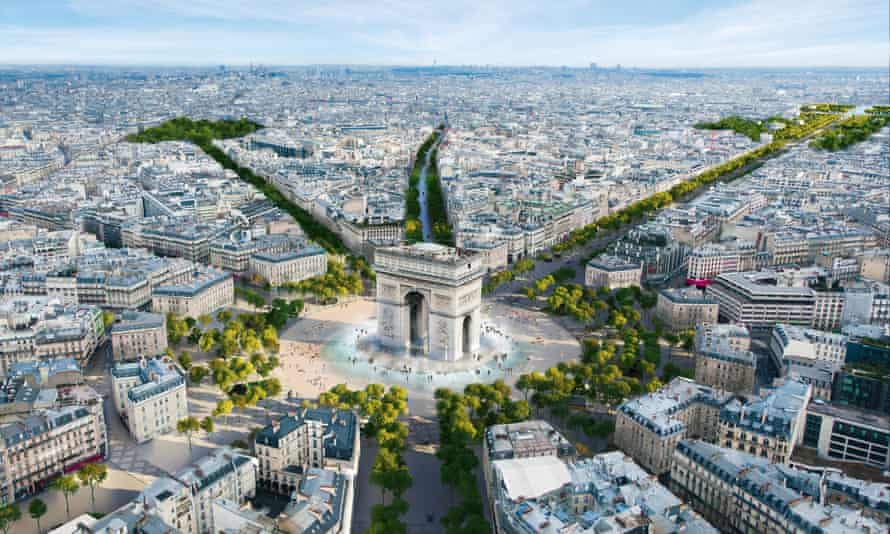
The Mayor of Paris, Anne Hidalgo, has approved a $304-million (250 million euro) plan to transform the city’s famed Champs-Élysées into a pedestrian-friendly public space by 2030.

The ambitious restoration project, proposed by the local community and first unveiled in 2019, will overhaul the 1.2-mile-long central street in of the French capital that connects the Arc de Triomphe to the Place de la Concorde into what Hidalgo refers to as an “extraordinary garden” in Le Journal du Dimanche.

Frustrated by the alienating effect that the luxury stores and expensive restaurants had on the locals, the Champs-Élysées committee has been campaigning for the redesign since 2018 and proposed the now approved project in 2019. The scheme was designed by PCA-Stream, a French architectural firm based in Paris. PCA-Stream principal and founder Philippe Chiambaretta stated that his goal was to convert the boulevard into a space that would be “ecological, desirable and inclusive.”

Lately, the “world’s most beautiful avenue,” as it’s sometimes known, has fallen on hard times and hosted several consecutive crises thanks to its prominent location in the heart of the French capital: After the gilets jaunes (yellow vest) protests, strikes, and high-end retail gentrification over the last 30 years, the scheme looks to return the street to local residents. The committee, headed by Jean-Noel Reinhardt welcomed the mayor’s good news.

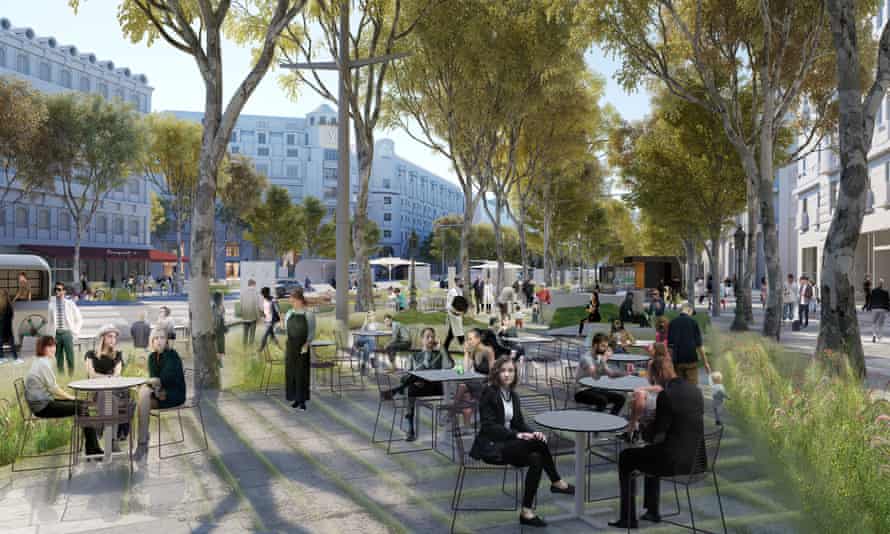
PCA-Stream’s scheme seeks to close half of the street’s eight lanes to cars and insert pockets of greenery or “planted living rooms.” According to Chiabaretta, this will improve the air quality of a street that sees up to an average of 3,000 cars per hour. The revitalization will also introduce food kiosks and meeting spaces in an attempt to attract locals back into the area and return it to a space closer to its original purpose of fostering open-air comingling.

The avenue was originally conceived by André Le Nôtre, King Louis XIV’s landscape architect, in 1667 as an extension to the gardens at the Tuileries Palace to the southeast on the bank of the River Seine. In 1709, the finished boulevard took its name from the Greek Elysian Fields, an outdoor paradise for the righteous to frolic in for all eternity. The new renovation be delivered in two stages; the work at the Place de la Concorde, Paris’s largest public square, will be completed before the Olympic games in 2024 with the rest following, with a completion date set for 2030.

Source: Paris’s Champs-Élysées will get a pedestrian-friendly green overhaul

‘Call My Agent!’: Camille Cottin on Portraying Paris Without the Clichés

The final season of the hit French show is now on Netflix.

BY LALE ARIKOGLU

If there’s been one unexpected hit during a time when our main activity is Netflix and, well, more Netflix, it’s Call My Agent!

The French television show set at a Parisian talent agency has been a lighthearted salve thanks to its razor sharp depictions of the relationships between stars and their agents—not to mention the added charm of Paris as its backdrop. It’s fourth and final season is now available to stream here in the U.S. and comes complete with cameos from big names like Charlotte Gainsbourg and Sigourney Weaver, as well as the usual competitive antics we’ve come to expect from its beloved cast. We caught up with Camille Cottin, who plays the incomparable Andréa Martel, to talk about the challenges her character faces, Parisian clichés, and what she has missed most about the city during lockdown.

The show launched in France in 2015 but it really only landed on most American’s radars this past year. How do you think it’s been received by the different audiences?

It’s difficult to have popular and critical success at the same time, but that is what happened in France, and it’s funny to see all this interest starting again now. I just read an article in the New York Times saying that what makes the show interesting is [the way] it talks about the industry. Previously, the industry was always shown as cynical, and this is a tender show. There’s humor, there’s satire, we make fun of the people we’re depicting, but at the same time, there’s love, big love for cinema, big love for actors, big love for the people of the industry.

The producers [told me] they were quite surprised that it had an international echo, though, because it only talks about French actors. But it really depicts a star: the selfie star, or the nervous star, or the jealous star. Plus, the [agency] is like a family, they are all figures with whom you can identify with—and their [dynamics] of power, competition, and jealousy. The problems they deal with are human ones.

Paris, of course, is the backdrop to those relationships. What have been some of your favorite locations to film in?

Well, I loved the flat they gave [Andréa], which is twice the size of mine! But one true favorite is the scene at the end of season one: [My character] just got dumped and I feel lonely and sad, walking along that very famous bridge,

Continue reading “‘Call My Agent!’: Camille Cottin on Portraying Paris Without the Clichés”

Paris’s Musée d’Orsay, from a train station to a world-class museum

Paris’s Musée d’Orsay, from a train station to a world-class museum

The Musée d’Orsay is the second most-visited museum in France after the Louvre. In 1986, this former Paris train station became a showcase for Impressionist art. The exhibition rooms are constantly evolving because only half the paintings are on display at any one time; the others are kept in the storeroom. Curators regularly renew the exhibits. Sometimes, the masterpieces require the expert care of restorers, who then have the delicate mission of bringing the paintings back to life. We take a closer look.

Paris agrees to turn Champs-Élysées into ‘extraordinary garden’

Mayor Anne Hidalgo gives green light to £225m-scheme to transform French capital’s most famous avenue

The mayor of Paris has said a €250m (£225m) makeover of the Champs-Élysées will go ahead, though the ambitious transformation will not happen before the French capital hosts the 2024 Summer Olympics.

Anne Hidalgo said the planned work, unveiled in 2019 by local community leaders and businesses, would turn the 1.9 km (1.2 mile) stretch of central Paris into “an extraordinary garden”.

The Champs-Élysées committee has been campaigning for a major redesign of the avenue and its surroundings since 2018.

“The legendary avenue has lost its splendour during the last 30 years. It has been progressively abandoned by Parisians and has been hit by several successive crises: the gilets jaunes, strikes, health and economic,” the committee said in a statement welcoming Hidalgo’s announcement.

“It’s often called the world’s most beautiful avenue, but those of us who work here every day are not at all sure about that,” Jean-Noël Reinhardt, the committee president said in 2019.

“The Champs-Élysées has more and more visitors and big-name businesses battle to be on it, but to French people it’s looking worn out.”

The committee held a public consultation over what should be done with the avenue. The plans include reducing space for vehicles by half, turning roads into pedestrian and green areas, and creating tunnels of trees to improve air quality.

The Champs-Élysées’ name is French for the mythical Greek paradise, the Elysian Fields. It was originally a mixture of swamp and kitchen gardens.

André Le Nôtre, Louis XIV the Sun King’s gardener, first designed the wide promenade lined with a double row of elm trees on each side, called the Grand Cours.

It was renamed the Champs-Élysées in 1709 and extended, and by the end of the century had become a popular place to walk and picnic.

An image showing the planned redevelopment of the Champs-Élysées
An image showing the planned redevelopment of the Champs-Élysées. Photograph: PCA-Stream

Paris celebrated the 1944 liberation from Nazi occupation on the Champs-Élysées and World Cup victories still bring out the crowds, but its famous charm has faded and it is mostly shunned by Parisians.

Today it is famous for its expensive cafes, luxury shops, high-end car salesrooms, commercial rents among the highest in the world and the annual Bastille Day military parade.

Before the Covid-19 crisis halted international tourism, the architect Philippe Chiambaretta, whose firm PCA-Stream drew up the makeover plans, said that of the estimated 100,000 pedestrians on the avenue every day, 72% were tourists and 22% work there.

The eight-lane highway is used by an average of 3,000 vehicles an hour, most passing through, and is more polluted than the busy périphérique ring road around the French capital, he added.

Chiambaretta said the Champs-Élysées had become a place that summed up the problems faced by cities around the world, “pollution, the place of the car, tourism and consumerism”, and needed to be redeveloped to be “ecological, desirable and inclusive”.

The plans also include redesigning the famous Place de la Concorde – Paris’s largest place – at the south-east end of the avenue, described by city hall as a “municipal priority”. This is expected to be completed before the Olympic Games. The aim is to transform the Champs-Élysées by 2030.

Hidalgo told Le Journal du Dimanche that the project was one of several intended to transform the city “before and after 2024”, including turning the area around the Eiffel Tower into an “extraordinary park at the heart of Paris”.

Source: Paris agrees to turn Champs-Élysées into ‘extraordinary garden’ | Paris | The Guardian

Joyeux Noël from Notre Dame Cathedral

Sous les auspices de l’Église de Paris représentée par Monseigneur Michel Aupetit, archevêque de Paris la Maîtrise Notre-Dame de Paris donnera un concert de Noël dirigé par Henri Chalet, son directeur, dans la cathédrale Notre-Dame de Paris. Ce concert événement, diffusé sur France 2 et KTO se déroulera dans le strict respect des normes sanitaires en cours et réunira 20 chanteurs du choeur d’adultes de la Maîtrise, accompagnés par Yves Castagnet à l’orgue positif (instrument loué pour l’occasion), ainsi que par 2 solistes: Julie Fuchs (soprano) et Gautier Capuçon (violoncelle).