At 22, the young actress is an international star thanks to her role in “Adèle H” by François Truffaut and has just shot her first film in the United States, “The Driver”.
En Fançais
A 22 ans, la jeune actrice est une star internationale grâce à son rôle dans “Adèle H” de François Truffaut et vient de tourner son premier film aux Etats-Unis, “The Driver”. Avec maturité, éloquence, et naturel, Isabelle Adjani se confie à Christian Defaye sur ses débuts dans “Le petit bougnat”, son passage à la Comédie-Française, les rôles qui l’ont marquée, son travail de comédienne. Cet entretien événement fut exceptionnellement diffusé à 20h20, avant le film de la soirée, le 13 décembre 1977 dans Spécial Cinéma.
Gabriel Yared’s music featured on Radio France: the opportunity to rediscover 40 years of creation for the big screen, from the English Patient to Auntie Danielle, including L’Amant and Le Talentueux Mr Ripley.
Few of the French film music composers have been awarded an Oscar. Gabriel Yared is part of this very small circle, which also includes Maurice Jarre, Michel Legrand , George Delerue, Ludovic Bource and Alexandre Desplat . The audience-less concert offered by Radio France, with Gabriel Yared at the piano and the Radio France Philharmonic Orchestra under the direction of Dirk Brossé, offers listeners a glimpse of the French composer ‘s broad musical palette.
The contemplative and romantic scores, tinged with a deep melancholy, hold the high part of the program. The music of Camille Claudel (film directed by Bruno Nuytten in 1988) strongly influenced the own admission of Gabriel Yared by the Tenth Symphony of Mahler and Transfigured Night by Schoenberg , leads the listener into a heightened lyricism, which tormented the treble violins interact with the dark bass of cellos. In the soundtrack of The English Patient (Anthony Minghella, 1996), it is the comforting brass that comes to support the passionate strings, all guided by a melancholy bassoon.
The performed excerpts also reveal the influence of jazz in the work of Gabriel Yared. This is particularly true of the score of 37 ° 2 in the morning (Jean-Jacques Beineix, 1986), where Lewis Morison’s saxophone, with its intense and sensual sound, plunges into a jazzy atmosphere, which would perfectly suit the images of a sunrise over Manhattan. The sounds are also felt, although in a more discreet way, in the soundtrack of L’Amant , a delicate page relating the birth of the amorous passion, from which emerge, in the middle of a delicate harp and cottony layers of violins , some jazzy piano notes.
A great lover of classical music, Gabriel Yared does not hesitate to pay tribute to his masters in his works. This is the case in The English Patient , for which he composed an elegant prelude in the style of Bach , or even in the score of the ballet Raven Girl , choreographed in 2013 by Wayne McGregor , a light refrain in which the influence is felt. by Mozart , played here with malice by the pianist Suzana Bartal, offering a nice moment of complicity with the orchestra.
A composer without borders, Gabriel Yared ventures into Argentinian music with La Lune dans le gutter (Jean-Jacques Beineix, 1983). Here he performs a tango for large orchestra, where Juanjo Mosalini’s mysterious and lascivious bandoneon dialogues with a solo violin, performed with passion by Nathan Mierdl, with almost Gypsy accents.
The concert is also an opportunity to discover new pages. Like this excerpt from the soundtrack of Troy (Wolfgang Petersen, 2004), a big budget Hollywood peplum, for which the composer’s music was ultimately not chosen. A surprising decision when listening to this excerpt, supposed to accompany the bag of the city of Troy, martial page in which the brass warriors sound the attack, supported by thunderous percussions. A page at the antipodes of another unpublished piece, Adagio for an unreleased film , a serious and majestic passacaglia inspired by Bach .
For her two interventions, the young soprano Héloïse Poulet, spotted a few years ago by the composer, delivers a successful performance, without suffering from the comparison with the two singular voices that preceded her on the screen. In “Lullaby for Cain”, lugubrious and melancholy lullaby initially sung by Sinéad O’Connor for the film The Talented Mr. Ripley(Anthony Minghella, 1999), the crystalline and delicate voice of the soprano subtly alternates moments of great sweetness and fury. It begins with an almost imperceptible thread of voice, on the edge, picking up the high notes with a touching fragility. But very quickly the instruments were carried away, and the voice was overwhelmed by the orchestra, only succeeding in extricating itself from it fully during the apotheosis of the piece, the pronunciation of Cain’s name, in a heart-rending cry.
Héloïse Poulet makes the stylistic splits for her second stint on stage, where she performs “La Complainte de la vieux salope”, a humorous song interpreted by Catherine Ringer in Tatie Danielle (Étienne Chatiliez, 1990), a large demonstrative number which is more similar from the world of opera. The soprano delivers a performance that is certainly less bombastic than the singer of Rita Mitsouko, who played the diva to their heart’s content on this piece, but this allows the interpretation to gain in elegance and vocal power. Héloïse Poulet shows great dramatic expressiveness and a beautiful length of breath, proudly showing off her piercing highs and her laughing vibrato, offering splendid vocalizations.
So many musical pages that allow us to grasp the universe of Gabriel Yared, carried here by the Philharmonic Orchestra of Radio France , under the precise and passionate direction of Dirk Brossé, whose musicians prove once again that they are capable of anything play, recalling the many bridges between classical music and film music
How do you pronounce fauteuil in French? How about écureuil, or accueil? Each of these words use the weird French sound “euil”
It’s no secret that many French words have weird pronunciation. And one sound that always makes French learners pause is the “euil” sound. You’ll see it in words like un fauteuil (an armchair), un écureuil (a squirrel), and un accueil (welcome / hospitality / an entrance lobby). In today’s lesson, I’ll show you some tricks for getting around this weird French pronunciation, so you can get better at speaking real, everyday French! Let’s go!
Take care and stay safe. 😘 from Grenoble, France. Géraldine
What seafood dishes to eat in France? 10 typical traditional French national and local seafood dishes, original recipes, pairing tips, and the most popular, famous and iconic authentic restaurants with French cuisine. Must try dishes, the ultimate bucket list for seafood lovers.
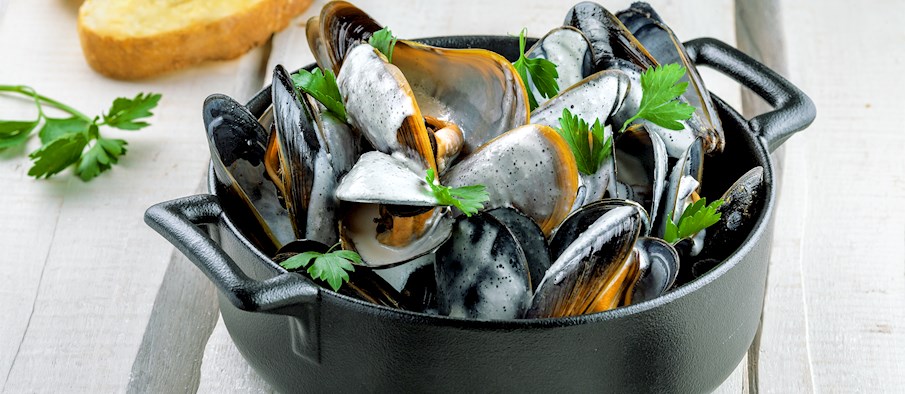
Moules à la marinière
(Moules marinière)
Moules à la marinière is a classic French dish that consists of mussels cooked in cider or wine-based sauces. The dish is typically made with shallots, garlic, and herbs such as parsley, thyme, and bay leaves, which are sweated in some butter before being combined with white wine or cider.
Fresh mussels are then added to the mixture and cooked until they open up. The dish is usually enhanced with freshly minced parsley, lemon juice and (optionally) mayonnaise or crème fraiche. Simple and flavorful, this mussel dish is typically enjoyed warm with slices of crusty bread and a glass of French wine on the side
SERVE WITH
Baguette
PAIR WITH
Picpoul de Pinet Savennières Entre-Deux-Mers Jasnières Pouilly-Fumé Saint-Véran Witbier
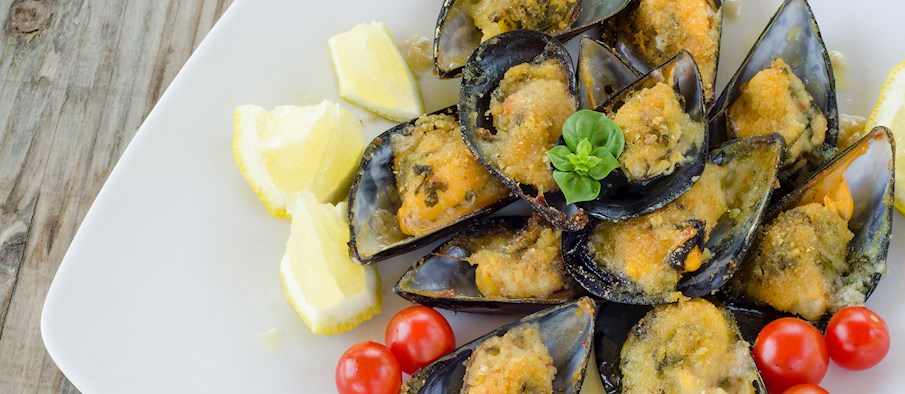
Moules farcies
(Stuffed Mussels)
Moules farcies is a French dish in which mussels are stuffed and baked or grilled. The dish is prepared with mussels, butter, parsley, garlic, shallots, black pepper, nutmeg, parmesan cheese, and breadcrumbs. The butter is combined with garlic, shallots, nutmeg, and pepper.
The mussels are steamed until opened, and the empty halves of the shells are discarded. The butter combination is spooned into each shell, and the mussels are then sprinkled with breadcrumbs and parmesan before being baked or grilled until bubbling.
For the best experience, moules farcies should be sprinkled with parsley before serving it with a crusty baguette on the side, which is used to mop up the melted butter mixture.
SERVE WITH
Baguette
PAIR WITH
Picpoul de Pinet Sancerre Tavel
Bourride
Also known as bouillabaisse’s cousin, bourride is a popular fish stew originating from the French region of Languedoc-Roussillon, unlike bouillabaisse, which originated in the city of Marseilles. Most commonly it is made with white fish such as mullet, mackerel, or sea bass, but the original and most traditional recipes primarily include monkfish [ . . . ] Continue at : 10 Most Popular French Seafood Dishes – TasteAtlas
France is not unique in seeing its service industry shut down in the midst of the COVID-19 pandemic. But compared to other countries, France has a robust safety net of social security, unemployment, and healthcare. France has also implemented emergency measures that may prevent many of these businesses from going under.
As French restaurants begin to slowly reopen for outdoor service, the culinary landscape in France looks very different when compared to the United States.
Government Aid: Two Countries, Two Philosophies
In March, President Emmanuel Macron said he would do “whatever it takes” to ensure that no company, big or small, collapsed under the financial weight of the pandemic. He announced 300 billion euros in loan guarantees and tax exemptions. The government also played a role in negotiating rent forgiveness for restaurants.
Perhaps even more helpful, at least in the short-term, were easy-to-access “solidarity funds:” 1500 euros per month given tax-free to small businesses, compounded with an additional allowance of up to 2500 euros from URSSAF, a social security union for small businesses. On April 15, Gérald Darmainn, Minister of Public Action and Accounts, also announced that the restaurant industry’s taxes and social charges – about 750 million euros – would be forgiven instead of merely suspended for the duration of administrative closure.
In the U.S., by contrast, most small restaurants didn’t qualify for loans, while huge corporations like McDonald’s and Shake Shack did. According to the New York Times, big chains were able to access “tens of millions of dollars while many smaller restaurants walked away with nothing when the $349 billion fund was exhausted [April 16].” The Los Angeles Times reported that those small businesses that did qualify were reluctant to apply for the Small Business Administration’s Paycheck Protection Program because of the “strings” attached to loans.
Restaurant Workers Feed Us, But Can They Eat?
As far as restaurant employees are concerned, in France, most are secure within the net of the country’s robust social structure. When forced closures were announced mid-March, restaurant workers were encouraged to first use up their paid vacation (an average of about five weeks per year) before becoming eligible for partial unemployment (the equivalent of 84 percent of their salary.) Continue reading “Are French Restaurants More Likely than American to Survive the Lockdown?”→