Julian Lage: “Jazz is a story of people: their heart, their state of mind and their soul”

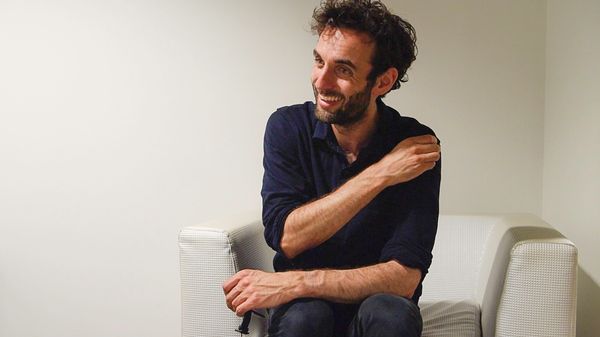
At 30, he is one of the best jazz guitarists of today, but he defines himself more like a blues guitarist, shared music with his father when he started making music at only 5 years old. Portrait of Julian Lage at Jazz in Marciac 2018.

When he’s on stage with his trio, composed of bassist Jorge Roeder and percussionist Eric Doob , the deal is perfect. The musicians breathe together, their eyes in the eye, the instruments touch almost in a bewitching dialogue. That’s it, jazz, and beyond the genre, that’s the music for this virtuoso and creative musician: sharing in the moment. And Julian Lage rubbed shoulders with many others, big names in the jazz scene, during his meteoric rise. At only 30 years old, the musician counts 25 years of music, first of all in family, then very quickly with giants like Carlos Santana (at eight years old), Pat Metheny , Kenny Werner , Toots Thielemans, Martin Taylor or David Grisman . But who is this Californian smiling and youthful, who teaches and composes, and who is one with his guitar? Backstage meeting on the occasion of his concert at the Jazz in Marciac 2018 festival.

France Musique: How did you come to jazz?

Julian Lage: I went into the music blues, and then, naturally I went to jazz, because it was in the order of things. We start with a style and very quickly the curiosity takes us elsewhere, and in my case, it was jazz.

You started playing the guitar very young, at 5 years old. You often say that your father had a very important role at the beginning?

My family, and especially my father, were decisive in my choices. At the time, my father started playing guitar because he wanted to play the blues. To spend time with him, I got started too. My father was taking a lesson with a teacher and then he was teaching it to me. For me, it was an excuse to be with him. [ . . . ]

Continue at Francemusique: Julian Lage: “Jazz is a story of people: their heart, their state of mind and their soul”
France: Video shows harasser slap woman on Paris street 

A man has been caught on video forcefully slapping a woman after he allegedly sexually harassed her on the streets of Paris.

A man has been caught on video forcefully slapping a woman after he allegedly sexually harassed her on the streets of Paris.

The man is seen walking by a streetside cafe when he picks up an ashtray from a table and throws it over customers’ heads in the woman’s direction. He then comes face to face with her, waving his hands, before striking a blow and turning around to walk away.
The woman, Marie Laguerre, posted CCTV footage of the incident on her Facebook account, saying that she was on her way home on Tuesday last week when the man started whistling and making noises at her, and said “dirty words that were humiliating and provocative as I passed by him.” [ . . . ]

Watch the video at: France: Video shows harasser slap woman on Paris street – CNN

Wine of a very different hue on sale in France

Spanish wine making a splash on south coast of France

There is red wine, white wine and rose – and there is a blue wine, too.

A company in Sète is selling marketing Vindigo, a 100% natural wine that is a very a different colour to the usual wines served at aperos in France.

The unusual colour of the wine, a 100% chardonnay, is created from anthocyanin, a pigment in grape skins, through which the liquid is filtered.

Distributor René Le Bail told France Bleu Hérault that the wine, developed in Spain, is, “an ideal wine for the summer, to drink as an aperitif, on the sand or at the edge of the swimming pool.

“It tastes like fruit. There’s cherry, passion fruit, blackberries,” he said. [ . . . ]

Continue at ConnexionFrance : Wine of a very different hue on sale in France


Pas de Merde has more stories about Food & Wine . Bon Appétit!

6 French Honeymoon Ideas You Should Consider Instead of Paris 

France has so much more to offer.

There are few things not to love about Paris. From the history, to the architecture, to the language and the food, it’s always at the top of honeymooners’ wish lists. But Paris is hardly the only honeymoon spot in France, and if you’re the kind of couple who like to do things a bit differently, we encourage you to set your sights beyond the City of Lights. Getting outside the big city will illuminate all sorts of charming aspects of French culture, from the joys of a cozy aprés-ski in the mountains, to eating fresh oysters in the seaside villages of Brittany. So when it comes to planning your honeymoon in France, there are plenty of places to love—and be in love.

French Alps

Dramatic landscapes, outdoor adventure, charming villages—if these sound appealing to you, perhaps you should consider a trip to the French Alps. Flying in and out of Geneva is probably the easiest way to get there from the States, and from there you are in prime position to explore Mont Blanc, Chamonix, Verbier, and Megève. The L’Hermitage Paccard is a decadent experience with unparalleled views of the Alps, and the W Verbier has a bit more of a scene going on in case you want to have more options by way of restaurants and nightlife. The Cheval Blanc in Courchevel is the region’s grande dame of hotels, and the fifty-five room Four Seasons Megève has all the walnut-paneled walls and fireplaces you’d expect from a luxury property in this neck of the woods. Obviously winter sports are the region’s main draw (“apré-ski” is a French term, after all), but these little towns also have a dedicated community of hikers and mountaineers in the warmer months. Wherever you end up staying, your concierge will be able to arrange all sorts of beautiful hikes and such so you can make the most of your stay [ . . . ]

Continue reading at BRIDES: 6 French Honeymoon Ideas You Should Consider Instead of Paris | Brides


 Listen to Pas De Merde’s Chanson du Jour | More stories on FRENCH MUSIC


An expat’s guide to Paris

Paris allows you to discover its secrets slowly. It kept my wife and me at bay in the 1990s when we lived and worked here. It ran down boulevards when we chased it. It hid behind copies of the newspaper Le Figaro and the magazine Paris Match. It vanished into clouds of café steam.

The city was everywhere, except where we happened to be. Until the day when, out for breakfast, we bit into tartines instead of croissants. And the day we put on shoes for a walk instead of sneakers. Paris was burning away its mist of strangeness, and we were starting — just beginning — to understand.

Kathy and I planned to revisit the city early last fall. It had been decades since we had learned what an expat learns about daily life and culture, about eating out and getting around. Would our memories and knowledge be useless — or at the very least, gnawed at, by years back in the States?

I started jotting things down. I scratched my head. I found that I was working, without realizing it, on a sort of guide.

It would have American-in-Paris tips for travelers in several categories. I would try to focus them as much as I could for short-term tourists. And when I was done, we would test all the advice during our week of revisiting. Here is what we found:

Daily life and culture

On our return trip here, Kathy and I were reminded how T-shirt-and-ballcap-casual our life in America had become.

Unless you're a jogger, leave the trainers at home.
Unless you’re a jogger, leave the trainers at home. (Arvind Garg / Getty Images)


We knew we had some relearning to do when it came to Paris’ rites and rituals. We remembered a simple rule of thumb: The city will open up to you in a thousand small ways if you can blend in and play by a few of its rules.

  • Paris protects its daily traditions, such as greeting store owners on entering and leaving, perhaps by saying “Bonjour, madame,” instead of just “Bonjour,” and by respecting at least some small-scale formalities between strangers while, at the same time, shaking hands or double-kissing just about everyone you know. Though we frequently failed, we tried to keep these formalities in mind.
  • Do your best to roll with the slower pace in ticket lines, restaurants and the like. When American friends visited us, some claimed that waiters in bistros and brasseries ignored them or were rude. Kathy and I would listen, then do what we could to explain. “The French don’t want fast service,” we would say. “They want leisure to enjoy.”
  • Try using a few words of French when you begin to speak, instead of launching into English right away. If you can, modulate your voice a little, no matter how enthusiastic or friendly you may feel. The more modestly you mumble, the better.
  • I’m embarrassed to admit that, when we lived here, I memorized the phrase for “Sorry, I don’t speak French well” and used it at the start of just about every sentence. (That’s ”désolé, je ne parle pas bien le français,” in case you’re wondering.) Even grouchy Parisians tended to back off on hearing this — falsely (though politely) assuring me that I was “doing fine.”
  • How you dress, as an expat or as a tourist, is a language of its own — and one that locals quickly understand. Parisians are good at guessing things about you based on your style of raincoat or how you angle your hat. For reasons I’ll never understand, the language of shoes seems to shout loudest when it comes to suggesting who you are. When we lived here, I realized that my American-style sneakers were doing the talking for me: They were saying things I didn’t want them to say in a city of leather shoes. Ironically, retro-chic canvas sneakers seem to be cool in Paris right now, but probably best not to pack your cross-trainers.
  • Consider leaving sports-style clothing at home — your Gore-Tex, your nylon, your trail-trekkers, your Thinsulate gear. Replace it with wool and cotton, with whatever take on the classics you can muster. Parisian street style isn’t fancy, as some seem to think. It’s simple, but with personal twists, my stylish wife said. Men add colorful pocket squares to Brooks Brothers standards; women like to add an interesting scarf or jacket to jazz up a pair of jeans. Continue reading “An expat’s guide to Paris” →