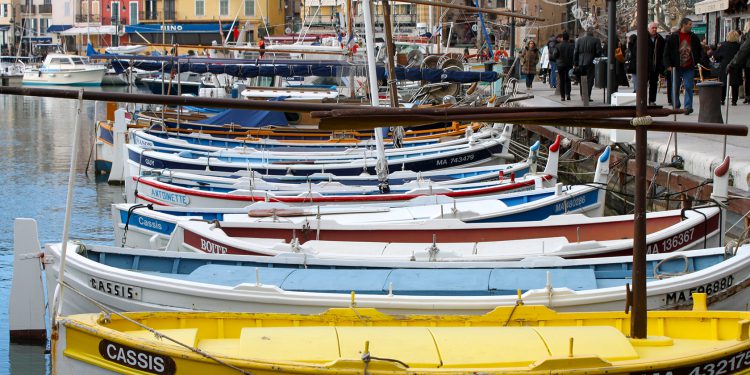
Just east of Marseille lays the charming coastal town of Cassis, nestled at the bottom of steep, vineyard-covered hills that come almost to the sea. It’s so adorably cute that you might think you are walking into a postcard. There’s nothing better than a stroll through town followed by a bowl of fish soup or some moules-frites at one of the many restaurants that line the docks.
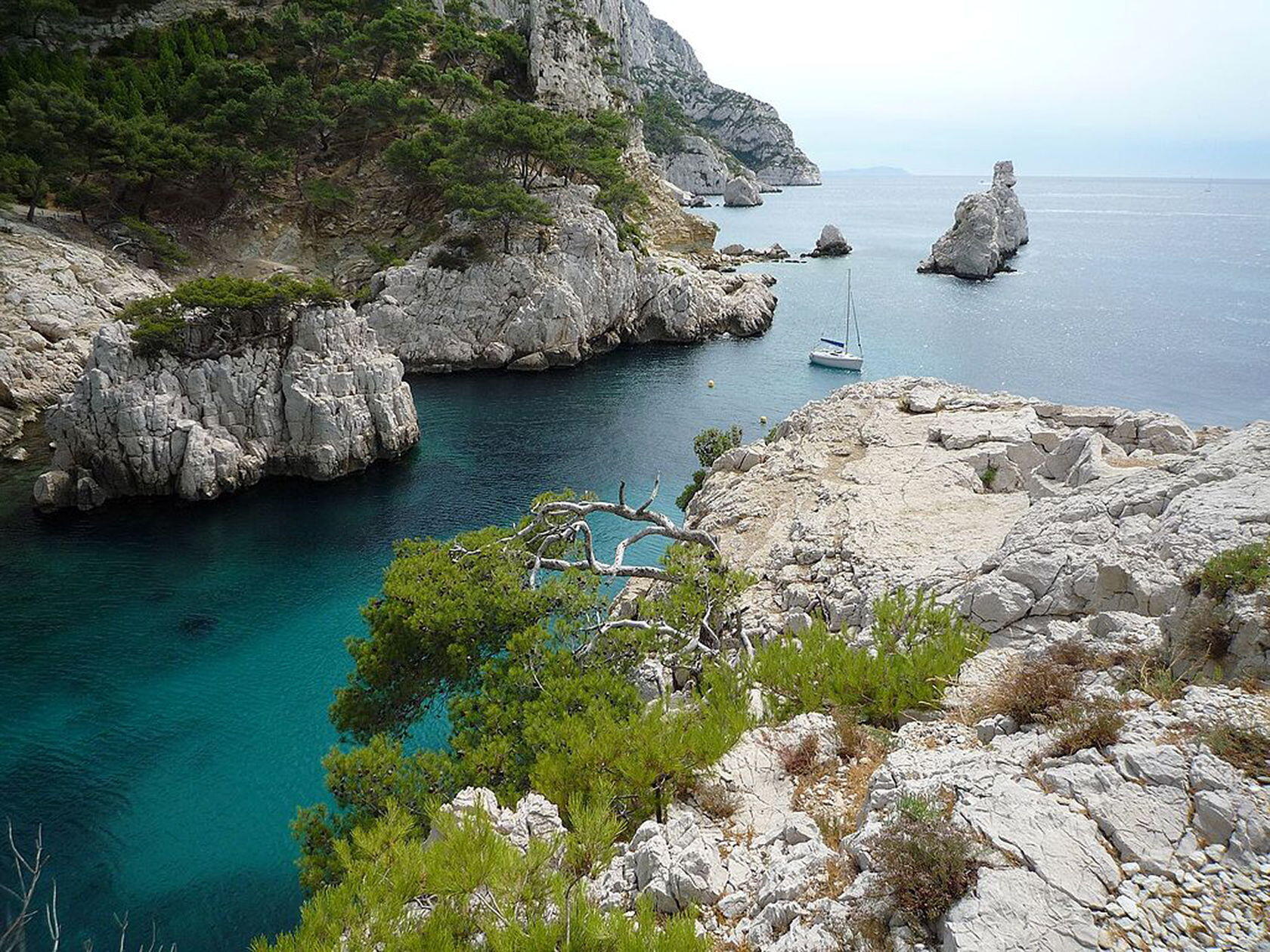
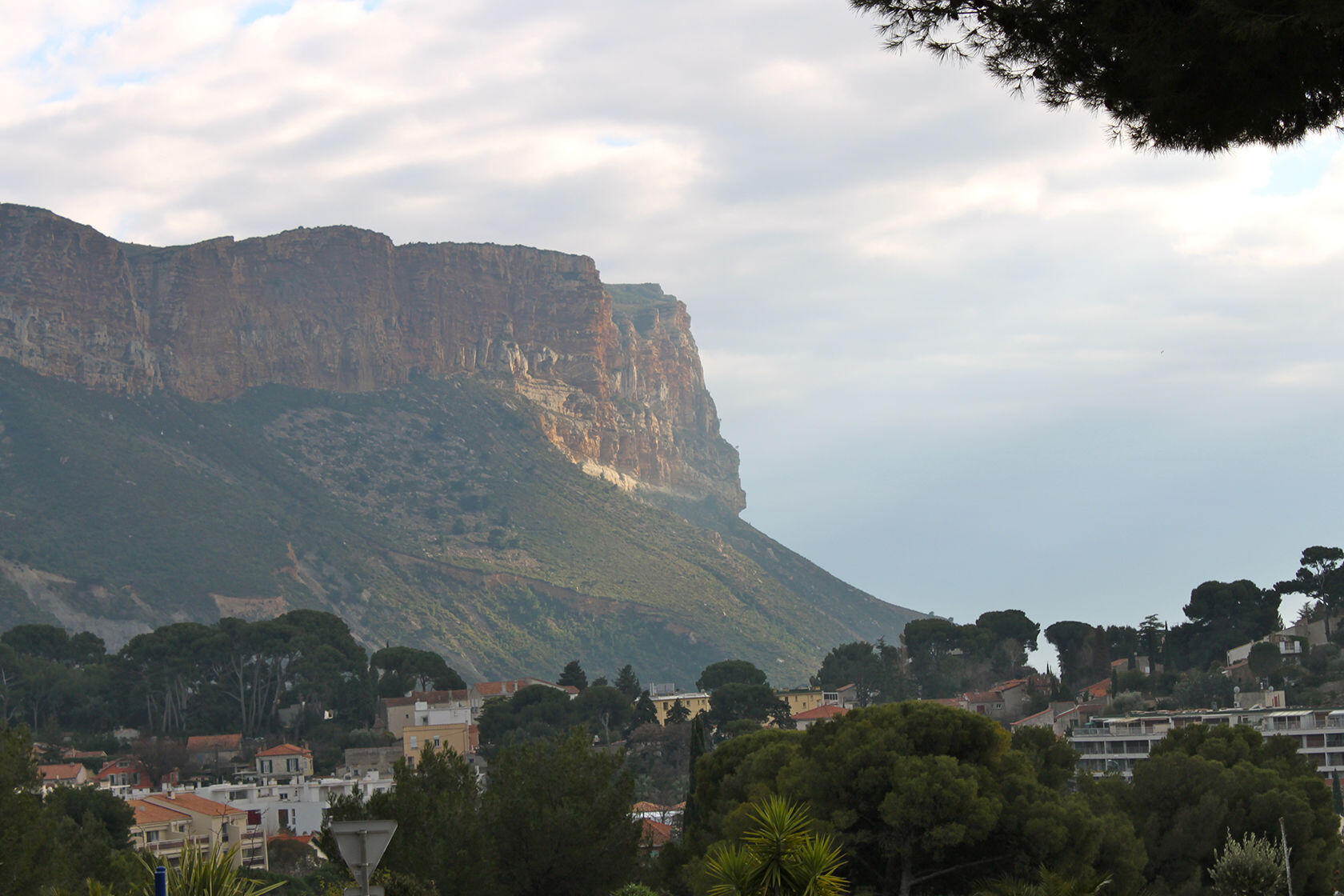
The setting of Cassis is dramatic. Besides those vineyards, Cap Canaille—the highest cliff in France—towers over the town on its east side. And to the west are the beautiful and rugged calanques, the so-called mini fjords of France [ . . . ]
Including Julia Child’s very own cottage (with plenty of kitchen utensils included).
We’ve said it again and again: there’s so much more to France than just a trip to Paris. Case in point? The South of France—a.k.a. the Provence-Alpes-Côte d’Azur region—is home to some of our favorite towns. There are big names like Cannes, Marseilles, and Nice in the area, but there are plenty of smaller towns to enjoy, like Menton, Grasse, and Cassis. If you want to live out your provincial French fantasy—whether it’s smack on the beach, in a historic old town apartment, a multi-acre château, or in Julia Child’s own kitchen—we’ve got some Airbnbs for you to book, spread all across the region.
As a bonus, all of the Airbnb selections are run by Superhosts, who each have a rating of 4.8 or above, a record of zero cancellations, and at least a 90 percent response rate, meaning they’ll get back to you ASAP. Read on to find the perfect Airbnb for your vacation along France’s southern coast [ . . . ]
Jimmy won’t you please come home? Where the grass is green and the buffaloes roam Come see Jimmy your uncle Jim Your auntie Jimmie and your cousin Jim Come home Jimmy because you need a bath And your grandpa Jimmy is still gone daft Now there’s buffalo Jim and buffalo Jim And Jim buffalo now didn’t you know Jim Jim Jimmy its your last cigarette But there’s buffalo piss and it’s all kind of wet Jambo Jimmy you’d better hold your nose All roads lead to roam with the buffaloes And the Buffaloes used to say be proud of your name The Buffaloes used to say be what you are The Buffaloes used to say roam where you roam The Buffaloes used to say do what you do Well you’ve gotta have a wash but you can’t clean your name You’re now called Jimmy you’ll be Jimmy just the same The keys are in a bag in a chest by the door One of Jimmy’s friends has taken the floor Jimmy won’t you please come home Where the grass is green and the buffaloes roam Dear old Jimmy you’ve forgotten you’re young But you can’t ignore the buffalo song And the Buffaloes used to say be proud of your name The Buffaloes used to say be what you are The Buffaloes used to say roam where you roam The Buffaloes used to say do what you do If you remember you’re unknown Buffaloland will be your home
Monsieur Pas de Merde
I was introduced to Rosemary Standley’s music a few years back in her collaboration with Brazilian cellist Dom La Nena “Birds On a Wire” – a fine tribute to Leonard Cohen. I loved Standley’s voice, which reminded me a bit of the plainly beautiful vocals of the late Kate McGarrigle (listen to “Talk to Me of Mendocino”). Crazy, that I somehow had bypassed Standley’s work as lead singer for the Paris-based band Moriarty, which is now my favorite. I say “crazy,” since I listen to French music and Americana music all the goddamn time – often switching from a Francis Cabrel CD to a Lucinda Williams.
Now, I’m catching up as quickly as possible to the band, which is now over 20 years old. YouTube and Spotify Moriarty binges have been a daily exercise. The band’s Live double album Echoes From the Borderline shows the band at the top of their game. Recorded in 2017 (Moriarty regards it as their 10th anniversary album) there’s 24 songs recorded all about the globe – and they are all fucking fantastic.
I have to see this band live – perhaps in Paris or New York? Hell, I’ll even take Fall River!
Grâce à de nombreux prêts, le musée d’Orsay propose une rétrospective exceptionnelle de Berthe Morisot, un des grands noms de l’impressionnisme
Berthe Morisot (1841-1895) is not a dilettante painter, who would have exercised her talent as a bourgeois woman educated in the arts, in the shadow of Manet, Renoir and Monet, but a true professional painter, a founding figure of the Impressionism which exercised an art full of daring and modernity: this is shown by an exceptional exhibition at the Musée d’Orsay , which had never devoted a retrospective to him.
This is an event because of the 75 or so works collected at the Musée d’Orsay, half (37) come from private collections, only a dozen from French museums, the others are lent by foreign museums. Indeed, French public collections have been slow to take Berthe Morisot seriously and have very few of his works, while collectors and American museums have quickly bought his paintings. The exhibition shows paintings that have never been seen in France for decades.
Self portrait
Berthe Morisot was born in Bourges in 1841 into a bourgeois family (her father, then, is prefect). Her future wife and mother at home are all drawn. But his mother, open to the arts, teaches music and painting to her three daughters. It is not a career, but the two younger girls, Berthe and Edma, show a talent that leads them from a particular course to a certain Geoffroy Alphonse Chocarne to the Louvre where they copy the classics, from 1858. There they meet Henri Fantin-Latour, before meeting Corot.





 Pas De Merde