
France 24
Yael Naim “Ima”
The Hebrew lyrics translate:
“Mommy’s not afraid,
mommy only loves,
mommy’s here at the edge of the day,
mommy’s here to stay,
just like in a dream,
beauty and innocence,
and forever you belong,
come here my little one, let us now breathe,
from within me you’re creating”
Happy Mother’s Day – M. Pas de Merde
These are the good times, compared to what’s coming next

We’re heading for a steep decline; Biden and the Democrats have no answers
What has the sudden shock of the coronavirus pandemic revealed about America? If you were to take a snapshot of this moment, what does it reveal about the country?
These days are the good times, as compared to what is coming next.
How does a society change so fast?
A society can change so quickly because the underlying structures are rotten. There is the patina or the veneer of a functioning system, but the foundations of it are so decayed that they can’t take the stress. That was true in the Weimar Republic in Germany, before the Nazis took full control. That was true in Yugoslavia before the civil war and ethnic violence. It is true here in the United States too. This country cannot withstand the stress of the coronavirus pandemic. Beyond the obviousness of what the Republicans are doing, the Democratic Party’s response to this crisis exemplifies the problems America is facing as a whole. Continue reading “These are the good times, compared to what’s coming next”
Erik Satie “Gymnopédies”
The Gymnopédies, published in Paris starting in 1888, are three piano compositions written by Erik Satie.
Satie was a colorful figure in the early 20th century Parisian avant-garde. He was a precursor to later artistic movements such as minimalism, repetitive music and the Theatre of the Absurd.
Paintings: Édouard Cortès
Confinement Sessions: Volo

On the occasion of the release of their new album With his brother at At-Home, Le Cargo! puts the spotlight on Volo , a French duo made up of two brothers whose songs, both touching and militant, succeed in bringing together a loyal and ever-growing audience.
We should have filmed the Volos a few months earlier. We had an appointment in Montreuil, in the room where they were playing that evening. It happened at Mains D’euvres , in St Ouen, so very far from the meeting place, that we thought that the room was particularly quiet for a day of concert. So we managed to plant a shoot for the first time in over 1000 sessions. But today we have a meeting in Paris, towards Pigalle, rue Lepic, a street that will forever be linked to the greatest defender of French song, the late Jean Meyrand . In a Volo friend’s apartment, thank you to him for the welcome, we find the two brothers that we involuntarily put in the same configuration as during their first session for the Cargo! toured by Micky . A sofa, a light here in chiaroscuro, a communicative complicity and humor and songs. Songs with poetic lyrics, committed, which aim just, with a certain modesty. Beautiful songs that can be found in their new album which has just been released and which is a great morale booster.
Cardinal Dolan’s public flattery of Trump forgets a few things
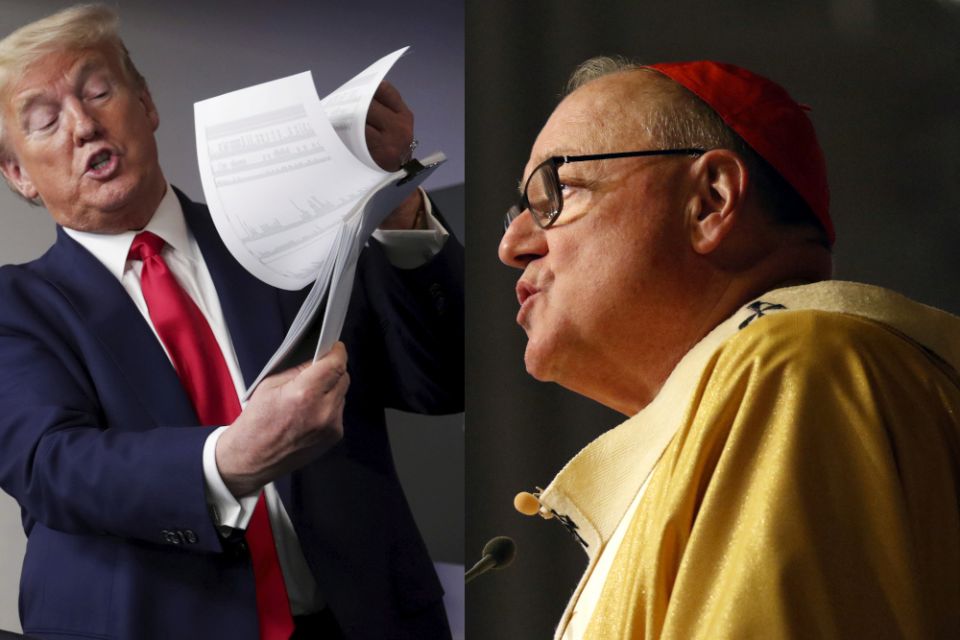
I wonder whether the U.S. Catholic bishops have crossed a sort of Rubicon recently.
When their Roman predecessor, the general Julius Caesar, brought his army illegally over the Rubicon River, he set in motion the events that ended the Republic and saw him presented with a crown. “The die is cast,” he is reputed to have said as he marched his army toward Rome: there was no going back. What he had done could not be undone and it would change the shape of history.
I do not think that New York Cardinal Timothy Dolan is in any danger of being crowned emperor (or, anything else). But I do believe that his public flattery of President Donald Trump from the pulpit of St. Patrick’s Cathedral and on Fox News may prove to be a moment from which American Catholicism cannot turn back.
Smart analysts have interpreted the cardinal’s blandishments as a savvy effort to smooth-talk the president into devoting stimulus funds to help Catholic schools that, no doubt, will struggle in the post-pandemic environment. Maybe that is what the cardinal thinks he is doing. Maybe it even looks smart from one point-of-view. But it seems to me that we have to overlook a lot to see how smart the cardinal is being.
Dolan praised Trump’s sensitivity to the “feelings of the religious community” on Fox News. Think about that.
Then, think about this. “I think Islam hates us,” or, “The children of Muslim American parents, they’re responsible for a growing number for whatever reason a growing number of terrorist attacks,” or think about what Trump said after the Supreme Court struck down his first travel ban that fulfilled his campaign promise of a “total and complete shutdown of Muslims entering the U.S.” — “Put a commission together. Show me the right way to do it legally.”
Continue reading “Cardinal Dolan’s public flattery of Trump forgets a few things” Pas De Merde