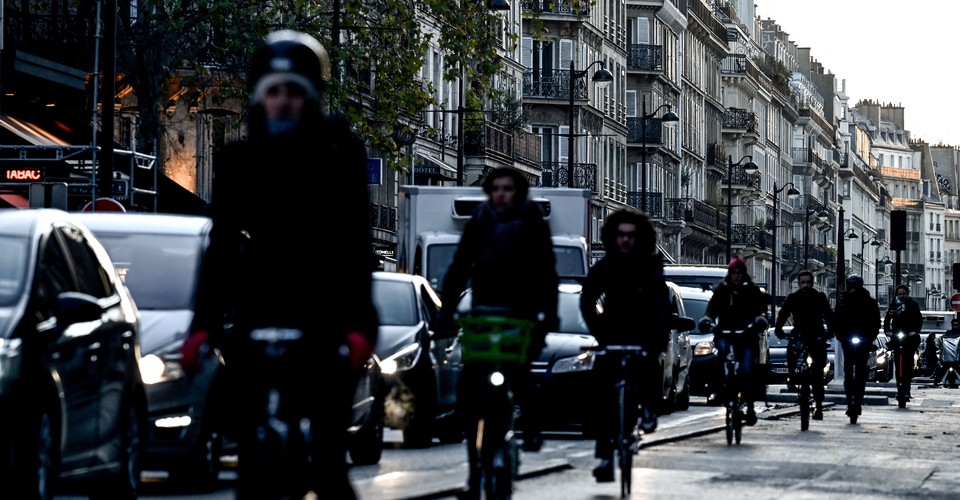
Paris needs to become a “15-minute city.” That’s the message from the manifesto of Mayor Anne Hidalgo, who is seeking re-election this March. Hidalgo has been leading a radical overhaul of the city’s mobility culture since taking office in 2014, and has already barred the most polluting vehicles from entry, banished cars from the Seine quayside and reclaimed road space for trees and pedestrians. Now, she says, Paris needs to go one step further and remodel itself so that residents can have all their needs met—be they for work, shopping, health, or culture—within 15 minutes of their own doorstep.
Even in a dense city like Paris, which has more than 21,000 residents per square mile, the concept as laid out by the Hidalgo campaign group Paris en Commun is bold. Taken at a citywide level, it would require a sort of anti-zoning—“deconstructing the city” as Hidalgo adviser Carlos Moreno, a professor at Paris-Sorbonne University, puts it. “There are six things that make an urbanite happy” he told Liberation. “Dwelling in dignity, working in proper conditions, [being able to gain] provisions, well-being, education and leisure. To improve quality of life, you need to reduce the access radius for these functions.” That commitment to bringing all life’s essentials to each neighborhood means creating a more thoroughly integrated urban fabric, where stores mix with homes, bars mix with health centers, and schools with office buildings.
Paris en Commun has created a diagram to illustrate the concept of what should be available within 15 minutes of “Chez Moi” (home)
This focus on mixing as many uses as possible within the same space challenges much of the planning orthodoxy of the past century or so, which has studiously attempted to separate residential areas from retail, entertainment, manufacturing, and office districts. This geographical division of uses made sense at the dawn of the industrial era, when polluting urban factories posed health risks for those living in their shadows. Car-centric suburban-style zoning further intensified this separation, leading to an era of giant consolidated schools, big-box retail strips, and massive industrial and office parks, all isolated from each other and serviced by networks of roads and parking infrastructure. But the concept of “hyper proximity,” as the French call it, seeks to stitch some the these uses back together, and it’s driving many of the world’s most ambitious community planning projects.
Barcelona’s much-admired “superblocks,” for example, do more than just remove cars from chunks of the city: They’re designed to encourage people living within car-free multi-block zones to expand their daily social lives out into safer, cleaner streets, and to encourage the growth of retail, entertainment, and other services within easy reach. East London’s pioneering Every One Every Day initiative takes the hyper-local development model in a slightly different direction, one designed to boost social cohesion and economic opportunity. Working in London’s poorest borough, the project aims to ensure that a large volume of community-organized social activities, training and business development opportunities are not just available across the city, but specifically reachable in large number within a short distance of participants’ homes. Continue reading “Paris Mayor Pledges a Greener ’15-Minute City’” →

 Pas De Merde