A Letter From Wartime France

Streets that are normally busy, all of a sudden aren’t.

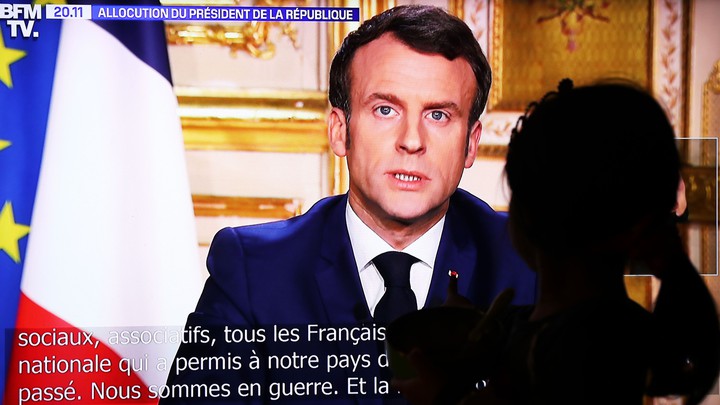
At noon today, as France slipped into confinement, I looked down from my balcony at the street below. A few people were riding bikes or walking. At the tobacconist next to the closed café, a woman was wiping down the door frame. The street is normally busy, and all of a sudden it wasn’t. For the next two weeks, and likely longer, we cannot go out except for urgent reasons: food, medicine, or essential work. A nationwide lockdown, enforced by police. “We are at war,” French President Emmanuel Macron said six times in a speech yesterday evening. “The enemy is there—invisible, elusive—and it is advancing.”

Macron is right. COVID-19, the disease caused by the novel coronavirus, has killed thousands and will likely kill thousands more, a tsunami that doctors have been warning will overwhelm the health-care system, as it’s already doing in neighboring Italy, the country hardest hit by this virus after China. This weekend, the government ordered all restaurants, cafés, and retail stores closed in France.

And finally, last night, Macron followed Italy and Spain—but not Britain or the United States—and mandated confinement to slow the exponential spread of the virus. Overnight, Macron, who was elected on a fluke and has faced popular revolts and flagging popularity, has become a war president.

We are at war. How strange to hear those words in Europe in 2020. It’s impossible, here in Paris, not to think of the Second World War. Not since Continue reading “A Letter From Wartime France”

To ban or not to ban? What future for pesticides and GMOs in the EU?

PART ONE

French Agriculture Minister Didier Guillaume tells Catherine Nicholson why he believes a transition to lower-chemical farming is essential and how he thinks it can be achieved.

Meanwhile, Green MEP – and organic farmer himself – Benoît Biteau tells us why what he learnt converting his father’s farm to greener practices can be replicated.

In our reports, we meet some of the mayors who have banned pesticides around their towns and find out more about the conflict with the farming community. We also meet French farmers who are testing how to reduce their dependence on chemical pesticides

PART TWO

Source: To ban or not to ban? What future for pesticides and GMOs in the EU? (part 1) – Talking Europe

Paris’ hidden vineyards

Tucked amid the city’s urban sprawl, dozens of secluded vineyards dot the French capital and produce some of France’s most exclusive wines.

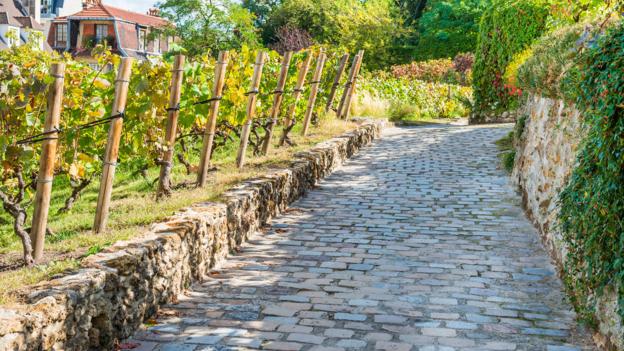
When I first met Irene Henriques, it was the hottest-recorded week in French history. She was standing at the foot of her vineyard wearing long trousers and a thick khaki workman’s coat. When I asked how she wasn’t melting, she laughed and replied in her soft-spoken voice, “After 30 years of wine-growing, you get used to it.”

Gesturing towards the rolling, bucolic hill behind us, Henriques begged, “It’s beautiful, no?” I had to agree. The land that she and her team have spent decades cultivating looks like a Rococo painting come to life; an Arcadian vision of the French countryside. Climbing wisteria and lilacs line the surrounding iron fence, while apple and pear trees provide much-needed shade. Henriques’ most important crops, the Pinot Noir, Chardonnay and Muscat grapes, crown the hill, gorging themselves on sunlight.

France has strict vine-planting regulations, and until recently, only certain regions – including Bordeaux, Bourgogne and Champagne – could bottle and sell wine commercially. But in 2016, an EU-mandated liberalisation of the French wine sector extended the right to sell wine commercially throughout most of France. Yet, wines produced within the French capital can still not be sold to commercial markets because of the perceived threat urban pollution may have on the grapes.

But the goal of Parisian vineyards was never to make money. So rather than going from wine cellars to wine sellers, the bottles have always been auctioned off to benefit the city during harvest time. Also, because the vines are owned and operated by the City of Paris, you can’t just go for a tasting or a tour, as you can in other French regions. Continue reading “Paris’ hidden vineyards”

French nationality ranked ‘best in world’ again

passport

The French nationality has been ranked the best in the world for the eighth consecutive time, according to the latest ranking (2018) of the global Quality of Nationality Index.

The index defines nationality as “legal statuses of attachment to states”.

It takes into account nationality qualities such as home-country economics, peace, stability, citizens’ opportunities for development, ease of visa-free travel, and opportunities to work and live abroad.

These “make one nationality better than another in terms of a legal status through which to develop your talents and business”, the index – full name full name Kälin and Kochenov’s Quality of Nationality Index (QNI) – says.

The QNI ranks the world’s nationalities by a strict set of criteria (Map: Quality of Nationality Index (QNI) / nationalityindex.com)

France came out on top of the ranking, with a score of 83.5 out of 100. This was closely followed by Germany and the Netherlands (both 82.8); Denmark (81.7); and Sweden and Norway (81.5).

France won out due to its place as the world’s sixth largest economy, but also for its place in the European Union, the list said, with all EU members listed at the top of the table due to their freedom of movement.

France was especially praised for its qualities in helping citizens to travel, live and work abroad. A French passport allows the holder to travel in almost 165 countries without a visa.

The top 10 was rounded out by Finland (81.2), Italy (80.7), the United Kingdom (80.3), Ireland (80.2) and Spain (80.0)
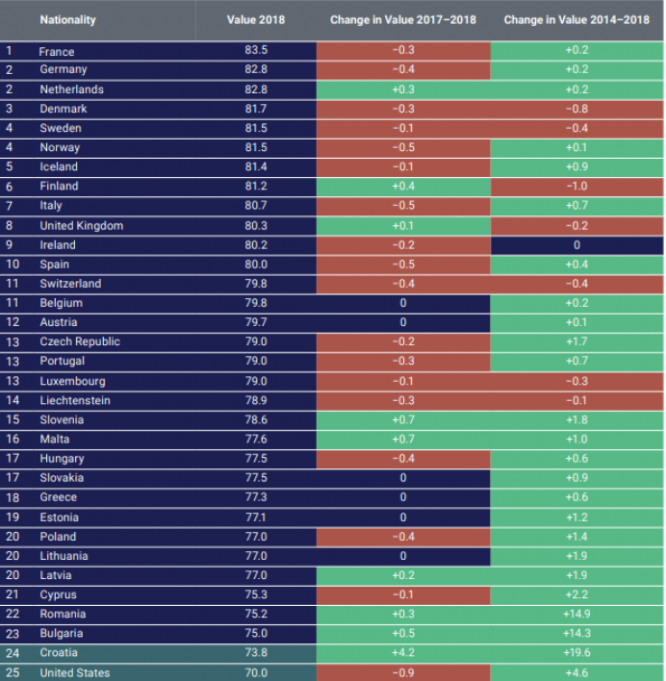
(Table: Quality of Nationality Index (QNI) / nationalityindex.com / LaDepeche.fr)

At the bottom of the top 25 were the United States (70.0), with Croatia (73.8), Bulgaria (75.0), Romania (75.2), Cyprus (75.3), Poland, Latvia and Lithuania (all 77.0) coming just ahead.

The bottom three nationalities were South Sudan (157th), Afghanistan (158th), and Somalia (159th), with respective scores of 15.9, 15.4, and 13.8.

Risks of a ‘hard Brexit’

But the UK could see its ranking fall to 56th globally in the next list “if it pursues a ‘hard Brexit'”, the researchers have suggested, putting it on a par with China (currently 56th) and Russia (currently 62nd).

The index is named after its creators, Dr. Christian H. Kälin and Professor Dr. Dimitry Kochenov.

Dr. Kälin is a law professor and chairman of law firm Henley & Partners, and is considered an expert in investment migration.

Prof. Kochenov is a Chair of EU Constitutional Law at the University of Groningen in the Netherlands, and writes widely on comparative and European citizenship law and migration regulation.

In a statement, Prof. Kochenov said: “The UK may be about to establish a world record in terms of profoundly undermining the quality of its nationality without going through any violent conflict.

“Depending on the still-to-be determined outcome of Brexit, the UK could see itself falling from the elite group of ‘very high quality’ nationalities into the ‘high quality’ bracket.

“A truly ‘hard’ Brexit would result in the UK having a nationality that does not grant Britons settlement or work rights in any of the EU jurisdictions or Switzerland, Norway, and Iceland: a collection of the most highly developed places on earth, greatly diminishing the quality of its own nationality in an irrevocable manner: either you have such rights, or not – and in such a scenario UK citizens won’t have them.”

Prof. Kochenov added: “The QNI is a clear illustration of the simple fact that speaking of the different nationalities of the world as equal, or even comparable, is misleading.

“We see that some nationalities offer bundles of rights, while others, quite clearly, are painful liabilities, dragging down the holders.”

Read more at source: French nationality ranked ‘best in world’ again

Fine Arts Paris and beyond

The fair underscores its links with the museum world in its third edition. Plus highlights from Paris Photo and Also Known as Africa

Fine Arts Paris began in 2017 as a boutique affair of 34 dealers, and though it has now grown to 46 exhibitors – most of them French – it still prides itself on carefully crafted displays and museum-quality works. This year (13–17 November), the fair is looking to underscore its links with the museum world with an events programme that offers behind-the-scenes tours of various institutions. Visitors will also be treated to a first look at the Château de Fontainebleau’s most recent acquisition: a late 16th-century mythological scene by a follower of Francesco Primaticcio. La Piscine – the museum of art and industry in Roubaix – provides a pop-up display of works from its collection, by artists including Marc Chagall and Camille Claudel.

At Galerie Charvet there is a selling exhibition on the theme of museum interiors; highlights include a painting of a man polishing the armour of a horse guard at the Royal Armoury in Turin, by the Piedmontese artist Giovanni Giani in 1892. [ . . . ]
Continue at
APOLLO MAGAZINE: Fine Arts Paris and beyond | Apollo Magazine

French rebel mayors defy government by imposing illicit pesticide bans

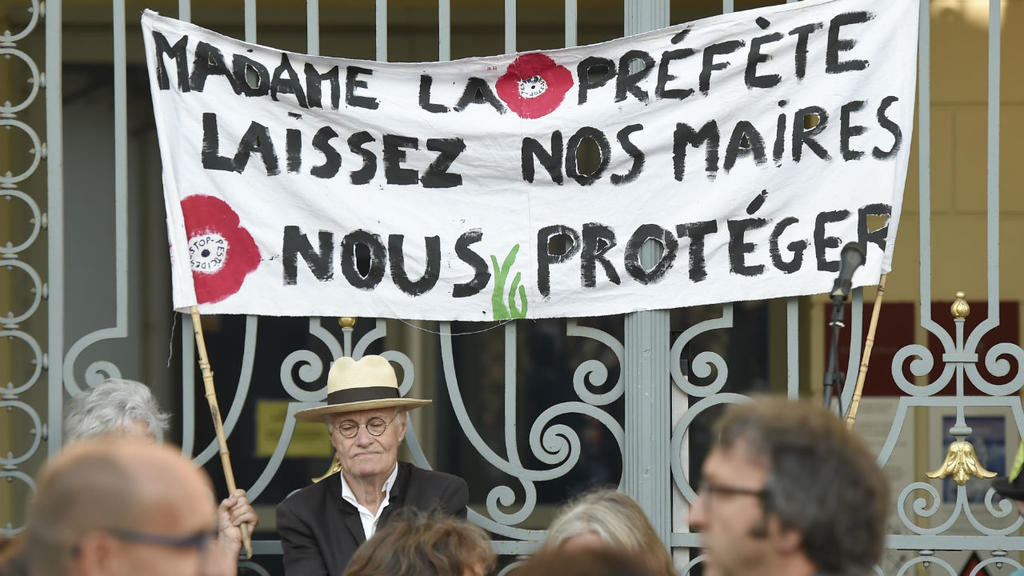
Dozens of French mayors have taken the law into their own hands and illicitly banned pesticides near populated areas in their towns and villages. The rebel move has angered France’s agriculture minister who says it threatens French food production.

It all began when Daniel Cueff, the mayor of Langouët in Brittany, on May 18 climbed onto a wooden box dressed in white protective gear and announced to his village that he had imposed a ban on pesticide use within 150 metres of the district’s homes and workplaces. “It is legitimate for a mayor to take action when there is incompetence by the state,” he said, referring to the 2009 European Union directive that requires member states “to take steps to protect residents from pesticides”. [ . . . ]

Source: French rebel mayors defy government by imposing illicit pesticide bans