Movie Review: Montparnasse Bienvenue


SCREENDAILY
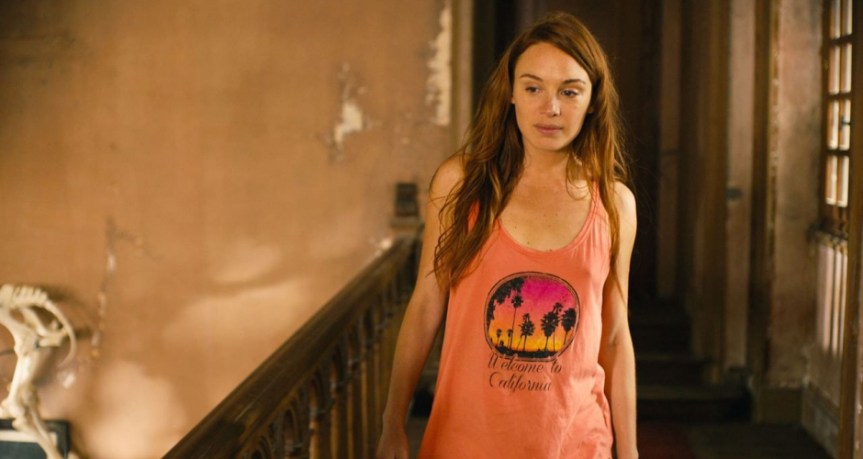
A fearless, powerhouse performance by Laetitia Dosch infuses every frame of Montparnasse Bienvenue (Jeune Femme), the kinetic, incident-packed portrait of rudderless yet resilient Paula, a 31-year-old woman in emotional free-fall. This first film by writer-director Léona Serraille is full of snap and surprises as energetic scatterbrain Paula ricochets from situation to situation after getting dumped by a lover — her former teacher and prominent photographer Joachim (Gregoire Monsaingeon) — with whom she lived for a decade. Following its debut in Cannes (Un Certain Regard) this should travel.

We meet Paula pounding on a door — first with her fist and then with her forehead — demanding to be let in. In a sequence at the hospital where the resulting gash is treated, we witness Paula’s manic gift for navel-centered gab and her oblivious knack for casually insulting the very people trying to help her. She’s a walking train wreck who manages to lurch from station to station as we look on. There’s literally never a dull moment. [ . . . ] READ FULL REVIEW

Rodolphe Burger, the artist with music “philosophical pop”

A singular spoken-sung that imposes an intoxicating presence and maintains its music in a state of weightlessness. An ecstatic blues rock and loops with hypnotic reverb, the textual cut-up stowed with saturated and saturated riffs, the guitar considered as one of the fine arts

For thirty years, Rodolphe Burger has written one of the most beautiful pages of popular and literary music. A music that could even qualify as “philosophical pop.” The name seems odd however for the one who led one of the best formations in France with the group Kat Onoma (1986-2002), before continuing his musical adventure solo. The name seems curious for the founder of the festival C’est dans la vallée, who writes for both Alain Bashung and Jacques Higelin, playing with the same spirit in the company of bluesman James Blood Ulmer or singer Rachid Taha.

A philosophical pop music, in spite of everything, because, as Gilles Deleuze said, who launched the formula and wanted to “do a course in philosophy as Dylan organizes a song,” Rodolphe Burger composes albums as books of images and sounds. With Good , his latest album (Last Band, 2017), he mixes this time the acoustics and electronics, thanks to the rhythm of Christophe Calpini.

The texts ? Poetry uttered. On the phrasing of the German romantics (Goethe for “An Lili” or Büchner for “Lenz”), on the grain of the voice of English-speaking authors of the last century (from Samuel Beckett for “Good” to TS Eliot for “Waste Land”) without forgetting the contemporary French writers, Michel Deguy ( “Nothing and nobody”) to Olivier Cadiot ( “golden Poem” and “Providence”) or Pierre Alféri ( “Happy Hour”), Rodolphe Burger made a direct album and learned, sensitive and thinking.

An irresistible pulsation

Good immediately sets the tone and sets the ambition high. An organic scansion, an irresistible pulsation, a Beckettian voice from beyond the grave leaning against a sublime rise of copper-plated strings. In “Cummings”, the guitarist’s voice is intertwined with a recording of that of the poet E. E. Cummings, whose variations and melodic lines he follows. The charm operates and the archive provides immense vertigo [ . . . ]

Read entire story: Rodolphe Burger, the artist with music “philosophical pop”

Marie Richeux, what movie buff are you? 

Back on France Culture with ‘By Les Temps qui cour’ (which replaces ‘Les Nouvelles Vagues’ since the beginning of the school year), the passionate and thoughtful Marie Richeux also released at the end of August her third book, Climats de France, a rich exploration and poetic of Franco-Algerian relations taking as a point of departure his childhood in a city of Meudon-la-Forêt. We wanted to know which films water this great thirsty for culture.

Three Favorite Films of All Time

King of the Wind and Electric Queens  (2014) by Cédric Dupire and Gaspard Kuentz, a so-called “documentary” experience about a fair in India that never clearly reveals its stake and is so powerful in the electricity of this moment. The Lesser Mantra  (1997) by Fernand Deligny, Josée Manenti and Jean-Pierre Daniel. His film shows, like his books, how to question the way we look at others, and to make this interrogation the very subject of a link (therefore a cinema) is fertile. The Wonders  (2014) Alice Rohrwacher. It is so beautiful. Amongst other things, there is this scene where the two sisters look with concentration at the way the sun settles on the floor and the walls. It is very moving [ . . . ]

Read the Full Interview at: Marie Richeux, what movie buff are you? – THREE COLOURS