
UniFrance supports the red carpet walk made by 82 women on Saturday, May 12, at the Cannes Film Festival with this short montage of images from 70 recent French films directed by women. Music: “La Grenade” by Clara Luciani.
Is France Showing Us What America’s Next Civil War Will Look Like?

“Everything I’ve seen so far out of France is singing loudly that, yes, it’s a small world, after all – and that what’s happening on the barricades is both a reflection of what’s going on in much of the developed world and a screaming alarm for what could come next.”
It’s October 2021. America is in a state of turmoil – so much so that the ongoing felony trial of disgraced former president Donald Trump seems only a footnote. The chaos of the 2020 election has meant no honeymoon for Beto O’Rourke, the 47th president, whose narrow win over the GOP’s Nikki Haley (the Republican convention in Charlotte having rejected President Pence) had only enraged both the right and an increasingly angry left, which was still insisting that Democrats had cheated Bernie Sanders out of the nomination at their divided, brokered convention.
Still, President O’Rourke had small Democratic majorities in the House and Senate, and – after a summer of record heat waves had left more than 250 dead in the Los Angeles wildfires and seen Hurricane Gigi swamp many of the same New Orleans neighborhoods that had been inundated by Katrina – the charismatic, Kennedyesque chief executive had convinced Congress to pass, by exactly one vote in each chamber, a 40-cent-a-gallon gas tax to promote solar and wind power and subsidize electric cars.
Within hours, angry truckers had parked their rigs across the entrance to every tunnel on the Pennsylvania Turnpike. In small towns across America, protesters – encouraged by Sean Hannity on Fox News and by fake stories on Facebook that the O’Rourke administration planned to reopen Trump’s Texas detention camps for immigrants and use them to imprison tax resisters – gathered at gas stations. Many of their rallies were infiltrated by the political fringes – neo-Nazis of the right and Black Bloc anarchists of the left – and there were scattered reports of violence. In Charleston, S.C., a CNN reporter was reporting from a full-blown riot when gunfire was heard in the distance, just a cannonball shot away from historic Fort Sumter.
Paris is burning.
You’d think the rapid decline of Western civilization would get more news coverage in America – normally, flaming barricades in the shadow of the iconic Arc de Triomphe and hundreds fleeing tear gas in the heart of the French capital might be considered must-see TV, especially when the other option is a panel of aging Watergate prosecutors – but the latest chess moves in the Trump-Russia scandal and the embattled White House continue to trump most other headlines [ . . . ]
Continue at COMMON DREAMS: Is France Showing Us What America’s Next Civil War Will Look Like?
Jain: Artist You Need to Know
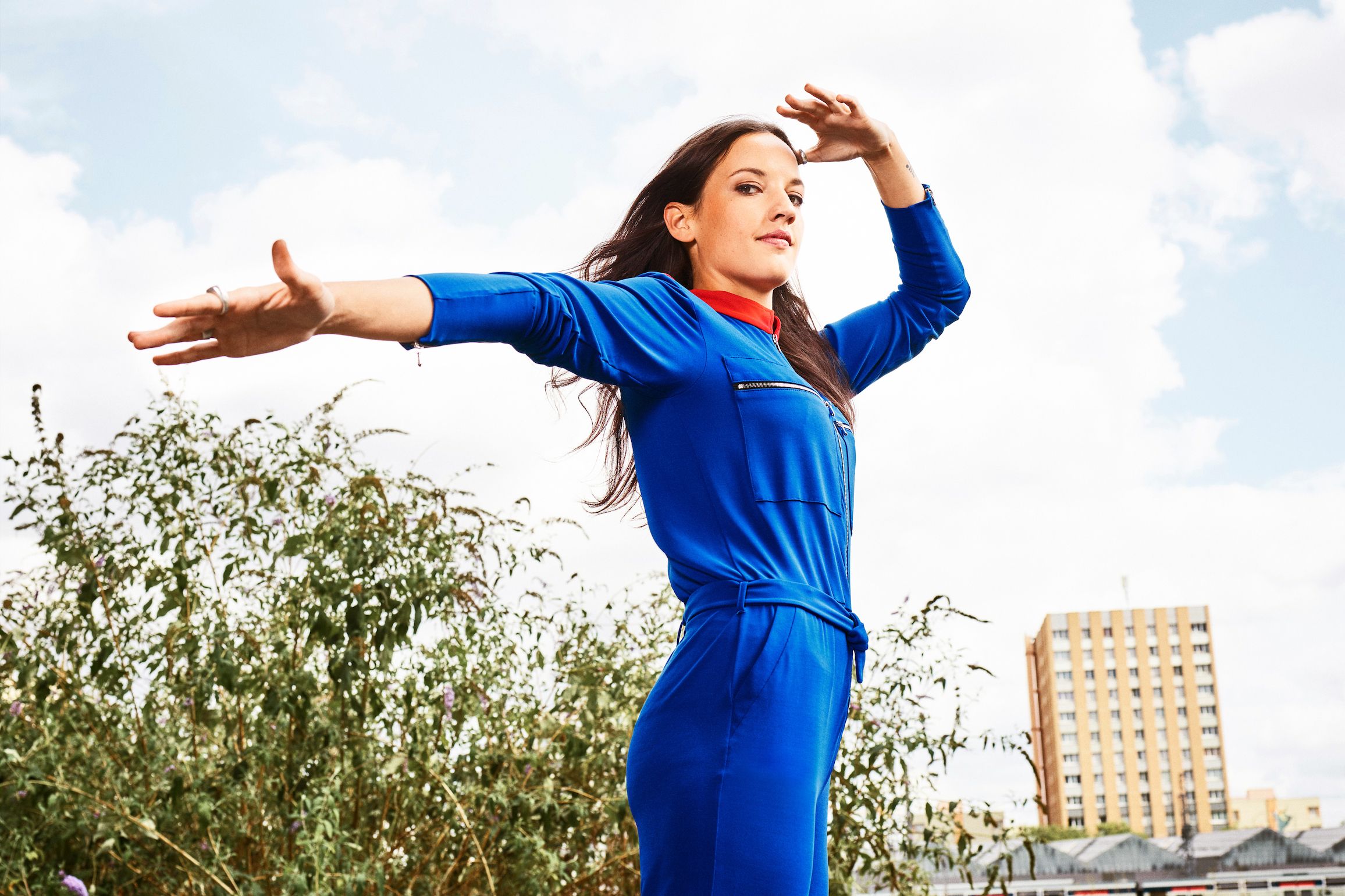
French singer mixes pop, Afrobeat and more influences in a winning combination
t’s a chilly October night, yet Jain has packed the mid-sized Brooklyn venue Warsaw with a mix of New Yorkers and visitors from her native France. Over there, she’s a phenomenon: Her 2015 debut, Zanaka, which blends pop with Afrobeat, is certified diamond, and her follow-up, this year’s Souldier, hit Number One on the country’s albums chart. The 26-year-old regularly plays multiple nights at venues like Paris’ historic Olympia and Marseilles’ Le Moulin, and she’s opened for Seal and Christine and the Queens. Here, though, it’s clear she knows how to work a slightly smaller crowd.
With a striking concert presentation and a set list full of dance-floor movers, she gets the crowd jumping, dancing and singing along. She does it all while alone on the stage: Like a DJ, she has a podium where she controls her music — loops she creates in real time, sometimes using a remote-control gauntlet she’s woven into her blue jumpsuit that looks like a high-tech Wonder Woman — and she’s enfolded herself in video screens and lighting arrays of pure color.
“You wanna be a staaaar, but you don’t know who you are,” she sings amid jittery synthesizers and a hip-hop beat on “Star,” off Souldier. Based on how confident she looks, it’s hard to imagine she’d be singing about herself.
Although Jain sings in English and is a smash across Europe and Canada, she’s still working on making a dent in the U.S. The video for “Makeba,” her song praising the late South African civil rights activist Miriam Makeba, earned her a Grammy nomination, and the song appeared in ads for Levi’s and Mitsubishi, but she’s still proving herself here. Judging from the Brooklyn show, she’s beginning to turn the tide. That’s partly because Souldier, with its rap and Arabic influences, reflects who she has become since her last record as much as where she’s come from.
“I wanted to talk about women, the star system and the technology that surrounds us and people that are trying to sell things all day long,” she says a couple of weeks after the Brooklyn show. Her voice sounds both confident and optimistic. “[Souldier] is a little bit more adult and engaged, and it’s mostly about our modern society.”
Jain has a unique view of the world, mostly because she’s lived all over. She was born Jeanne Galice in Toulouse, in the southwest of France. When she was nine, her family relocated to Dubai for her father’s work in the oil industry, which also took her to Congo and Abu Dhabi. It was in Pointe-Noire, Congo, where she lived from ages 12 to 16, that she began making music. Her big sister started playing guitar and taught her a few chords. Jain wrote “Come,” a catchy, acoustic foot stomper, and met a local producer who called himself Mr. Flash. He helped her make what she remembers as a “really cheap” recording of the song, and she uploaded it to Myspace. “I sent this demo to every major record company in France, and I had only one answer,” she says. “It was from the person who became my manager.” (She pays tribute to the man who kickstarted her career on Souldier’s “Flash (Pointe-Noire).”) [ . . . ]
Continue at ROLLING STONE: Jain: Artist You Need to Know – Rolling Stone
Pomme
Rodin’s paper cuttings exhibited for the first time, in Paris
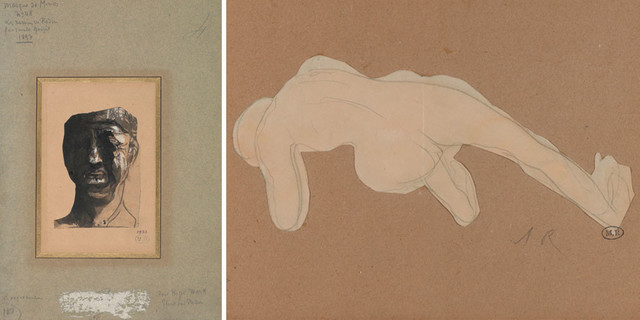
Rodin would it be a precursor of the papers glued, announcing the modernity of Matisse? A new facet of the work of the master of sculpture is to be discovered at the Musée Rodin: one realizes that all his life he cut figures, variations of his drawings that he glued, assembled, with a great freedom (until 24 February 2019).
Auguste Rodin (1840-1917) is a bit like Picasso, his inventiveness seems limitless and we always discover new aspects of his work. Beyond his drawings, full-fledged works that are not preparatory studies for his sculptures, Rodin has always cut and pasted figures.
The Musée Rodin retains some 7,500 drawings. “I have a great weakness for these little sheets of paper,” said Rodin. 250 are presented in the exhibition, including a hundred or so cut papers. “I have exposed almost all the paper cut, all that we have, and there is almost no outside (of the museum),” says Sophie Biass-Fabiani, heritage curator in charge of drawings at the museum Rodin and Commissioner of the [ . . . ]
Source: Rodin’s paper cuttings exhibited for the first time, in Paris
What’s Really Behind France’s Yellow Vest Protest?

It’s not just about the fuel tax; it’s about anger at ever-increasing burdens on the working class.
If the movement has managed to win such broad support thus far, it’s because it has clearly tapped into a deeper sense of social injustice. While that sentiment is shared nationwide to varying degrees, the protests themselves sprung up largely in rural areas and in what’s known as le périurbain: the sparsely populated outer bands of suburbs and metropolitan areas. These are parts of the country that suffer from high joblessness and rely heavily on state investment to keep their communities afloat, from unemployment benefits to the public rail network that connects them to larger cities.
Read full story at THE NATION: What’s Really Behind France’s Yellow Vest Protest? | The Nation
 Pas De Merde