Is France Showing Us What America’s Next Civil War Will Look Like?

“Everything I’ve seen so far out of France is singing loudly that, yes, it’s a small world, after all – and that what’s happening on the barricades is both a reflection of what’s going on in much of the developed world and a screaming alarm for what could come next.”

It’s October 2021. America is in a state of turmoil – so much so that the ongoing felony trial of disgraced former president Donald Trump seems only a footnote. The chaos of the 2020 election has meant no honeymoon for Beto O’Rourke, the 47th president, whose narrow win over the GOP’s Nikki Haley (the Republican convention in Charlotte having rejected President Pence) had only enraged both the right and an increasingly angry left, which was still insisting that Democrats had cheated Bernie Sanders out of the nomination at their divided, brokered convention.

Still, President O’Rourke had small Democratic majorities in the House and Senate, and – after a summer of record heat waves had left more than 250 dead in the Los Angeles wildfires and seen Hurricane Gigi swamp many of the same New Orleans neighborhoods that had been inundated by Katrina – the charismatic, Kennedyesque chief executive had convinced Congress to pass, by exactly one vote in each chamber, a 40-cent-a-gallon gas tax to promote solar and wind power and subsidize electric cars.

Within hours, angry truckers had parked their rigs across the entrance to every tunnel on the Pennsylvania Turnpike. In small towns across America, protesters – encouraged by Sean Hannity on Fox News and by fake stories on Facebook that the O’Rourke administration planned to reopen Trump’s Texas detention camps for immigrants and use them to imprison tax resisters – gathered at gas stations. Many of their rallies were infiltrated by the political fringes – neo-Nazis of the right and Black Bloc anarchists of the left – and there were scattered reports of violence. In Charleston, S.C., a CNN reporter was reporting from a full-blown riot when gunfire was heard in the distance, just a cannonball shot away from historic Fort Sumter.

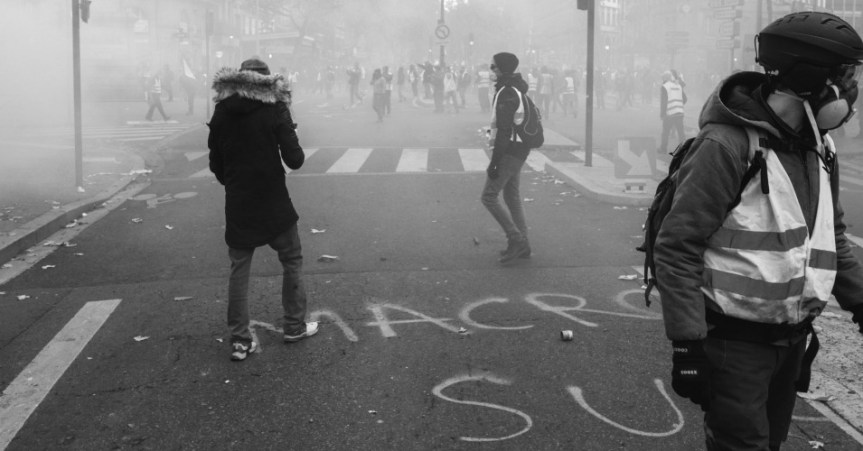
Paris is burning.

You’d think the rapid decline of Western civilization would get more news coverage in America – normally, flaming barricades in the shadow of the iconic Arc de Triomphe and hundreds fleeing tear gas in the heart of the French capital might be considered must-see TV, especially when the other option is a panel of aging Watergate prosecutors – but the latest chess moves in the Trump-Russia scandal and the embattled White House continue to trump most other headlines [ . . . ]

Continue at COMMON DREAMS: Is France Showing Us What America’s Next Civil War Will Look Like?

What’s Really Behind France’s Yellow Vest Protest?


It’s not just about the fuel tax; it’s about anger at ever-increasing burdens on the working class.

If the movement has managed to win such broad support thus far, it’s because it has clearly tapped into a deeper sense of social injustice. While that sentiment is shared nationwide to varying degrees, the protests themselves sprung up largely in rural areas and in what’s known as le périurbain: the sparsely populated outer bands of suburbs and metropolitan areas. These are parts of the country that suffer from high joblessness and rely heavily on state investment to keep their communities afloat, from unemployment benefits to the public rail network that connects them to larger cities.

Read full story at THE NATION: What’s Really Behind France’s Yellow Vest Protest? | The Nation

‘In the end, the power of love is all’

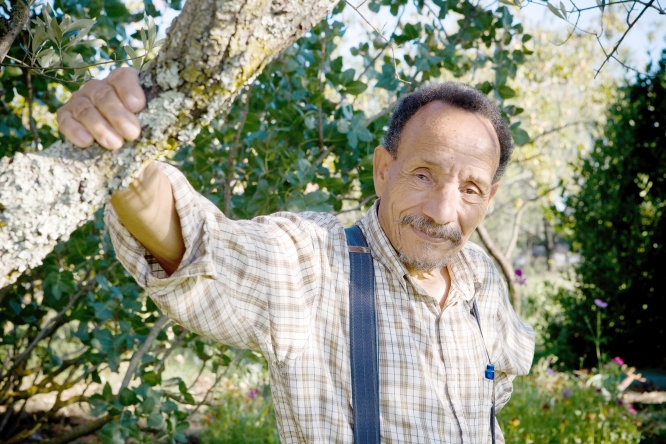
Pierre Rabhi
Pierre Rabhi

As one of France’s most admired environmentalists, Pierre Rabhi advocates a simplified existence in order to live a sustainable, happy life. Jane Hanks falls under the sage’s spell in an exclusive interview

Pierre Rabhi is a French farmer, writer, philosopher and environmentalist who is well known to the French as a man who has been promoting an alternative, simpler way of life for many years, long before it became fashionable. He is now 80, but retirement is not for him as he continues to strive to create what for him would be a better world, with less emphasis on making money and more on being happy with what we already have.

Just recently a report from the government environment and energy management agency body Ademe quoted an Ipsos study which found that most households thought they had a total of 34 electronic pieces of equipment, but in fact the figure is closer to an astonishing 99 and that people buy three times more now than in 1960.

One of Pierre Rabhi’s many books, Vers la Sobriété Heureuse, was translated into English last year, The Power of Restraint. What did he mean by this title?

“We live in a world where there is part of it which is suffering from over consumption and throws too much away, and another part where there is still famine. We produce 40% more than we need.

“One fifth of our world, of which I am a part, uses four fifths of the world’s resources. I cannot morally accept that situation. To change that we need to adopt more modest lifestyles. In our society we have more than enough to eat, but even then we are not happy.

“There is no joie de vivre. People in the West are always worrying about what they do not have, rather than enjoying what they do have. If we were producing all these goods and people were satisfied, then maybe our civilisation would have been successful, but people are not happy, so we must change things.”

Source THE CONNEXION: ‘In the end, the power of love is all’

Yellow Vests: French PM meets opposition after weekend of violent clashes 

French Prime Minister Édouard Philippe cancelled his appearance at the COP24 climate change summit in Katowice, Poland, on Monday, instead meeting with French political leaders to formulate a response to the violent ‘yellow vest’ protests.

Source: Yellow Vests: French PM meets opposition after weekend of violent clashes – France 24