Review: À Voix Haute 

Speak Up is a stylish, moving, funny, and well-paced documentary, released in France as À voix haute, la force de la parole.

Speak Up is a stylish, moving, funny, and well-paced documentary. But most importantly, makes you smile. Released in France as À voix haute, la force de la parole, we caught its UK premiere this Wednesday.

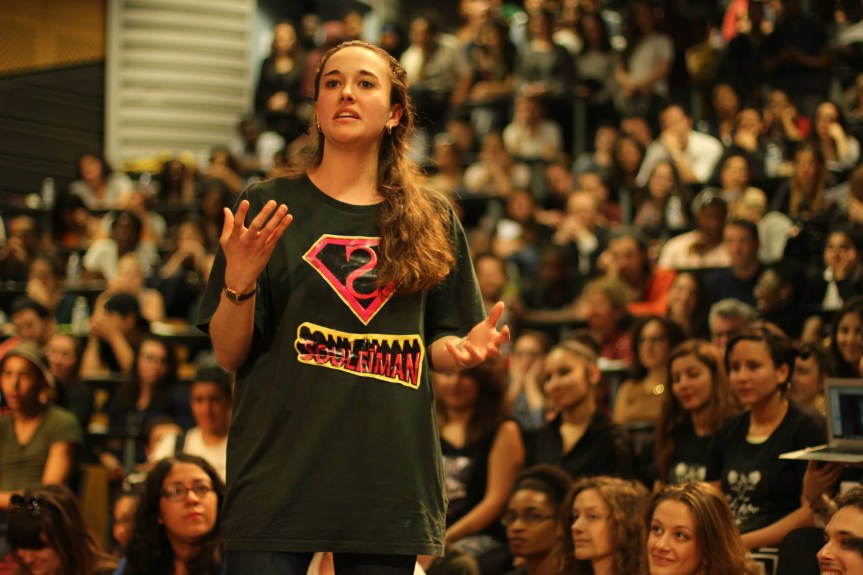
I was sceptical that a film about university students learning to speak would be able to hold my attention for 90 minutes, let alone entertain me. I was wrong – it’s the best documentary I’ve seen so far at Raindance. Set in the University of Saint Denis, just outside Paris, it follows a class of young people as they embark on a thirty-day challenge to prepare for a public speaking competition.

A documentary like Speak Up lives or dies by its editing, and this one’s is superb. There is no narrator; the story is told through footage of lessons, interviews with students, and culminates in the competition itself. Because the class is small (around 20) and the editing is razor-sharp, we quickly get acquainted with its vibrant characters – students and teachers alike. They are almost all witty and likeable, all the more so as the film develops and their eloquence increases.

The individuals in the class have many different cultures, life experiences, pet subjects and senses of humour, and this shines through in their public speaking. Not only does the film exhibit the power well-thought-out speech can wield, it shows anybody can learn to do it, and do it well.

We meet Elhadj, a young man who as a teenager escaped a fire in his house by jumping from a sixth floor window, becoming homeless for a number of years. He speaks poignantly about how language is one of the most powerful weapons anyone can have. If he had the right words at the right time, he says, his life could have turned out very differently.

I was so surprised that a film like this could evoke so much joy in me. I was smiling almost constantly – from the hilarious footage of lessons that brought back memories of classroom banter, to the heartwarming stories of the students and their ineffable willingness to persevere with the mostly barmy lessons their eccentric teachers threw at them.

This review is going to be shorter than most of my other Raindance dispatches, purely because you should just go and watch this film. It’ll hook you in from the beginning, and spit you out the other end. My one qualm was that it’s in French, so reading subtitles and facial expressions simultaneously was sometimes difficult. But I guess there’s not much they could have done about that.


Source- THE PANOPTIC: Speak Up (À voix haute, la force de la parole)
Movie Review: Montparnasse Bienvenue


SCREENDAILY
A fearless, powerhouse performance by Laetitia Dosch infuses every frame of Montparnasse Bienvenue (Jeune Femme), the kinetic, incident-packed portrait of rudderless yet resilient Paula, a 31-year-old woman in emotional free-fall. This first film by writer-director Léona Serraille is full of snap and surprises as energetic scatterbrain Paula ricochets from situation to situation after getting dumped by a lover — her former teacher and prominent photographer Joachim (Gregoire Monsaingeon) — with whom she lived for a decade. Following its debut in Cannes (Un Certain Regard) this should travel.

We meet Paula pounding on a door — first with her fist and then with her forehead — demanding to be let in. In a sequence at the hospital where the resulting gash is treated, we witness Paula’s manic gift for navel-centered gab and her oblivious knack for casually insulting the very people trying to help her. She’s a walking train wreck who manages to lurch from station to station as we look on. There’s literally never a dull moment. [ . . . ] READ FULL REVIEW

‘Django’: Life — And Music — During Wartime

Though overall, a disappointment – I’m glad I finally got to see Django, which just hit my local cable movie offerings. I’ll first ac-cent-uate the positive, and say actor Reta Kateb makes a dashing Django Reinhardt. I’ll add  that close-ups of Ketab’s guitar fingering is as impressive as … well, Sean Penn’s, anyway. I can forgive even the amount of fabrication in the screenplay. But, by the time Django with his gypsy bandmates and family are planning their escape from Nazi-occupied France in 1943, the movie just seems to run out of gas. (I’d say run out of heart, but the movie’s never has much of that to begin with.) The movie did make me pull out my Django recordings and listen to Minor Swing, Nuages, (the unofficial anthem of the French Resistance) and Sweet Georgia Brown. And that’s always a good thing.

Read the LA Times Review below:

In German-occupied France, guitarist Django Reinhardt (Reda Kateb) awakens to the horrors inflicted upon his people in this musically accomplished but “oversimplified, underfed and overburdened” film.

A bar fight breaks out during a pivotal scene in Django, the musically crisp yet mournful new wartime drama by Étienne Comar. As the fracas unfolds, the band keeps playing, with a blithe bemusement that seems to say: This happens all the time. But these are far from normal times.

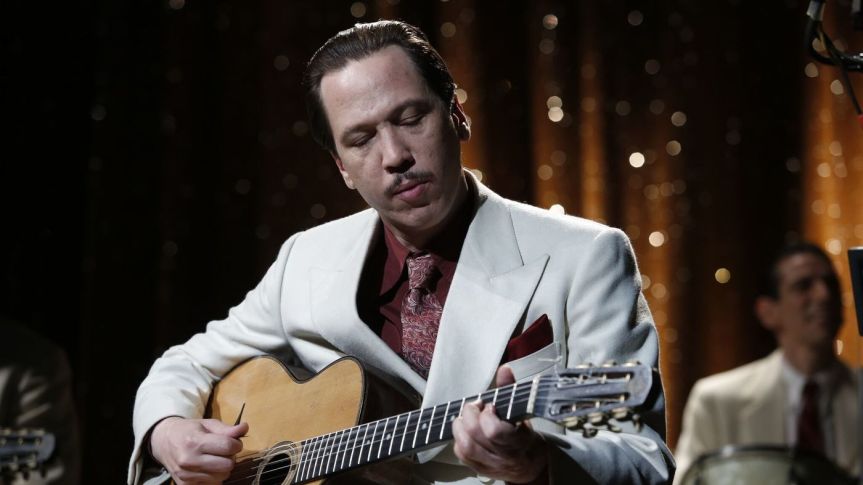
The leader of the band is Django Reinhardt, the incomparably gifted Romani jazz guitarist, soulfully embodied by the French-Algerian actor Reda Kateb. He’s biding his time in the French Alps during German occupation, hoping for stealth passage across Lake Geneva into Switzerland. One of the men throwing punches is a Nazi solider, which means the inevitable: a lineup, a lockup and the sternest of warnings. Reinhardt is no good, it would seem, at laying low.

Kateb studied the guitar for a year to prepare for this role, and his work is evident: There’s an unstudied naturalism to the flicker of his fingers across the fretboard, and the film perks up whenever music is playing [ . . . ]

Read Full Review at: ‘Django’: Life — And Music — During Wartime

Vincent Lindon in Xavier Giannoli’s “The Apparition” – illuminated film about faith

[ English translation] The subject of faith refers to “Men and Gods” (2010) Xavier Beauvois, whose Giannoli is not very far in his approach to an ambitious French auteur cinema. If their approach to the faith is different, the first referring to the assassination of the monks of Tibhirin (1996), Giannoli deals with an apparition of the Virgin Mary, as a fact, as it is documented. The starting point is an investigation launched by the Vatican to determine the veracity of a case of “appearance”. The following is realistic, precise. As at Beauvois.

Veracity and faith rarely go hand in hand. The second is not rational, lived as an inner conviction, the first is an accumulation of evidence. Giannoli’s scenario puts both in the balance. The opportunity to project a form of mysticism in the light of a skeptic (Vincent Lindon), facing the clairvoyant (amazing Galatea Bellugi), a priest (excellent Patrick d’Assumçao), a fanatic (disturbing Anatole Daubman) and to a crowd of pilgrims no less exalted.

Earth time and eternity

Beautiful equation, that all the sobriety of Vincent Lindon serves perfectly. Just like the staging of Xavier Giannoli. The subject, the apparition of the virgin to a witness, is rare in cinema (despite some seven biopics of Bernadette Soubirous); Therese of Lisieux, it is something else (The sublime “Thérèse” of Alain Cavalier). We will also mention “Fellini Roma”, with its long sequence of the appearance of the virgin with two children, rather sulphurous … with which “The Apparition” has connivances in the vision of the fanatics around the visionary child.

“The Apparition” finds this acuity of observation and analysis of Xavier Giannoli of “At the origin”. The filmmaker takes his time to account for earthly time in relation to eternity. He finds this crossroads to express doubt, in a scenario written in chapters, with his digressions (the episode of the icon). A war reporter has just lost his best friend in the field and is facing the afterlife. Beautiful subject, perhaps the main one, a film with drawers. A fair vision, ascetic, honest, and ambitious, in a fiction based on an investigation, so the suspense tense, dramatic, until an effective coup de theater. Pure in more than one way, “The Apparition” raises more questions than it answers: the mark of a work.

Source: Vincent Lindon in Xavier Giannoli’s “The Apparition” enlightened film about faith

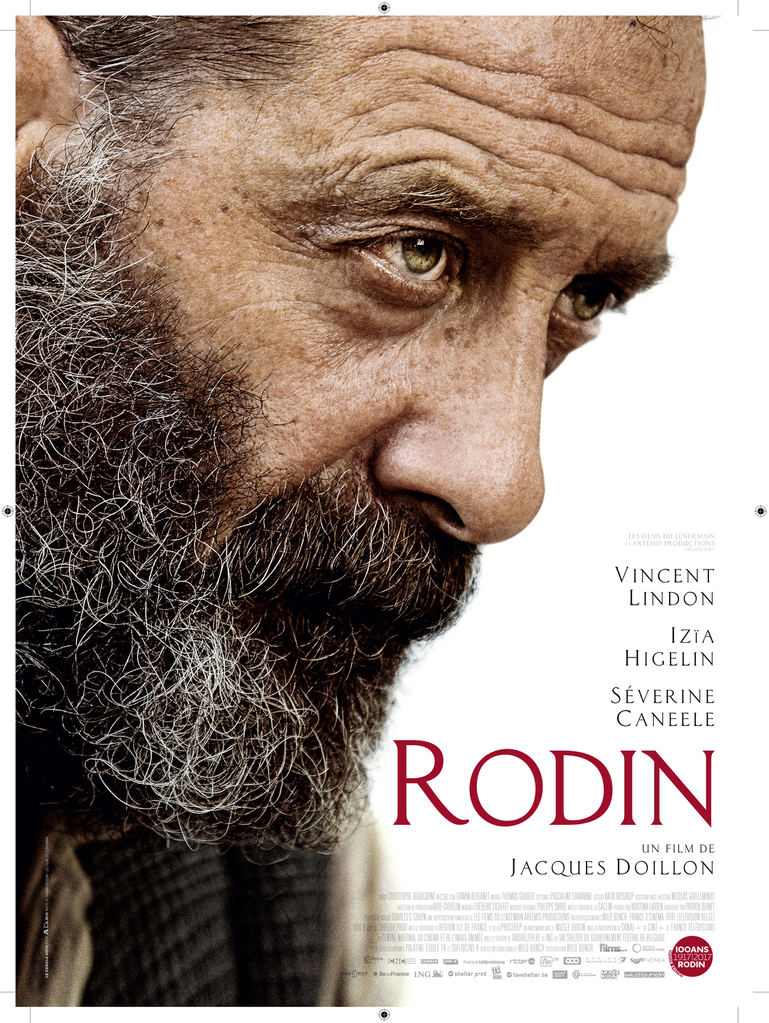
“Rodin” – a film by Jacques Doillon

In Paris, 1880, forty-year-old Auguste Rodin at last receives his first state commission: The Gates of Hell, a sculptural group work composed of many figures, some of which would be the basis of free-standing sculptures that would later bring him fame, such as The Kiss and The Thinker. At the time, he shares his life with Rose, his longtime companion. He meets young Camille Claudel, his most talented student, who quickly becomes his assistant, then his mistress. Ten years of passion, but also of mutual admiration and complicity. After their break-up, Rodin relentlessly pursues his work, coping with the rejection and the enthusiasm provoked by the sensuality of his sculptures, and with his Balzac, rejected during his lifetime, he creates the uncontested departure point of modern sculpture | More at UniFrance

‘Godard is not God!’


The women, the films, the fights, the flops … the director of The Artist has risked infuriating France with Redoubtable – a hilarious drama about Jean-Luc Godard.

Full Review: ‘Godard is not God!’ … Michel Hazanavicius on his film about France’s most notorious director | Film | The Guardian