The cliche is French food is better than ours. The trouble is, it’s true 

I am, by nature, suspicious of food cliches. I don’t think Grandma’s cooking was always better. Certainly, my grandmother’s wasn’t. She hadn’t met a packet she couldn’t open and regarded the notion that she should cook from scratch as a calculated insult. Likewise, the good old days were nowhere near as good as now: choice was limited, quality was poor and “abundance” was a word for spelling competitions, not a descriptive term to be applied to food stocks.

I have long bridled at the insistence that the food cultures of our European neighbours are so much better than ours. It ignores the realities of history. Yes, trying to find a good meal in Britain outside the home (and inside it, for that matter) immediately after the second world war was as tricky as finding an honest banker in London’s Square Mile. Then again, during that war we industrialised food production to help fight a war of national survival, losing purchase on both cookery traditions and kitchen skills.

It seems all it takes to soothe me is a good selection of cheeses and a recently picked fig

And what’s so good about those robust food cultures anyway? They tend to be inward-looking and small-minded. Two weeks in Tuscany sounds like a fabulous idea. Then the reality slides in, like ink seeping slowly across blotting paper: day after day of the same bloody pasta dishes, the same rustic salads and anything for dessert as long as it’s tira-sodding-misu or something “inventive” involving pears and almonds. By day five, what you wouldn’t do for a bit of Thai food doesn’t bear thinking about. We eat more widely and thrillingly in Britain specifically because of the weakness of our indigenous food culture [ . . . ]

Continue at THE GUARDIAN: The cliche is French food is better than ours. The trouble is, it’s true | Food | The Guardian

French MPs want new tax to tackle France’s salt addiction 

French MPs aim to introduce a new tax on salty foods in a bid to reduce the amount consumed in France where the intake of salt exceeds the recommended amount by a whopping 60 percent.

French food might be known for being mouthwatering but all those delicious cheeses, baguettes and saucissons don’t exactly help minimize your salt intake.  In fact, the French consume an average of 8 grams of salt per day while the World Health Organisation (WHO) recommends a maximum of 5 grams each day.  That means the French exceed the recommended intake of salt by 60 percent.  But now a group of 20 French MPs — all members of a committee carrying out an inquiry into industrial food production — is hoping to change all that by bringing in a tax on salty foods to encourage manufacturers to decrease the amount they include in their products, according to Le Figaro.

These MPs argue that at the moment consumers are too limited by what’s on the supermarket shelves.  “The consumer has no choice: most of the salt that they eat is found in pre-prepared dishes” with the consumption of these kinds of meals “exploding in recent years”, said the committee’s spokesperson, MP for La Republique en Marche Michele Crouzet.  [ . . . ]

Continue at THE LOCAL: French MPs want new tax to tackle France’s salt addiction – The Local

French wine bounces back after horror 2017

Ministry forecasts 25% year-on-year increase in production

Wine production in France should be 25% higher than in 2017, when late Spring frosts wrecked the grape crop, the Agriculture Ministry has said.

Producers in France expect to create some 46.1million hectolitres of wine in 2018, the Ministry announced – a rise of a quarter on 2017. Winemakers themselves, meanwhile, predicted an output of 44.5million hectolitres this year.

The summer heatwave does not appear to have damaged crops – and, in some cases, it may have saved it from mildew that threatened vines in early summer.

Production is expected to be below the five-year average in Languedoc-Roussillon, Corsica and the south-east, due to mildew, while Merlot grapes in Bordeaux were also affected – but in the latter’s case it is not expected to hit recovery.

Meanwhile, the heatwave actually stopped the spread of mildew in Burgundy, Beaujolais, Alsace and Champagne – leading to what are expected to be bumper harvests.

Source: French wine bounces back after horror 2017

Want To Work In A Vineyard? French Wine Growers Seek 2018 Harvest Labor

If working a wine grape harvest is on your bucket list, 2018 may be the year you realize the dream if you are eligible for employment in France. Due in part to an exceptionally hot summer in regions such as Jura and Alsace, the harvest date has crept up, leaving many growers in search of seasonal workers. As in other parts of the world, an agricultural labor shortage has become more common in recent years. In 2018, the early harvest in some parts of France has presented additional scheduling issues. Experienced pickers expect the work to begin a bit later in the year, and many of them are tied up with other jobs or are on leave.

Vineyard owners also say there seem to be fewer applicants as seasonal jobs appear less lucrative than in the past when some producers even held a waiting list for volunteers eager for the experience. Now some growers are prepared to provide bonuses, wine and small gifts to entice workers to choose their vineyards. Elise Bathelier is the human resources manager for Domaine Faiveley in Burgundy.

Employers realize the need to broadcast job openings via social media in addition to job fairs and personal networking. In late July, Alsace producer Domaine Allimant-Laugner posted on Facebook, “Harvest is approaching! Festivities launch on 8/24 or 8/27 with eight days of crémant harvest. Who wants to join our team?” Responses were met with personal messages regarding next steps. Soélis Défi, a provider of rural job matching services, has published an easy-to-use application form on Facebook.

The 2018 harvest in France is expected to produce a significant improvement on the yields of record-breakingly low 2017. According to July 2018 reports from the French Ministry of Agriculture, estimates are up double digits over last year. This is good news for the growers, but all those grapes must be picked at the perfect time.

Harvest is a flurry of urgent activity, with bands of laborers streaming down the rows with clippers. Harvested grapes are placed into bins that are carried or held on one’s back — when the bins are full they go into larger containers to be taken into the winery. This continues for days to weeks, depending on the size of the vineyard and the pattern of grapes being harvested.

Because grapes are harvested when they are perfectly ripe, certain portions of a single vineyard could be picked in their own time. Having a mobile team of workers on hand makes this process much easier. As vineyards blush closer to that magic moment, growers hope that plenty of eligible people answer the call.

Source: Want To Work In A Vineyard? French Wine Growers Seek 2018 Harvest Labor

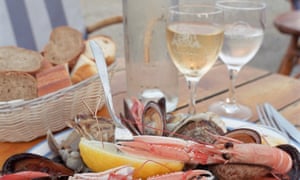
Three classic French whites that go perfectly with seafood 

Domaine Félines-Jourdan Picpoul de Pinet, Languedoc, France 2017 (£8.50, The Wine Society) Picpoul de Pinet is never going to come off well in a comparison with some of the bigger French wine hitters. The dry, unoaked white wine from the western end of the Languedoc isn’t the kind of thing anyone would buy to put in a cellar, or make a flashy fuss of ordering at a restaurant. The gap between the best and the worst examples isn’t especially wide: a friend in the trade likes to say it all comes from one big tank. And yet, all of the above is somehow part of its attraction. It’s there to do a job – match the seafood from the nearby Med and the Thau lagoon – without too much fuss. The picpoul grape variety’s natural acid nip and breeziness combining with lemon, touches of leafy herb and, in the impeccable production from Félines-Jourdan, a swell of stone-fruity richness.

Pierre Luneau-Papin Folle Blanche, Pays Nantais, France 2017 (£9.95, Joseph Barnes)
The affinity with seafood has meant Picpoul de Pinet has inevitably drawn comparisons with the original French fruits de mer favourite made further north around the Loire estuary: Muscadet. For the most part, wines in this area are made from melon de bourgogne, and it is to the whites made from chardonnay in Burgundy’s Chablis that the locals prefer their wines to be compared. Certainly that’s a relevant point of departure with the family domaine Pierre Luneau Papin’s classically steely Domaine de Verger Muscadet Sèvre et Maine Sur Lie 2016 (£12.99, Buon Vino). Curiously, however, the folle blanche takes us back to picpoul, the titular grape variety being a relation of the southern variety, although here making a much sharper but equally oyster-compatible dry white.

Château Lestrille Entre Deux Mers Blanc, Bordeaux, France 2017 (£12.12, Corking Wines)
There’s a touch of the 1970s bistro wine list about muscadet. If you set that retro charm alongside its ability to stand in for chablis when smaller vintages in burgundy have led to shortages in supply, then you can begin to understand why muscadet has become a firm favourite for sommeliers working in some of the country’s trendier restaurants. The same hasn’t quite come to pass for another dry white favourite of yesteryear, Entre-Deux-Mers, although I have begun to see a few merchants giving this Bordeaux region’s brisk spin on the sauvignon blanc-led blend another chance. Château Lestrille’s version is super-clean and cleansing; Château Sainte-Marie Entre Deux Mers 2017 (£10.95, Great Western Wine) has a touch of custard-richness and tropical fruit to go with the zinginess.

Source: Three classic French whites that go perfectly with seafood | Food | The Guardian

New Jersey’s Bobolinks’ Amram, The Little Stinky Cheese That Could, Wins Silver In Lyon

Nina White, a dancer and the co-founder of Bobolink Dairy & Bakehouse in Milford, New Jersey, looked quite chic last June, in her petite robe noire as she waited nervously for the results of the first annual Farm Cheese Awards in Lyon, France. After all, Lyon had been dubbed the world capital of gastronomy back in 1935, and cheese is such an integral part of the French identity that Charles de Gaulle joked in 1962, “How can one govern a country that boasts 258 different cheeses?” [ . . . ]

Source: New Jersey’s Bobolinks’ Amram, The Little Stinky Cheese That Could, Wins Silver In Lyon