Can The French Still Afford To Eat Their Own Food?

Aside from wine sales, the French agricultural sector is struggling to compete with cheaper, more intensively-farmed goods from overseas—are French people finding it difficult to buy French food?

France is incredibly protective of its agricultural sector—it has been the sticking point between France and the U.S. in the negotiation of their new trade agreement, the Transatlantic Trade and Investment Partnership (TTIP).  President Donald Trump has been threatening to increase tariffs on French food as a result of France not agreeing to include the agricultural sector in the trading agreements (France wants only non-auto “industrial goods” included and specifically not meat, fruit or wine).

Part of the problem is that France is resistant to allowing food to be mass-produced or intensively farmed; it wants to preserve the traditional ways of farming, of which it is proud. This means though, that food is much cheaper when it is produced by farmers in other European countries who don’t adhere to as strict agricultural standards as the French.

Christiane Lambert, chairwoman of the French Farmers’ Union reported in The Times, that President Emmanuel Macron’s approach to agriculture was pricing French food out of the market. “He told us to go upmarket but in the first six months of this year we imported a lot more poultry from Poland and Germany because it is cheaper,” she said. It has come to the point when French people cannot afford to buy their own food.

The deficit to the French economy is about €300 million, but many believe it’s a worrying sign and a marker of the health of the agricultural sector in general—even French cheese is suffering as consumers are increasingly turning to cheese from Ireland or the Netherlands (the growth appears to be in more “industrially-produced” cheeses for pizza toppings).

The only part of the food and drinks sector which is buoyant is the alcohol industry, where sales of wine and cognac are still far outselling imports, notably due to a huge increase of sales in the U.S and China of French wine. The French government reported in May that this success might be masking a more dire warning for the French agricultural sector in general.

Source FORBES: Can The French Still Afford To Eat Their Own Food?

How to eat like a French woman

Guilt-free two-hour lunches are standard in the south of France

Alix O’Neill is a freelance journalist and writer, who, after years of on-off scheming, has finally taken the plunge and moved to the South of France. In search of a simpler life, filled with more cheese and less stress, she charts her new chapter in the ‘rose city’ of Toulouse, with husband ‘Mr G’ and baby ‘Tibs’ in tow. You can read all about the highs and lows of settling into French culture here in her brand new column.

At my last antenatal appointment, the gynaecologist’s assistant told me I had a “beautiful uterus”. I’m as in awe of the female reproductive system as the next person, but it’s never occurred to me to compliment another woman on the pulchritude of her internal organs.

Of course, she wasn’t referring to the physical attractiveness of my womb. She was simply confirming that everything was healthy and progressing as it should be. I’m coming to learn that in French, anything has the potential to be beautiful, from an idea to cheese. The pursuit of beauty and its partner pleasure is a serious business here. As Lucy Wadham writes in her 2009 memoir The Secret Life of France, “Traits like rigour, reserve and resilience – qualities which, significantly, are usually attributed to France’s Protestant minority – are begrudgingly admired but never championed.”

Buying groceries becomes a thing of beauty

The French seek out small pleasures on a daily basis. Guilt-free two-hour lunches are standard, while I’ve seen locals enjoy a glass of wine at 10am before opening shop for the day. Even buying groceries can be a thing of beauty, if approached in the correct manner. When we were living in London, discounting weekends pottering around Borough or Broadway markets, most days I reluctantly joined the self-service queue of office workers clutching bags of ravioli and stir-in pasta sauce in my local Tesco. Beyond amusing myself by attempting to guess who would lose it at the next “unexpected item in bagging area”, it was invariably a soulless experience.

In Toulouse, picking up ingredients for dinner each evening is a joy. After coffee and croissants, Tibs and I will head to the market to stock up on fruit and veg, seeing what’s in season before deciding what to eat that day. We’ll head to the fromagerie and boulangerie, Tibs going native by demanding to tuck into warm baguette on the way home. (For non-perishable purchases, it’s Lidl. Even the French can’t make toilet paper sexy.)

The joys of simple cooking

In France, food and cooking is one of the greatest pleasures in life, and played a not inconsiderable part in our decision to move. Mr G is an excellent cook and I’ve always been a gourmand (not a gourmet. An important distinction. The latter knows a lot about food; the former is essentially a human waste disposal unit). Zola once said, “When there’s nothing good to eat for dinner, I’m unhappy – really unhappy. That’s all there is; nothing else exists for me.” I can relate. My friend Jude and I had a bad lunch on our sixth-form girls’ trip to Magaluf. I’m not sure what we were expecting from this well-known culinary hotspot, but the disappointment plagues us to this day. [ . . . ]

Continue at YAHOO: How to eat like a French woman

The 15 Hottest New Restaurants in Paris

Today, Eater returns to Paris to check in on the newest and buzziest dining destinations in France’s restaurant-rich capital. Once again, longtime resident and food writer Alexander Lobrano selects his picks for the unmissable openings of the past 12 months.

“This year’s most eagerly anticipated new restaurant in Paris hasn’t opened yet — Maison by Sota Atsumi, who won rave reviews for his exquisitely creative contemporary French cooking while chef at Clown Bar,” says Lobrano. “But the dining scene here is still sizzling.” He adds that Paris has never been more gastronomically cosmopolitan than it is right this minute, with menus spotlighting cuisines from around the world (Double Dragon, Ibrik Kitchen, Piero TT) like never before, while also placing renewed focus on the cooking of France’s own diverse regions, from Nice to Gascony and beyond (Baieta, Marsan).

For Paris’s essential stalwarts, head to the Paris 38, and for an even more comprehensive look at the City of Light, check out Eater’s Guide to Paris. But here now, the Eater Heatmap to Paris.

Continue at EATER: The 15 Hottest New Restaurants in Paris

Trump could target French wine with tariffs

That bottle of French wine may be getting more expensive. 

That bottle of French wine may be getting more expensive.

President Trump said Monday that he plans to “do something” about the European Union tariffs imposed on American wine, saying the U.S. pays too much to export wine to France while the U.S. imposed low tariffs to import French wine.

“France charges us a lot for the wine. And yet we charge them very little for French wine,” the president told CNBC.com, adding that California winemakers have complained to him about the EU tariffs.

“So the wineries come to me and say…’Sir, we’re paying a lot of money to put our product into France, and you’re letting’ — meaning, this country is allowing — ‘these French wines, which are great wines, but we have great wines too — allowing it to come in for nothing. It’s not fair,”’ Trump said.

Source: Trump could target French wine with tariffs

Marais and Beaubourg area guide

Galleries and good times in the heart of Gay Paree

For the last two decades the Marais (sandwiched between St-Paul and République) has been one of the hippest parts of the city, packed with modish hotels, vintage boutiques, restaurants and bars – in no small part due to its popularity with the gay crowd (this is the only part of Paris where the blokes get winked at more than the ladies). But it’s also prime territory for art lovers, with a vast concentration of art galleries (both small and important) and museums, more often than not set in aristocratic 18th-century mansions spared by Haussmann. Two of the most sumptuous hôtels particuliers, Hôtel Guénégaud and Hôtel Carnavalet, contain (respectively) the wonderful Musée de la Chasse et de la Nature (hunting museum) and fascinating Musée Carnavalet, which retraces Paris’s history. The Marais has also long been the focus of the Jewish community: amble along rue des Rosiers, rue des Ecouffes and rue Pavée (where there’s a synagogue designed by Guimard, the brain behind Paris’s iconic Métro stations) and the air fills with the scent of falafels and sizzling shawarmas, sold in their hundreds from stalwarts Chez Hanna and L’As du Fallafel.

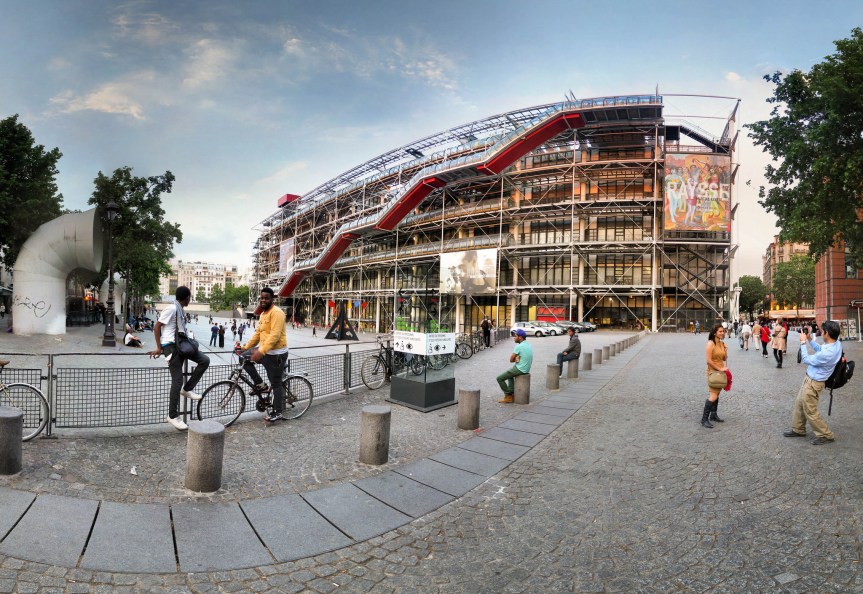
The Marais’s western neighbour is Beaubourg, whose focal point is the Centre Pompidou modern art museum, a benchmark of inside-out high-tech design signed Richard Rogers and Renzo Piano. This is also where you’ll find the Atelier Brancusi, the sculptor’s former workshop left to the state, and moved here from the 15th. Wander north of here for two of Paris’s lesser-known gems: The first, the Gaïté Lyrique (set in Offenbach’s former theatre) is a temple to digital arts, with streams of digital installations and live electro concerts; the second is the Musée des Arts et Métiers – a fabulous science museum with early flying machines displayed in a 12th-century chapel.

Source: Marais and Beaubourg area guide – Time Out Paris