The Vatican released the document, entitled “I have loved you,” which Francis had begun to write in his final months but never finished. Leo credited Francis with the text, cited him repeatedly, but said he had made the document his own.
Pope Leo XIV criticized how the wealthy live in a “bubble of comfort and luxury” while poor people suffer on the margins, confirming in his first teaching document that he is in perfect lockstep with his predecessor Pope Francis on matters of social and economic injustice.
The Vatican on Thursday released the document, entitled “I have loved you,” which Francis had begun to write in his final months but never finished. Leo, who was elected in May, credited Francis with the text, cited him repeatedly, but said he had made the document his own and signed it. [ . . . ]
For a long time, a sector of the Church directed and financed from the US attempted to depose the Vatican leader in order to impose its own identity-based ideology
By Daniel Verdu
On the morning of August 26, 2018, while the Pope was visiting Ireland with the usual entourage of journalists and Vatican staff, the bomb dropped. Archbishop Carlo Maria Viganò, a former Vatican envoy in Washington between 2011 and 2016 and a heavyweight within the Curia, accused the Pontiff in an 11-page letter of having covered up the abuses of Cardinal Theodore McCarrick, and demanded his resignation. The violent tone of that letter and the accusations it contained were the culmination of a campaign that had begun a few years earlier within the Holy See to overthrow a Pope they considered too progressive, a heretic even. The attempted schism was directed and financed from the United States, where Donald Trump was spending his first term in the White House and in search of a cultural and ideological narrative capable of flourishing on the Judeo-Christian roots of the Western world. And the Vatican, from that perspective, could not be governed by a Pope who was an environmentalist, tolerant of homosexuality, an anti-capitalist, and, above all, extremely belligerent toward the anti-immigration policies that characterized Trump’s first presidency.
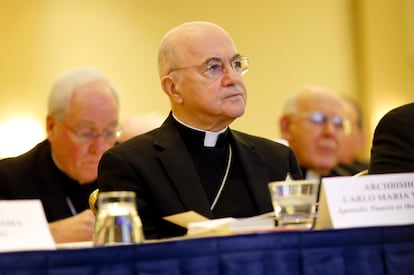
In this 2015 file photo, Archbishop Carlo Maria Viganó, Apostolic Nuncio to the U.S., listens to remarks at the U.S. Conference of Catholic Bishops’ annual fall meeting in Baltimore.Patrick Semansky (AP)
There have always been tensions and internal struggles in the history of the Roman Catholic Church. Unity and avoiding schism were an obsession. But never in contemporary history had a Pope been so violently targeted. And, above all, it was completely unusual for the Pontiff’s enemies to come from the traditionalist sector, supposedly the keeper of the essence of Catholicism. Until then, such battles had been fought only by far-right groups like the Society of St. Pius X, founded by the rebel French archbishop Marcel Lefebvre, who was excommunicated in 1988 after ordaining four priests without Rome’s permission.
The symptoms had been clear for some time. Steve Bannon, Donald Trump’s chief advisor before his fall from grace, a sort of Elon Musk avant la lettre, settled into the penthouse of the Hotel De Russie on the luxurious Via del Babuino. From there, he began receiving Italian and European leaders who viewed the Pope unfavorably: from Matteo Salvini to Trump himself. Bannon attempted to open a sort of school of populism on the outskirts of Rome, increasing the pressure through sympathetic media. The American Cardinal Raymond Burke became the political arm of this new movement within the Vatican, and together with other cardinals such as the excellent theologian Gerhard Müller, they began to hatch a plan to expose Francis’s alleged lack of intellectual preparation.
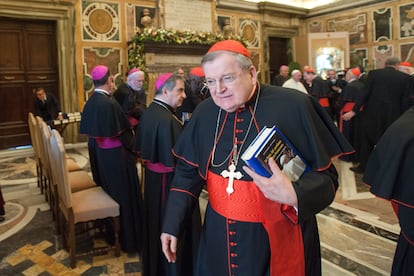
Former archbishop of St. Louis Cardinal Raymond Burke leaves the Clementina Hall during the Christmas greetings of the Roman Curia to Pope Francis on December 21, 2017 in the Vatican.Vatican Pool (Getty Images)
“It began early, in the summer of 2013, when it was already clear that many U.S. bishops didn’t recognize him as one of their own,” notes Massimo Faggioli, a professor in the department of theology and religious sciences at Villanova University in Philadelphia. “American conservatives thought that after John Paul II and Benedict XVI, their destiny was forever marked by neoconservatism. And the Pope didn’t allow it. That was his sin,” he adds.
In the United States, there are approximately 72.3 million baptized people, almost a quarter of the population. But the influence of Catholics has grown in recent years. A third of the members of Congress practice that faith, according to a study by the Pew Research Center. Vocations to one of the richest churches in the world have fallen more than anywhere else, and pedophilia scandals, with the now-famous Boston case, wreaked havoc. However, the obsession with the Vatican of the new White House occupants and neoconservative power circles has continued to grow.
One of the impressions that always haunted Bergoglio was that Benedict XVI’s resignation in 2013, despite having been a gesture of generosity and humility, had opened a rift in the Church that the conservative sector seized upon to wage its struggle. The fiction that was established was that if there were two men dressed in white strolling through the Vatican gardens, why not close ranks around the more conservative one? Ratzinger, an excellent theologian, though not skilled in personal relationships, never accepted that role. But some oversights and the influence of his personal secretary, Georg Gänswein, who was at odds with Francis, caused some slip-ups.
The height of tension came five years ago with the publication of a book that the Pope Emeritus was supposedly co-authoring with the ultra-conservative Cardinal Robert Sarah, in which he strongly opposed optional celibacy and, above all, the ordination of married men (From the Depths of Our Hearts). This was an issue on which Francis was due to address the synod on the Amazon, and which turned the publication into an act of interference.
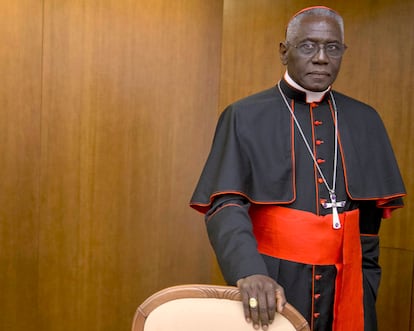
Cardinal Robert Sarah in Rome on October 14, 2015.Andrew Medichini (AP)
Francis kept up the fight to the bitter end. On February 10, in fact, he sent a letter to the U.S. bishops (195 dioceses) denouncing the Trump administration’s program of mass deportations. The letter infuriated Tom Homan, known as the border czar. “He has a wall around the Vatican, does he not? I wish he’d stick to the Catholic Church and fix that and leave border enforcement to us,” he replied. “He never let himself be intimidated. He responded all those years with appointments, trips, documents. And the things he didn’t do, like the appointment of female priests, it was because he didn’t believe in it,” Faggioli argues.
The Joe Biden administration provided temporary relief, but the American Church itself was already deeply divided. “These are cultural and social universes that have grown in a different way. It’s a Catholicism that is more based on identity. That’s why we now find ourselves at a critical point with this conclave. There is a neoconservative movement that began in the 1980s. And the Vice President of the United States, J. D. Vance, is one of its exponents. They have a long-term strategy to return to a certain traditionalism that will not end with the conclave, no matter what.” In an ironic twist of fate, perhaps his way of dealing with this struggle, Francis dedicated part of his last day on this Earth to receiving Vance at the Vatican.
I can no longer in good conscience call Jean Vanier a saint, but I cannot accept the disturbing truth about him as proof, as some have understood it, that sanctity does not exist.
By Colleen Dulle
I keep a photo of Jean Vanier on my desk. It is painful to look at today.
I’ve written almost completely uncritically about the founder of L’Arche several times at America: I called him a “revered spiritual master and prophetic voice” whose messages “always bear repeating” in a review of his last book; I wrote America’s obituary of Vanier; I teared up on camera while talking with Tina Bovermann of L’Arche USA about Vanier’s life.
Now, L’Arche has released an internal report detailing credible allegations of sexual abuse against Vanier by six non-disabled women. The report says that Vanier initiated sex in the context of spiritual direction and offered “highly unusual spiritual or mystical explanations used to justify these behaviors.” This kind of behavior echoes the sexual abuse perpetrated by Vanier’s spiritual mentor, Father Thomas Philippe. The new L’Arche report also shows that Vanier lied about how much he had known about accusations against Father Philippe.
Ms. Bovermann, the L’Arche spokeswoman I interviewed just after Vanier’s death, spoke to my colleague Michael J. O’Loughlin about the abuse allegations against Vanier: “I can’t wrap my head around it,” she said.
Nor can I.
I don’t mean that I disbelieve the women who brought these accusations forward. The public excerpts of their testimonies were harrowing, and I trust the thoroughness of the third-party investigation. What I mean is that it is difficult for me to reconcile Vanier’s abuse with my long-held image of him as a saint.
I was introduced to Jean Vanier’s thought as a senior in college, when I was stressed about my impending graduation to “the real world.” Would I make enough money? Would I move up quickly in my career? Would people think well of me?
One night, I sat with my friend Katie, who had recently returned from a year at a L’Arche community in Ireland. In response to my anxieties, she asked if I’d ever heard of Jean Vanier. She explained to me his idea that, while society tells us we will only find happiness by climbing the ladder of wealth and prestige, true Christian happiness comes from climbing down the ladder, choosing to give up power and money in order to live in community and solidarity with the poor and outcast.
The idea was a revelation. I chewed over it for hours in my prayer and writing and tried to apply it, however poorly, in my decision-making. I deeply wanted the true happiness Vanier pointed to. I read his books and listened to his interviews slowly and meditatively and urged others to do the same. After he died, I hung a photo of him on my desk. Like many, I believed he was a saint.
Part of me wonders now if I was foolish, if I should have known better than to valorize any Catholic this way after watching Theodore McCarrick’s precipitous fall from grace in 2018 or even watching St. John Paul II’s record on sexual abuse be called into serious question after hearing the crowds chant “Santo Subito” in 2005. If such widely respected men could commit decades of abuse or turn a blind eye to allegations, why should I have believed Jean Vanier could not do the same?
I think of the women who had to endure the trauma of hearing a man who had sexually manipulated them be called a “living saint” when he was alive and as the world eulogized him. Although none of the women’s allegations were public until this morning, perhaps if those of us praising him had thought more critically about Vanier’s relationship with Father Philippe, we would at least have been more hesitant to canonize Vanier in our popular imagination.
This kind of critical thinking will be vital as those of us who admired Vanier struggle to reconcile the good he did with the abuse he perpetrated. It is difficult, but possible and necessary, to hold the truth of both Vanier’s good and evil at the same time. Holding these facts in tension both invites, as the leaders of L’Arche International wrote, “mourn[ing] a certain image we may have had of Jean” and raises important concerns about who holds power in the church, the ways that power can corrupt those who hold it and the disturbing links between spiritual and sexual abuse in so many similar cases in the church. L’Arche, especially, faces a long road ahead of reimagining its past and protecting against future abuses.
Mourning and grappling with the upsetting paradox of Jean Vanier has made me angry, but I am trying to resist letting it drive me to despair. I can no longer in good conscience call Jean Vanier a saint, nor will I hypothesize about any conversion he may have had before or after his death, but I cannot accept the disturbing truth about him as proof, as some have understood it, that sanctity does not exist. Rather, I think it challenges us to consider our own and others’ simultaneous capacity for profound goodness and evil, to seek models of holiness away from the world’s spotlight and to pursue holiness ourselves far from the spotlight, at the bottom of the ladder.
History will remember Pope John Paul II as the person who brought back the Inquisition and who handpicked Cardinal Ratzinger to be its chief Inquisitor as head of the Congregation of the Doctrine of Faith, CDF, formerly known as the Office of the Sacred Inquisition.
The name was changed after the Second Vatican Council under Pope Paul VI. Though the Council had called for freedom of expression and opinions among theologians, all that came to an abrupt halt under JPII and Benedict XVI who as head of CDF and then as Pope Benedict XVI, managed to silence, suppress or expel 107 theologians from countries all around the world, myself included.
I list the names of these persons in my book on Ratzinger, The Pope’s War: Why Ratzinger’s Secret Crusade Has Imperiled the Church and How It Can Be Saved.
As I know from my experience with him, Cardinal Ratzinger was a bully of the first order. His brother, who was a priest in Germany, admitted to physically abusing boys in his choir though denied he was part of the sexual abuse of the boys that also occurred in that same choir.
NBC News’ Joshua Johnson and Boston Globe former Spotlight editor Walter Robinson discuss Benedict’s admission of presence at a 1980 meeting on priestly pedophilia.
Yale psychology professor Young Shin Kim, an expert on bullying, says 85% of bullying cases happen for the benefit of an audience. That is clearly a big part of the raison d’etre for Benedict’s actions against Leonardo Boff in Brazil, Eugene Drewermann in Germany and myself in North America. This same psychologist observes that “bullying is often used to maintain the social pecking order” and there was plenty of that going on in JP II and Benedict’s Vatican.
Criminologist William Black tells us that Bullies play a well known game. Their strategy is to intimidate…They must be confronted….Bullies are cowards…Giving in to bullies guarantees that they will act ever more abusively…An adult who repeatedly gives in to a bully is a coward.
Matthew Fox’s archival records, packed up to go to the University of Colorado. Photo by Matthew Fox.
When it comes to Ratzinger and myself, a big synchronicity occurred for me last Friday. On the exact day that Cardinal Ratzinger died, I finished a major task of sorting my papers and loaded them up in a U Haul for shipping to the University of Colorado in Boulder, where they will be digitized and made available for future generations to study.
A relative of mine who is a practicing Catholic pointed out the special synchronicity of that day because a chunk of my papers (two boxes of 36) holds correspondence twixt Rome, my provincial and myself. Also, thousands of letters of support written to the Vatican or to Dominican headquarters by Catholics and people of other and no faith traditions supporting my work.
That that journey happened on the same day that Pope Benedict’s soul took its journey is, well, surprisingly synchronistic.
Immaculate Conception Sister Marie-Paul Ross told the French-language Canadian news agency Presence info that the faithful must accept that ecclesial structures might need to change.
QUEBEC CITY (CNS) — A Canadian nun with a Ph.D. in clinical sexology said the sex abuse crisis in the church does not mean “the end of faith” but rather “the end of a lack of formation and the end of deviance,” and a call to return to Jesus’ message of love.
Immaculate Conception Sister Marie-Paul Ross told the French-language Canadian news agency Presence info that the faithful must accept that ecclesial structures might need to change.
The conviction of the archbishop of Lyon for covering up paedophilia in his diocese is a victory for victim and campaigner Francois Devaux, whose dogged efforts to publicise the abuse have made him a hero — and a reluctant cinema star. Archbishop Philippe Barbarin, 68, the most senior French cleric caught up in an abuse […]






 Pas De Merde