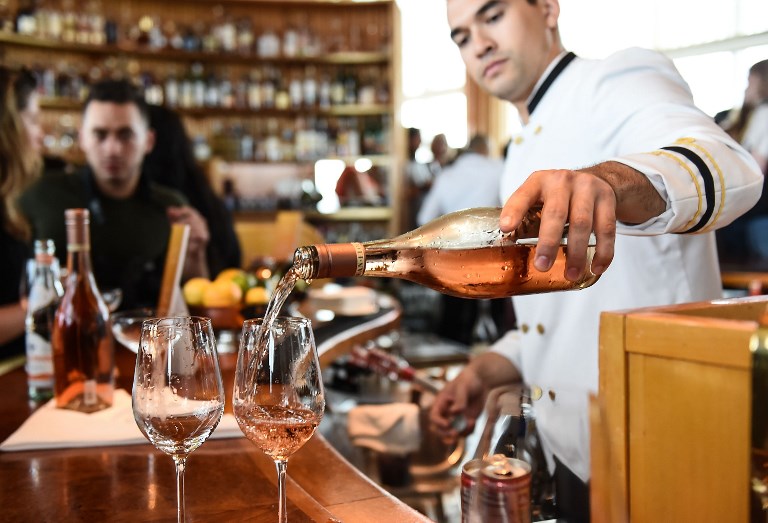
Exports of rosé wine from Provence have shot up and it’s largely because Americans have a growing thirst for the pink drink. But why is that?
THE LOCAL
The popularity of the drink which was mocked just 20 years ago has reached new heights abroad.
And that’s particularly true in the US, with the country accounting for a whopping 50 percent of exports of the Provencal rosé wine last year.
“The phenomenon of the internationalization of rosé wines from Provence is accelerating,” said Brice Eymard, leader of France’s Provence Wine Council (CIVP) during a press conference in Paris on Thursday.
“Until 2010-2011, we exported very little, France was the main producer and consumer, but we now see the share of exports sharply accelerating,” [ . . . }
Sure, it occasionally leaves us horizontal, but it’s a proud part of our identity, says freelance journalist Marie Le Conte
If you want to become – or remain – the president of France, you have to touch a cow.
François Hollande touched a cow; Nicolas Sarkozy touched a cow; Jacques Chirac touched more cows than anyone can remember; and every party leader or Elysée hopeful has had to touch a cow at one point or other. It cannot be any cow: the ceremonial patting must occur at the Paris International Agricultural Show, an annual event that does exactly what it says on the tin, and is attended by every French politician worth their salt.
The fair often becomes the scene of minor gaffes as senior politicos trip over themselves to show just how provincial and normal they are, with predictable results – a particularly amusing example in 2015 involved the then prime minister,Manuel Valls, getting thoroughly sloshed.
“From the liver’s point of view, wine really is alcohol!” was the title of the letter, which pointed out that nearly 60% of all alcohol consumed in France is in wine, and that alcohol kills around 50,000 people a year in the country.
Emmanuel Macron didn’t appear drunk at the agriculture show last week, but alcohol did end up causing him a headache. Speaking to journalists from the regional press, the president admitted to drinking wine every day “with lunch and dinner”, and being a staunch believer in his predecessor Georges Pompidou’s saying: “Don’t piss off the French.”
“It is a danger to public health when young people binge-drink spirits or beer,” he added, “but wine isn’t the issue.” He then confirmed that his administration had no ambitions to make the Loi Évin, a law passed in 1991 putting restrictions on alcohol and tobacco, any stricter than it already is.
This clearly didn’t go far enough for Christophe Castaner, the secretary of state for parliamentary relations, who took it upon himself to add in a TV interview: “Let’s not get carried away – there’s alcohol in wine, but it’s not strong alcohol. Wine is a part of our culture, our tradition, our national identity. It’s not our enemy.”
Shockingly, this didn’t please everyone. In an open letter published by the newspaper Le Figaro on Monday, nine health professionals politely but firmly reminded the head of state and his minister that wine is – believe it or not – an alcoholic beverage like any other.
“From the liver’s point of view, wine really is alcohol!” was the title of the letter, which pointed out that nearly 60% of all alcohol consumed in France is in wine, and that alcohol kills around 50,000 people a year in the country.
That this needed to be said is quite remarkable, but perhaps unsurprising; behind that glass of red sipped at a family dinner lies an interesting quirk of the French, and how we like to see ourselves.
You see, French people are civilised. They care about the food they eat and the bottles they carefully pick to go with it. They look down on anyone unsophisticated enough to suggest that their habits might not be as refined as they think.
Sure, they might occasionally drink more wine than the food can soak up and find themselves horizontal, but they don’t get drunk like the British do. Over the Channel lies a an island of feral binge drinkers who do shots and throw up on themselves and pass out in public. Isn’t it ghastly? Like retired people showing their slides after a holiday, French expats in the UK and holidaymakers who have been there catalogue instances of the British binge culture –it’s almost a national sport.
Of course, data collected by the World Health Organisation in 2015 shows that French people drink nearly as much as their British counterparts – 11.6 litres of pure alcohol per capita compared with 12 – but this doesn’t matter.
Every country has their very own national delusions – Brexit certainly counts as one – and France is no exception.
In a way, Macron embodies a lot of ours. He arrogantly charmed his way into the presidency, frequently pontificates about philosophy, unashamedly talks about his love of classical novels and poetry, and is passionate to the point of absurdity about the French language.
France isn’t, in reality, the France we know from the movies, and everyone knows it deep down. But it doesn’t hurt to pretend once in a while. However, deciding that wine simply isn’t a normal alcoholic beverage because it happens to be quintessentially Gallic is not harmless, and though the current crop of politicians are knee-deep in patriotic cliches, future generations might finally decide to put health before tradition.
They just need to make sure they touch a cow first, if they want anyone to pay attention.
Nine French doctors have rounded on President Emmanuel Macron and accused him of “endangering the health of the French people” with his recent positive comments about wine and failure to address the belief that wine is less dangerous than other alcoholic drinks.
This incredible greenspace would cover approximately 5.2 square miles and offer various outdoor pursuits for locals and tourists.
:: SIMPLEMOST :: The capital of France is famous for its many iconic landmarks, such as the Eiffel Tower, the Louvre Museum and Arc de Triomphe, just to name a few. However, if eco-conscious French politicians get their way, we may soon associate Paris with a suburban forest that is five times the size of New York City’s Central Park.
The creation of a roughly 5.2-square mile green area north of Paris in the suburb of Pierrelaye-Bessancourt would not only be a fabulous green space for outdoor activities but it is also meant to combat air pollution. Trees remove carbon dioxide (CO2) from the atmosphere and release oxygen back out, thus improving air quality, according to the Urban Forestry Network.
Why The French Government Wants To Build A Forest
The city’s air pollution levels have reached a dangerous high, and the air quality is so poor that the City of Lights change its nickname to the “City of Smog.” In 2017, a Parisian yoga teacher even sued the Continue reading “Paris Wants To Create Its Own Central Park”→
Throughout the Cesar Awards ceremony Friday night, presenters and winners referenced the movement that has campaigned for an end to abuses by powerful men.
And the packed concert hall stood in ovation as the presenter called on everyone to support the #MaintenantOnAgit (Now We Act) campaign launched this week, aimed at raising money to help women pursue legal complaints against abusers.
Anger over sexual violence and demands for gender equality in the cinema industry charged the atmosphere around this year’s Cesars – much like around the Oscars coming up Sunday in Hollywood.
Instead of wearing black – as actors in the U.S. and Britain have done at recent awards shows – French stars chose to wear a white ribbon to make their statement.
So did special guests like Penelope Cruz, given a special award for her career’s work.
“The entire world is talking about this, it’s not only a problem of our industry, but of all industries and of any woman who does not have the opportunity to have a microphone in front of her as I have myself,” she told reporters.
The most Cesar awards went to the AIDS drama “120 Beats Per Minute,” which took six prizes, including best film. Directed by Robin Campillo, the movie centers on the activist group ACT UP in Paris in the 1990s at the height of the AIDS crisis.
Producer Marie-Ange Luciani hailed the social change since that era, including growing acceptance of gay marriage. She also had a message for those disconcerted by the turmoil prompted by the #MeToo movement that started in Hollywood with sexual abuse accusations against producer Harvey Weinstein.
“Don’t be afraid of what will happen. This moment is not a threat. It is a promise. And history will show we are right,” she said.
France’s entertainment industry has seen divisions over the #MeToo movement, with Catherine Deneuve notably saying it had gone too far.
No one at the Cesars publicly said anything similar.
The ceremony’s president, Vanessa Paradis – singer and actress and Johnny Depp’s ex-wife – set the tone by opening the show saying: “I am wearing this white ribbon for the fight against violence against women.”
More than 100 personalities, including actress Sandrine Bonnaire, director Agnes Jaoui and actor-director Julie Gayet, asked for donations destined for associations helping women pursue cases before justice, “so that no woman ever again has to say #MeToo.”
French film stars including Juliet Binoche called in a proposal in newspaper Le Monde on Friday for quotas to guarantee that more government film subsidies go to movies directed by women.
The ceremony was dedicated to Jeanne Moreau, the smoky-voiced femme fatale of the French New Wave who died last year, known for her distinctive blend of sensuality, intellect and resolve.
Best actress winner Jeanne Balibar praised actresses for supporting each other amid discrimination, injustice and abuses. “Despite our differences and our competition, we hold on.”
In addition to a white ribbon, actorBlanche Gardin wore a pin with the picture of comedian Louis C.K., accused of sexual harassment, and earned laughter with a sarcastic plea:
“Producers no longer have the right to rape actresses . But do we still have the right to sleep with them to get roles?” she asked. “Because if we don’t, then we have to learn our lines, pass auditions, and we don’t have the time. You realize how much time that takes?”