
Are Parisians rude to Americans?
— Pas De Merde (@Mike_Stevenson1) April 10, 2018
5 wines to help you ring in spring
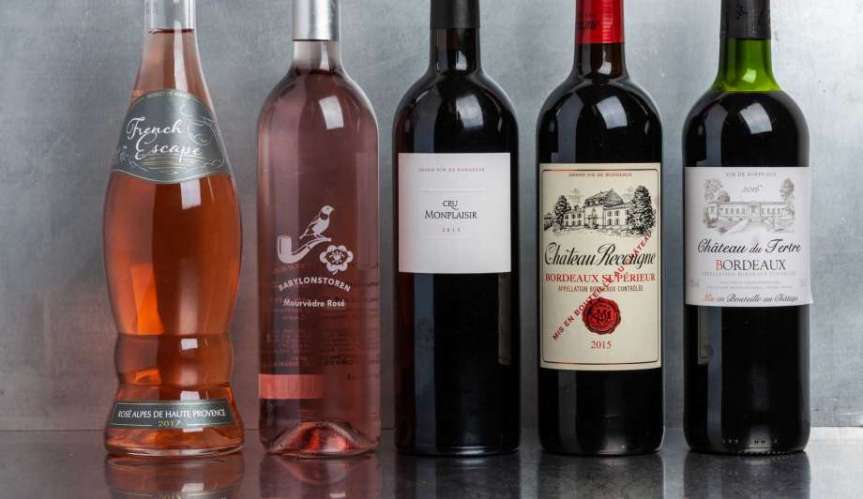 Here are three more examples of outstanding inexpensive Bordeaux from the 2015 and 2016 vintages. And since the weather is finally changing, it’s time to stock up on rosés for the summer.
Chateau Recougne Bordeaux ;Superieur 2015/ Bordeaux, France, $16
This wine is an overachiever. It hails from near the small city of Libourne, adjacent to the appellation of Fronsac, but it tastes as though its sights are set a little farther east in Saint-Emilion. It’s merlot at its best – big and warm, like the feeling of satisfaction you get from a trickle of sweat down your back after a long day and a job well done. Alcohol by volume: 14 percent.Cru Monplaisir Bordeaux Superieur 20152. [ . . . ]
Read more about these great values: 5 wines to help you ring in spring – SFGate
Chanson Du Jour “Le Festine”
Isabelle Huppert Says Michael Cimino “Never Got Over” ‘Heaven’s Gate’

“I loved him,” says the star of ‘Elle’ and ‘Things to Come.’
French superstar Isabelle Huppert — one of the leads of 1980’s legendary disaster Heaven’s Gate — says she stayed in touch with its director, Michael Cimino, and saw him “a few months before he died [in July]. In Paris.”
The actress — who has drawn acclaim for her role in Elle as a successful businesswoman who is raped by a mystery man, and whose new film, Things to Come, […] — added: “I loved him, of course. He was extraordinary, probably one of the greatest living American filmmakers.”
But, Huppert said, she believed the turmoil surrounding his picture, which went massively over budget and almost destroyed United Artists, had a terrible effect on him: “Basically he never really, deep inside, he never really got over it. But it was completely inspired. I went there for two months, and then we ended up being there, in Montana, for seven months.”
Huppert last saw the picture in Lyon, France, where it was screened at a film festival. “Michael remastered the print, with new colors,” she said. “It was a bit weird for me, I have to say, because the colors were very different. You know, the colors of the original film were very [muted].”
The actress added: “It was Vilmos Zsigmond, the great cameraman who passed away, too, recently. And Michael and Vilmos didn’t get along so well. After the movie, Michael always thought that it was not the color he wanted. It was a bit sepia-like. And then Michael was very happy with the new [version]. When I first saw it, the green was so green, and the red was so red. It was very, very different from what I saw in the first place. But he was happy that he did it. I think he was happy, because also he was completely immersed in the film again by doing this, because it took him many weeks to do that version.”
Since making Heaven’s Gate early in her career, Huppert, 63, has appeared in some 90 movies (even she is not quite sure of the exact number), including the Cannes release Elle, directed by Paul Verhoeven, and Things to Come, in which she plays a philosophy professor whose husband leaves her for another woman.
Speaking at Loyola Marymount University’s School of Film and TV earlier this month, while taking part in the ongoing interview series The Hollywood Masters, Huppert said she was not concerned about fallout from Elle‘s mix of comedy and drama — though she argued that it was a complete misnomer to refer to it as a “rape comedy,” as some have done.
“I think personally, the ‘rape comedy’ is absolutely irrelevant, because it can’t be a ‘rape comedy,’ you know?” she said. “To me there is an integrity to the film. It’s not [a comedy simply] because there’s this huge sense of irony; irony doesn’t mean that a film is comic. It’s two different topics. People get the film in its integrity, in its complexity, in its disturbance. I’m not denying how much Verhoeven is on the razor’s edge. And certain people won’t get the movie. But that’s the risk.”
[11/25/2016 by Source: Isabelle Huppert Says Michael Cimino “Never Got Over” ‘Heaven’s Gate’ | Hollywood Reporter
The spirit of 1968 rises again: can French students and workers triumph?
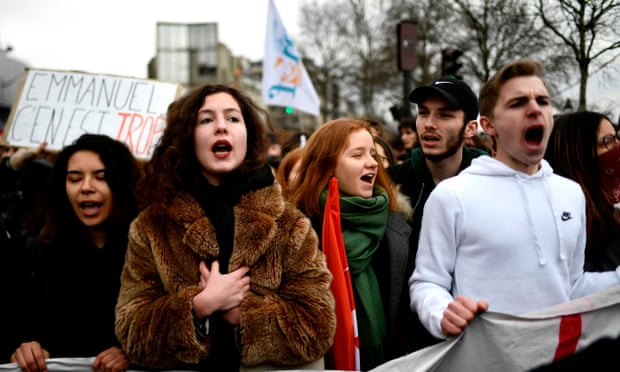
President Macron faces his biggest challenge as strikes and protests recall the epic struggle that rocked France to its core. We can win, insist this generation…
At Nanterre university, on the outskirts of Paris, militant students have a dilemma: how can they pass their end-of-year exams while simultaneously fighting to derail the French government’s education reforms?
“It’s a worry, but we’ll find a way,” says Annaël Lombe, a student union leader who is taking his political science finals in a few weeks. “Exams or not, we won’t stop the protest. We will carry on the action.”
Fifty years ago, Nanterre students issued much the same warning. It turned out to be far from an idle threat. Subsequent protests at Nanterre sparked the May 1968 civil unrest that drew 10 million students and striking workers on to the streets and brought France to a halt. It was a dramatic – some thought revolutionary –moment in French history that nearly toppled a government.
In the end, the protests fizzled out, but even now the events remain a model of how people power can rattle French political leaders and in doing so change society.[ . . . ]
READ FULL STORY at: THE GUARDIAN The spirit of 1968 rises again: can French students and workers triumph? | World news | The Guardian
Hold Tight, Jacques Higelin
Rest in peace, Jacques.

