In 1931, the miners and the mine owners in southeastern Kentucky were locked in a bitter and violent struggle called the Harlan County War. In an attempt to intimidate the family of union leader Sam Reece, Sheriff J. H. Blair and his men, hired by the mining company, illegally entered their home in search of Reece. Reece had been warned in advance and escaped but his wife, Florence, and their children were terrorized. That night, after the men had gone, Florence wrote the lyrics to “Which Side Are You On?” on a calendar that hung in their kitchen. She took the melody from a traditional Baptist hymn, “Lay the Lily Low”, or the traditional ballad “Jack Munro”
Reece supported a second wave of miner strikes circa 1973, as recounted in the documentary Harlan County USA. She and others performed “Which Side Are You On?” a number of times throughout. Reece recorded the song later in life, and it can be heard on the album Coal Mining Women.
The elite world of French cinema, one of the pillars of the country’s exception culturelle, was bitterly divided after Roman Polanski was named best director at France’s equivalent of the Oscars.Several actresses walked out on Friday night as the César was awarded to the Franco-Polish director who is still wanted in the United States after he admitted the statutory rape of a 13-year-old girl.The award was viewed as provocative and a slap in the face for sexual abuse victims and #MeToo campaigners who have struggled to gain recognition in France. Outside the ceremony, feminists clashed with police. Polanski, 86, had stayed away, saying he feared a “feminist lynching”.On Saturday, Ursula Le Menn, an activist with Osez le Féminisme (“Dare to be feminist”), the group that organised the protest outside the ceremony, said the award showed that nothing had changed in the world of French cinema. “The empathy shown is a facade …. There is no real change of mentality,” she said.
Polanski’s film, J’Accuse (An Officer and a Spy), about the Dreyfus affair, was nominated for 12 Césars, and won two others – for best adaptation and best costume design. But it was the decision to name him best director that caused the most outrage.
“Polanski has presented himself like Dreyfus, a victim, and used his film for his own defence. For women who have had the courage to speak out about the abuse they suffered, there is an enormous pain seeing this man distinguished,” said Le Menn.
“We ask women to come forward and speak out and they see not only are there no consequences for their aggressors, but those same aggressors are honoured in this way.”
Actress Adèle Haenel, who last year revealed she had been sexually abused as a child by another director, shouted “Shame!” as she left the awards. Others followed, including the director Céline Sciamma. The ceremony’s host, Florence Foresti, also failed to return to close the event. On her Twitter account Foresti said she was “disgusted”.
Alexis Poulin, a French journalist and co-founder of an online media site, said many in France felt the same way. “A lot of people in France are disgusted this morning. What happened yesterday was wrong and I have been saying this for ever. I think it’s unfair Polanski is given all these honours,” he said.
“Giving Polanski a prize was quite a statement. The film is something a lot of people work on, not just him. Giving him the prize protects him – it says you cannot reach him and the French cinema elite will stick together: it’s like a cinema mob and he’s the godfather.
“It says to the victims, ‘we don’t want to hear you, you are nothing, we don’t trust you’,” Poulin added.
J’Accuse recounts the persecution of the French Jewish army officer Alfred Dreyfus in the 1890s, convicted of trumped-up charges of treason. In an interview to promote the film, Polanski admitted he saw himself like Dreyfus: “I am familiar with many of the workings of the apparatus of persecution shown in the film… I can see the same determination to deny the facts and condemn me for things I have not done. Most of the people who harass me do not know me and know nothing about the case.”
Poulin said the award had revealed a deep problem in French society. “Polanski fled and found refuge in France. In France, we accept rapists on the run because they’re artists. It’s a problem of French society.”
Polanski admitted the statutory rape of 13-year-old Samantha Gailey in 1977 after more serious charges were dropped in a plea bargain. While awaiting sentencing, he fled the US. France has refused to extradite him.
Since then, a number of other sexual abuse allegations have been made against the director, who became famous with his film Rosemary’s Baby. The most recent was last November when a French photographer, Valentine Monnier, accused Polanski of raping her in 1975, when she was 18, at his chalet in Gstaad, Switzerland. Polanski has denied all the allegations.
He received backing on Saturday from the philosopher Bernard-Henri Lévy, who tweeted: “That the #Cesars waited until #Polanski was absent and could not respond, to mock him, humiliate him, overplay disgust and go so far as to refuse to pronounce his name, that says a lot about where the real “Miserables” were last night.”
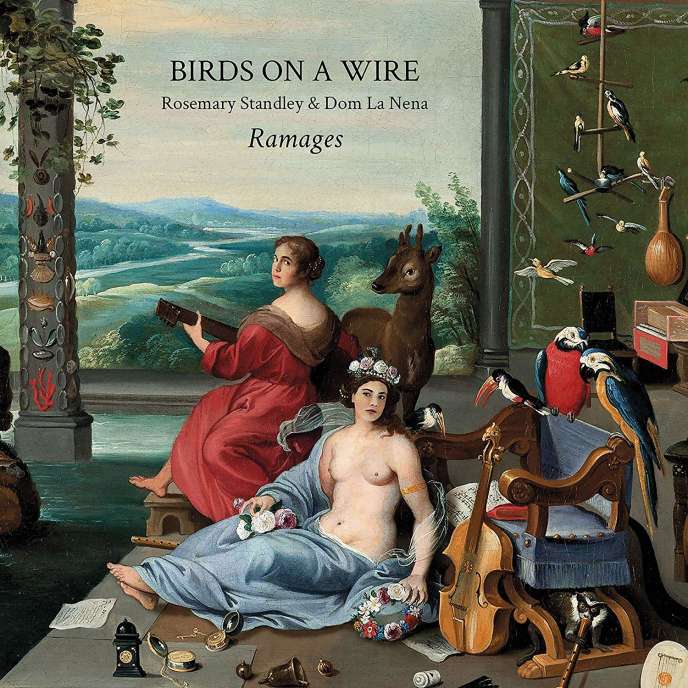
La chanteuse franco-américaine Rosemary Standley et la chanteuse-violoncelliste brésilienne Dom La Nena partent en tournée à travers la France. Elles étaient en concert à Paris, jeudi 27 février.
Is it because she learned to sing with her father, Wayne Standley, a native of Ohio, while interpreting standards of folk or country, that Rosemary Standley has such an appetite for covers? Is it because she studied lyrical singing at the Conservatory that the Franco-American woman walks so easily between genres?
In addition to the group Moriarty who made her known by composing an original repertoire based on a fantasized vision of American “roots music”, the young woman has multiplied projects dedicated to reinterpretation.
Whether with Love I Obey (2015), mixing baroque compositions and traditional songs; A Queen of Hearts (2016), dedicated to songs written for or by women; an album with the collective Wati Watia Zorey Band, paying homage to the Reunionese Alain Peters, or in duet with the Brazilian singer-cellist Dom La Nena, under the name of Birds on a Wire, with whom she had released a first eponymous album .
Playful dimension
Thursday, February 27, the pair with the surname inspired by a song by Leonard Cohen gave a sold-out concert in the Parisian hall of La Cigale, the day before the publication of a second opus, Ramages , confirming the eclecticism of a repertoire Latin trends encouraged by the contribution of the South American.
In the darkness, it is a traditional Catalan song – El cant dels ocells (“the song of the birds”) – which opens a concert whose purity dictates impeccable attention to listening. Behind his accomplice, Rosemary Standley advances in spectral appearance barely lit by the moon. The slow nobility of Dylan’s version of I Shall Be Released [ . . . ]
I just came from the gym and had a great workout. Somehow, in just one hour I lost seven pounds and became really muscular. But two other things happened! I noticed my treadmill had this wonderful aroma! It took me a few seconds before I deduced it was that happy,hoppy smell of warm beer – like the smell in a seedy local bar at 7am with the sun pouring in from a window directly on last night’s half-empty can of Schlitz! I LOVE that smell! Then I thought, “Hmmm, am I smelling the beer-sweat of the last mick who was on this treadmill?” That would be ok, I guess. Then I thought, “Well, I myself might exude this hoppy beer-sweat much of the time.”
So, I must smell pretty good to some people and pretty bad to other people.
The other thing was this: I was listening to my IPod while running on the beer-scented treadmill and the great Nina Simone was singing “To Love Somebody” – and Nina gender-corrects that powerful verse “I’m a man! Can’t you see that I am?” to “I’m a woman! Can’t you see that I am!” … and I was singing that part (“I’m a woman! Can’t you see that I am?”) loud enough that the guy next to me looked at me kinda funny and left.
Or maybe he just doesn’t like the smell of warm beer.



 Pas De Merde