
On a eu de la chance : on a passé 24 heures avec Emma Mackey et Sami Outalbali de Sex Education. Mais, c’est cool, on a tout filmé, donc tu vas pouvoir faire pareil
‘Emily in Paris’ moves to Netflix
 The series is created by and executive produced by Darren Star with Lily Collins starring as the titular Emily in addition to producing
The upcoming Paramount Network comedy series “Emily in Paris” is headed to Netflix.
Variety has learned that the series will debut exclusively on Netflix this fall rather than the basic cabler. The series is created by and executive produced by Darren Star with Lily Collins starring as the titular Emily in addition to producing. Continue reading “‘Emily in Paris’ moves to Netflix”
Film Review: “Summer of 85”

François Ozon revisits the romantic passions of adolescence with the accuracy and great rawness of emotion that are characteristic of his mature and masterful filmmaking approach
The exaggerated nature of desires and feelings, the sky-high intensity of the moment such that every single second assumes timeless dimensions, the clash of contradictory emotions, the shared secrets and pacts, the search for the other as a mirror of love, flirtation with risk and the electrified zone where Eros and Thanatos intermix, all set against the most banal daily life imaginable, composed of parents, high school, holidays and hesitant plans for the future. Adolescence is the age of plunging into the unknown, of nebulous transitions, of instinctive joy and deep, deep suffering; a time for romanticism par excellence Continue reading “Film Review: “Summer of 85””
Chanson du Jour: Barbara “Une Petite Cantate”
Un Petit Cantata is a song written by Barbara in tribute to pianist Liliane Benelli and published in 1965 on the album Le Mal de vivre.
Lyrics
Une petite cantate
Du bout des doigts
Obsédante et maladroite
Monte vers toi
Une petite cantate
Que nous jouions autrefois
Seule, je la joue, maladroite
Si, mi, la, ré, sol, do, fa
Cette petite cantate
Fa, sol, do, fa
N’était pas si maladroite
Quand c’était toi
Les notes couraient faciles
Heureuses au bout de tes doigts
Moi, j’étais là, malhabile
Si, mi, la, ré, sol, do, fa
Mais tu est partie, fragile
Vers l’au-delà
Et je reste, malhabile
Fa, sol, do, fa
Je te revois souriante
Assise à ce piano-là
Disant “Bon, je joue, toi chante
Chante, chante-la pour moi”
Si, mi, la, ré
Si, mi, la, ré
Si, sol, do, fa
Si, mi, la, ré
Si, mi, la, ré
Si, sol, do, fa
Oh mon amie, oh ma douce
Oh ma si petite à moi
Mon Dieu qu’elle est difficile
Cette cantate sans toi
Une petite prière
La, la, la, la
Avec mon cœur pour la faire
Et mes dix doigts
Une petite cantate
Mais sans un signe de croix
Quelle offense, Dieu le père
Il me le pardonnera
Si, mi, la, ré
Si, mi, la, ré
Si, sol, do, fa
Si, mi, la, ré
Si, mi, la, ré
Si, sol, do, fa
Les anges, avec leur trompette
La jouerons, jouerons pour toi
Cette petite cantate
Qui monte vers toi
Cette petite cantate
Qui monte vers toi
Si, mi, la, ré
Si, mi, la, ré
Si, sol, do, fa…
English Translation
A little cantata
A little cantata
obsessive and clumsy
climbs towards you
from the tip of my fingers.
A little cantata
like the ones we played in the olden days,
Now I alone play her clumsily
si mi la re sol do fa.
Claire Danel: Faith in action
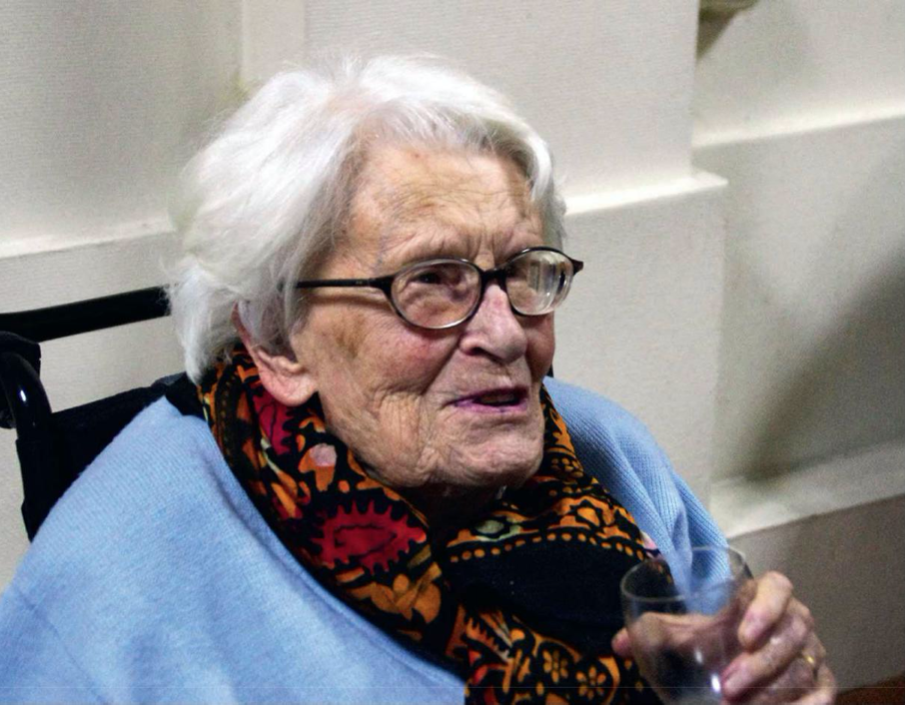
She had just celebrated her 101st birthday last February. Claire Danel, very attached to the Pastoral Center of Saint-Merry and still faithful to the Eucharistic Sharing group on Wednesday evening, left us. We publish here the homily pronounced by Dominique Lambert during his funeral on July 3
{GOOGLE TRANSLATED}
Take life as it comes, as God gives it to us, live the days and the events when they are there, knowing that misfortune is always lurking at our door. Here is a brief summary of the 1 st reading heard today of Ecclesiastes, atypical and so modern in many ways (1)
It is sometimes believed to be pessimistic because he observes what is happening “under the sun” and concludes that we cannot count on justice: there are wicked people who live long and righteous people who die too early, wise men poor and rich idiots. But is it really pessimism to say that the only sure values are the present moment and the generosity of God who gives it?
There is “a time for everything” and “God makes all things beautiful in its time”: each time of life has its meaning in its moment, says Ecclesiastes. What seems frightening and difficult at any given time can – with hindsight and re-reading – help us to grow or have positive consequences. Ecclesiastes offers a look at humans and society, which to be somewhat disillusioned, nevertheless remains sparkling with irony, and turned to the joy of the present moment to live fully.
Our ambiguity sometimes makes us suffer, we are capable of everything and its opposite. But this list in this reading also highlights the fullness, the richness of the existence made of these multiple different times. Despite the brevity and fragility of life, all these actions find their place there.
We who run after time, who speak of “lost” time, we who do not have time, reread Ecclesiastes and find a time for everything. It is a question of seizing and living fully the present time, whether happy or unhappy. There is no time lost, says Ecclesiastes, but times to live. Do not erase the moments of pain, nor forget those of joy … Each moment can be beautiful, even the worst, once you step back.
There is no eternal truth, time flies, everything changes. But we must not live in the regret of the past or in the illusion of the future, the present time is the only one we have.
With today’s Gospel, we have to see that salvation is not only for the cutting edge of our soul, but for our whole body (2) .
Jesus sometimes approaches and touches the sick or he heals him from a distance, as for the servant of the centurion. But it always goes through personal meeting.
The centurion, a stranger, no doubt attracted to rumor and designated by his function. The centurion is an author whose word is authoritative. The soldiers obey him “with the finger and the eye”. The centurion believes in the power of speech: once the order is pronounced, it is as if it was done.
He recognizes in Jesus this same authority and believes in the same way that the Word of Jesus will come true. Jesus adapts to the centurion’s thought pattern. He does not need to touch the patient. He says a word and the servant is healed.
You, Claire’s family, who prepared and chose the texts for this celebration, you could also have proposed the rest of this text which tells us about another healing of Jesus, this time with the story of Peter’s beautiful mother. A woman presented in the Gospel as a woman of action more than of speech. The evangelist reports no words between her and Jesus, and she immediately returns to service. Everything goes through the body: a look and a gesture. Jesus touches her hand. He joined her in his way of believing: that of faith in action “I will show you my faith by my actions” (Jacques 2/18).
Yes, Jesus raises us up and heals us if we allow ourselves to be joined by him in what we are. This requires a personal encounter to live, to desire, to grasp, to want! It is the meeting of the inexhaustible goodness of God proclaimed in this psalm sung just now.
Yes, Jesus joins us in our daily life, in what we have to live today, in our present moments.
Children of Claire, you chose these texts, because you found that the centurion, “It went well with mom. She knew what to do with her life. She was determined. She was not in trivial things. She asked for simple things. She knew what she wanted, ”you told me.
And for the 1 st reading, you said to me: “Mom was effective. In all situations, she adapted. She was in the concrete, in the relationship with the other, ready to listen ”.
So yes, let’s be determined too, live every moment that is given to us, thoroughly. “This great lady, energetic and committed, so often present at the preparations for the celebrations of the Pastoral Center of St Merry. I had great pleasure in seeing her again on June 23. She wanted to be present at this Mass for Gérard’s 50th anniversary, ”shared Eliane.
Let us be witnesses to the joy of God. Let’s have that smiling face of Claire in our relationships. Let us be full of empathy and kindness towards each other, as Claire was! Let us carry with us the humor that characterized Claire.
During our Eucharistic sharing on Wednesday evening, Jacqueline brought back to me this word heard by Claire: “Even if God could have invented something other than old age…! She had said. With her humor, in a convinced tone, Claire had a word that reflected the courage of her opinions, the frankness and the strength of the life she loved ”. Another Claire shared with me: “Ah, dear Claire Danel, she marked me with her freedom of speech”.
Finally, Georges said to me: “Claire presented a smiling but questioning face on the life of the beyond. For example, she wondered if her husband would always recognize her. ” It was indeed one of his great questions, which came up regularly in our Eucharistic sharing on Wednesday evening: “But what is on the other side?”.
Now Claire, you live this present moment with the father of your children. Let us remain in peace, and a serene joy.
Judges Order Antisemitic Murder Trial Against Two Suspects

L’octogénaire juive avait été tuée à Paris en mars 2018.
The judges in charge of the investigation into the murder of Mireille Knoll, a Jewish octogenarian killed in Paris in March 2018, ordered a assize trial for ” murder of a vulnerable person and committed because of the religion of the victim ” at the against two suspects, AFP learned Monday from concordant sources
On March 23, 2018, the body of this 85-year-old woman, suffering from Parkinson’s disease, was found stabbed with 11 stab wounds and partially charred in her apartment in an HLM, in eastern Paris [ . . . ]
Continue at Le Figaro: Mireille Knoll: Judges Order Antisemitic Murder Trial Against Two Suspects

