
🇫🇷 A year after an inferno engulfed #Paris's #NotreDame cathedral, reconstruction works are running months behind schedule, delayed by massive quantities of toxic lead, winter storms and now the #CoronavirusPandemic #F24's @abdelmassive spoke to Rector Patrick Chauvet pic.twitter.com/WcDHvlI8F7
— FRANCE 24 English (@France24_en) April 15, 2020
Category: News
Radio, companion of confined life, sees its audiences explode

With long-term confinement, the antennas adjust their grids to meet the demands of listeners
Thursday April 9, Médiamétrie will publish, as every quarter, the audience figures for French radio. With a week in advance and, due to the epidemic, different calculation methods, the field surveys having, for safety reasons, been suspended Monday March 16. Even without the usual analysis tools, these figures should bear witness to the explosion of hearings since the start of confinement. This is already notable in other surveys.
The Alliance for press and media figures (ACPM) reported on Monday April 6 that online radio listening had increased by 15% on average in France over the first two weeks of confinement – the information radios recording an increase of 40%.
The peak morning audience has shifted: 9 a.m., instead of 8 a.m.
Listening habits have also changed: a study carried out for Europe 1 by Kantar Profiles, Monday April 6, on 1,027 respondents in France, underlines that 44% of French people say they get up later since the start of confinement. The peak morning audience has shifted: 9 a.m., instead of 8 a.m., says Etienne Marut, marketing director for Europe 1. He also underlines a very strong increase in visits to the antenna site: 35 million in March, an increase of 125%.
Same story on the side of France Inter, whose site saw its audience grow by 111% in March. “At the time of the attacks, we already had a feeling that radio was the medium of the crisis ,” explains Erwann Gaucher, digital director of France Inter, even if the period was fortunately too short to draw conclusions from it. There, after a month, the numerical figures are still very high. “
Excitement of exchanges
Free time also strengthens the interaction between the radio and its listeners. “In February, says Erwann Gaucher, there were 800,000 interactions (comments and likes) on our Facebook page, in March: 1.4 million.” [ . . . ]
Continue reading at LE MONDE: Radio, companion of confined life, sees its audiences explode
France ‘at war’: how Parisians are coping with life under lockdown
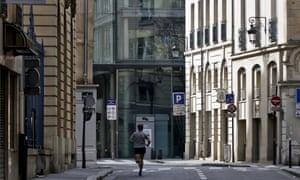
Residents of the French capital are adjusting to the country’s toughest restrictions on public life outside wartime
And suddenly, it was August. Grudgingly but obediently, the rue des Martyrs in Paris’s ninth arrondissement entered lockdown at midday on Tuesday, the few people on its pavements making their way home, baguettes and shopping bags in hand.
By 12.30pm, half an hour after France’s new reality – in essence, no going out unless to buy food or essentials, visit the doctor or get to a job certified as not doable from home – came into force, the normally bustling shopping street had emptied. Continue reading “France ‘at war’: how Parisians are coping with life under lockdown”
A Letter From Wartime France
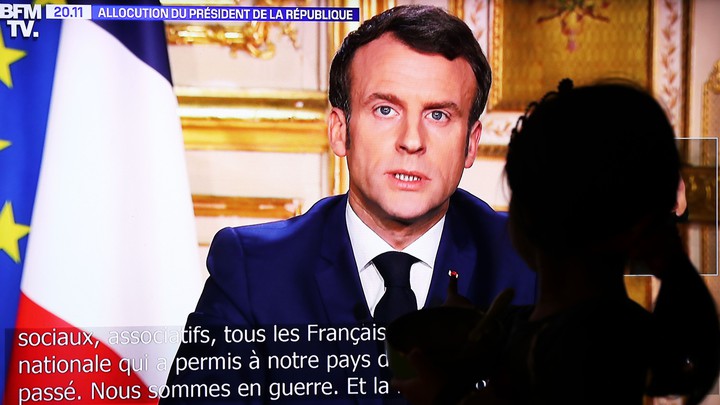
Streets that are normally busy, all of a sudden aren’t.
At noon today, as France slipped into confinement, I looked down from my balcony at the street below. A few people were riding bikes or walking. At the tobacconist next to the closed café, a woman was wiping down the door frame. The street is normally busy, and all of a sudden it wasn’t. For the next two weeks, and likely longer, we cannot go out except for urgent reasons: food, medicine, or essential work. A nationwide lockdown, enforced by police. “We are at war,” French President Emmanuel Macron said six times in a speech yesterday evening. “The enemy is there—invisible, elusive—and it is advancing.”
Macron is right. COVID-19, the disease caused by the novel coronavirus, has killed thousands and will likely kill thousands more, a tsunami that doctors have been warning will overwhelm the health-care system, as it’s already doing in neighboring Italy, the country hardest hit by this virus after China. This weekend, the government ordered all restaurants, cafés, and retail stores closed in France.
And finally, last night, Macron followed Italy and Spain—but not Britain or the United States—and mandated confinement to slow the exponential spread of the virus. Overnight, Macron, who was elected on a fluke and has faced popular revolts and flagging popularity, has become a war president.
We are at war. How strange to hear those words in Europe in 2020. It’s impossible, here in Paris, not to think of the Second World War. Not since Continue reading “A Letter From Wartime France”
To ban or not to ban? What future for pesticides and GMOs in the EU?
French Agriculture Minister Didier Guillaume tells Catherine Nicholson why he believes a transition to lower-chemical farming is essential and how he thinks it can be achieved.
Meanwhile, Green MEP – and organic farmer himself – Benoît Biteau tells us why what he learnt converting his father’s farm to greener practices can be replicated.
In our reports, we meet some of the mayors who have banned pesticides around their towns and find out more about the conflict with the farming community. We also meet French farmers who are testing how to reduce their dependence on chemical pesticides
Source: To ban or not to ban? What future for pesticides and GMOs in the EU? (part 1) – Talking Europe
The 391-MILE traffic jam: Paris suffers record road jam because of transport strikes
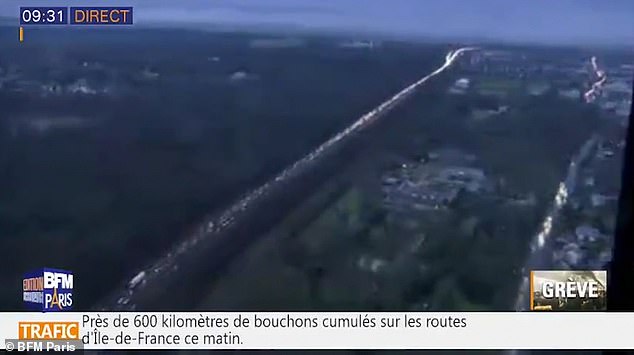
The Paris traffic jam was caused by the consecutive transport strikes that have been happening for the past three weeks to protest a governmental pension overhaul.
 Pas De Merde