
“All are from dust, and to dust all return”
– Ecclesiastes 3:20
“We are stardust, we are golden”
– Saint Joni
“Now don’t hang on, nothing last forever but the earth and sky”
– Rev. Kansas
“That was long ago, and now my inspiration is in the stardust of a song”
– Archbishop Carmichael
“SAD”
– The Devil
Category: Les pensées de Stevenson
Les pensées de Stevenson (Mike’s thoughts, large and small … mostly small.)
Under the Covers
By Michael Stevenson
Occasionally an artist remakes a classic film or an iconic song, and the effort makes me wonder, “why bother in the first place?” I’ve always felt that it makes more sense to remake lousy movies or records, and try to make these into something halfway decent.
Why remake a masterpiece such as Hitchcock’s Psycho, or James Ivory’s A Room With a View? Wouldn’t it be better to remake Cameron Crowe’s recent films – Elizabethtown, We Bought a Zoo, and Aloha – and make these something watchable? And why would a singer make a record titled “[insert name here] Sings Frank Sinatra” or “[insert name here] Sings Patsy Cline”?
Sometimes the Cover or Remake Works
Philip Kaufman’s remake of Invasion of the Body Snatchers was superior to the 1956 original, as was Coen Brothers’ version of True Grit. The Wizard of Oz that we all know and love (1939) was actually a remake of a 1925 bomb. As for music, the late Joe Cocker recorded a song off the Beatles’ Sgt. Peppers, and made it his own. The Beatles themselves forever swiped “Twist and Shout” from the Isley Bothers.
Forgive my Rachel Maddow-like preamble, but I now present Rodolphe Burger’s cover of Michael Jackson’s “Billie Jean” – a ballsy and brilliant remake of one of the most iconic songs belonging to a true American music legend.
Give it a listen and tell me – what do you think
No, Neil Gorsuch did not start a ‘Fascism Forever’ club at his Jesuit high school
By Michael Stevenson
At his Jesuit-run prep school, Supreme Court nominee Neil Gorsuch listed in his yearbook that he founded the “Fascism Forever” club. There was no such club. He was just joking. I also joked in my Pilgrim High School yearbook (I was a yearbook editor and cartoonist) but never wrote anything I thought wouldn’t help me get a date. But that’s just me ..
 Read Related Story: No, Neil Gorsuch did not start a ‘Fascism Forever’ club at his Jesuit high school | America Magazine
Chanson Du Jour: I Will Wait For You
By Michael Stevenson
 At the annual New Years Day celebration at Providence’s Casa DeLillo, we were delighted to see our old friend Stan, who once again entertained the revelers with piano renditions of Gershwin, Rogers & Hart and Hoagy Carmichael’s standards. While Linda and I helped drain several bottles of Monsieur Jim’s French wine, we all shaaang along to Stan’s Tin Pan Alley tributes. Accompanied by Monsieur Jim playing his standup bass, Stan closed the evening this wonderful love song from the 1964 French film Umbrellas of Cherbourg. All of us recognized the Michel Legrand melody, but I noticed only our friend Anna who grew-up in Poland knew the words to the song, which she sang in English. Linda, Belkys and I (below, right to left) provided the applause.

More likely Anna learned the lyrics to “I Will Wait For You” from Euro-star Nana Mouskouri rather than Cher, both of whom recorded the song.
Mouskouri sang versions in English, French, German, Spanish, Italian and Japanese, while Cher sang only in Cherenglish – presumably with an exposed tummy on the record jacket. Mouskouri usually wore a simple blouse along with her signature Buddy Holly frames, and unlike Cher, she could perform without always turning her vocal dial to “11.” Check out Nana’s version dueting with composer Legrand below.
As well as Mouskouri and Cher, “I Will Wait For You” has been covered by iconic vocalists Frank Sinatra, Astrud Gilberto, Tony Bennett, and Vikki Carr, as well as instrumental versions from jazz greats Oscar Peterson, Gil Evans, Donald Byrd, and Louis Armstrong.
I’ve discovered that lyrical translations from French to English are problematic at best, but you can get the general je ne sais quoi of this song from this English verse:
My love I will wait for you all my lifeStay close to me, come back I’m begging youI need you and I want to live for youOh my love don’t leave me
A bit desperate, “non?” Makes Dusty Springfield’s “You Don’t Have to Say You Love Me” sound like Alanis Morisette’s “You Oughta Know.”
American lyricist Norman Gimbel translated the lyrics, as he did with Toots Thielemans‘ jazz classic “Bluesette.” and Jobim’s bosso nova standard “The Girl from Ipanema.”
The film Umbrellas of Cherbourg (“Les Parapluies de Cherbourg”) was directed by Jacques Demy, starring Catherine Deneuve and Nino Castelnuovo.
The film was nominated for the Academy Award for “Best Foreign Language Film” and aslo “Best Song.”
Original Instrumental Soundtrack
Nana Mouskouri and Michel Legrand
Women’s March 2017
Some images from Rhode Island, USA – Women’s March. My wife Linda and I join the Resistance.


Etienne Comar’s “Django Melodies”

I’m greatly anticipating the upcoming release of Etienne Comar’s film,”Django Melodies,” which aims to tell a chapter from the extraordinary life story of legendary French jazz guitarist Django Reinhardt , specifically Django’s adventures trying to flee from Nazi persecution during World War II.
Reinhardt co-founded the iconic Quintette du Hot Club de France with violinist Stéphane Grappelli in the 1930s. He is regarded as the father of jazz manouche, or gypsy jazz.
The movie stars Reda Kateb as Django, Cécile De France (so terrific in the Dardenne Brothers‘ The Kid With the Bike) and the beautiful Hungarian folk singer Palya Bea.
The cast certainly looks the part (see below.) The proof of the pudding (or better, gypsy goulash) will be Comar’s telling of Django’s thrilling story fleeing the Nazis, and not in any attempted recreation of Django’s guitar playing. Woody Allen’s Sweet and Lowdown was a very good movie, and Sean Penn received a well-deserved Oscar nomination for his portrayal as the Django-obsessed “Emmet,” despite the fact that Penn’s guitar fingering was not particularly realistic. Certainly, the manner in which Django’s wonderful gypsy jazz music is presented will help determine the film’s success, but hopefully there will be few closeups of guitar fingering. Why bother?
Django Melodies marks the directorial debut of Comar, who also co-wrote the script with Alexis Salatko. Dutch jazz band Rosenberg Trio re-recorded Reinhardt’s music for the film’s soundtrack.
– [Mike Stevenson / Pas De Merde]
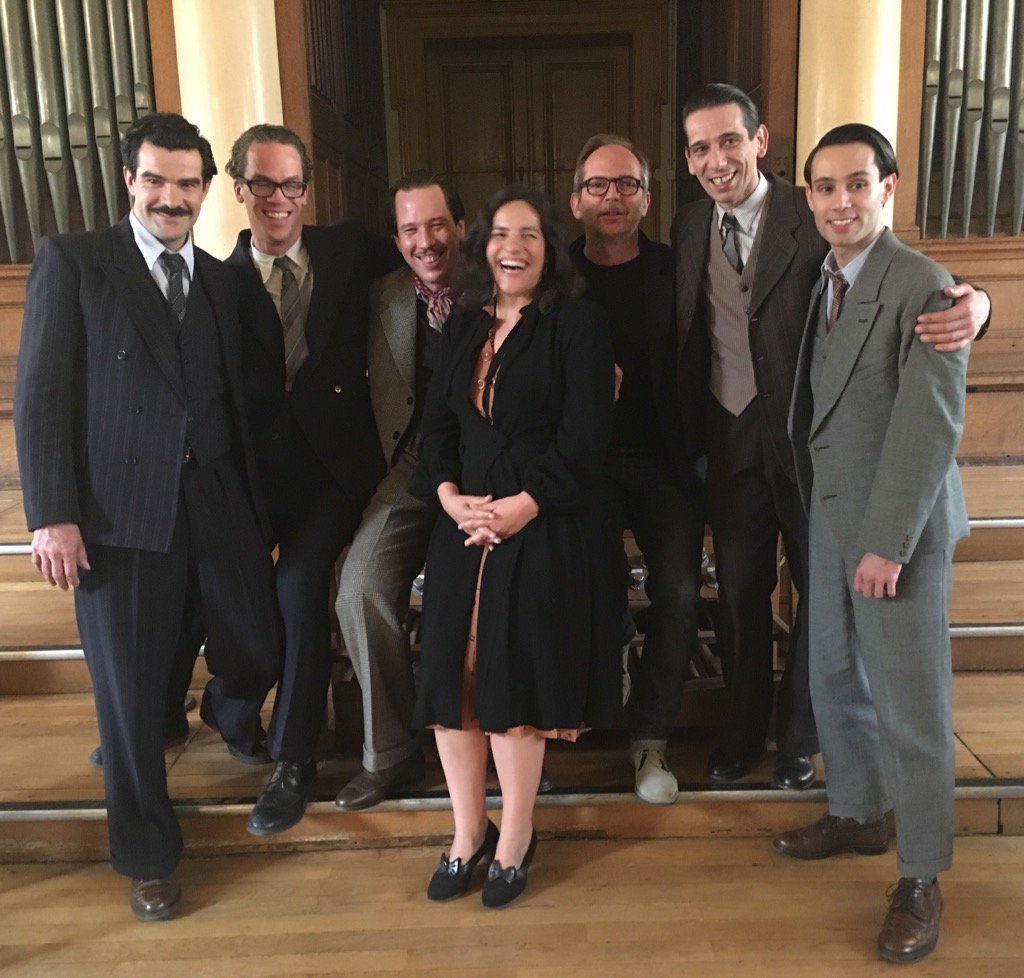
Django, sa femme, son groupe et… Etienne Comar, le réalisateur
Penned by Etienne Comar together with Alexis Salatko, and based on the novel Folles de Django, written by the latter, the story kicks off during the German occupation in 1943.
Gypsy Django Reinhardt, a true “guitar hero”, is at the top of his game. Every evening, he thrills the Paris smart set at the Folies Bergères cabaret music hall with his swing music, while elsewhere in Europe his brethren are being hunted down and butchered.
When the German propaganda machine wants to send him to Berlin for a series of concerts, he senses he is in danger and decides to escape to Switzerland with the help of one of his female admirers, Louise de Klerk. In order to make it there, he heads to Thonon-les-Bains on the shores of Lake Geneva with his pregnant wife, Naguine, and his mother, Negros. But the escape attempt turns out to be more complicated than anticipated, and Django and his family find themselves plunged headfirst into war.
Nevertheless, even during this dramatic period, he remains an exceptional musician who puts up a fight through his music and his sense of humour, and who seeks to attain musical perfection. [http://cineuropa.org/]
 Pas De Merde