Wine of a very different hue on sale in France

Spanish wine making a splash on south coast of France

There is red wine, white wine and rose – and there is a blue wine, too.

A company in Sète is selling marketing Vindigo, a 100% natural wine that is a very a different colour to the usual wines served at aperos in France.

The unusual colour of the wine, a 100% chardonnay, is created from anthocyanin, a pigment in grape skins, through which the liquid is filtered.

Distributor René Le Bail told France Bleu Hérault that the wine, developed in Spain, is, “an ideal wine for the summer, to drink as an aperitif, on the sand or at the edge of the swimming pool.

“It tastes like fruit. There’s cherry, passion fruit, blackberries,” he said. [ . . . ]

Continue at ConnexionFrance : Wine of a very different hue on sale in France


Pas de Merde has more stories about Food & Wine . Bon Appétit!

National Wine & Cheese Day: best pairings

The saying is — “when in Rome.” But today, we should really be looking to France.

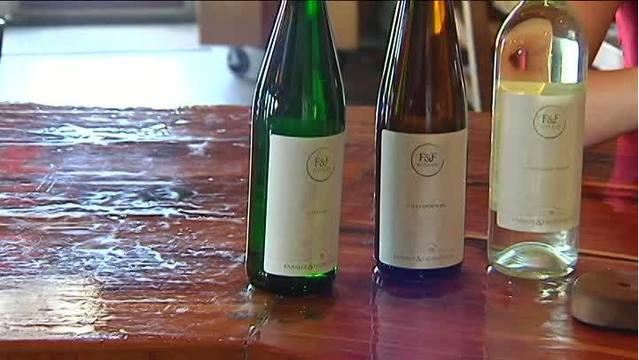
“The French, we are lucky enough to have more than 365 variety of cheese. So every day. Every lunch and dinner we have a piece of cheese,” says Farmer and Frenchman owner Hubert Mussat.365 days of wine and cheese make the French the experts.We dropped by Farmer and Frenchman for the inside scoop on pairing — the gouda, the brie, and the bleu.

Best wine pairings:

  • Jalapeno, or anything spicy, goes best with sweet wine
  • Riesling pairs best with spicy foods and cheeses
  • Chardonnay does well with hard cheeses
  • Sauvignon Blanc is best with seafood, not cheese
  • Red wines pair well with soft cheese like fontina and brie

Continue reading at: National Wine & Cheese Day: Wine 50% off, best Tri-State pairings


Pas de Merde has more stories about Wine fraud and less scandalous articles about wine in our Food & Wine category


Bon Appétit!

French pastry chef’s ‘food porn’ has millions drooling on Instagram

When Cedric Grolet takes out his pastry knife, millions of mouths water. The young Frenchman, named the top patissier on the planet last month by “The World’s 50 Best Restaurants” list, is an Instagram superstar.

Videos of him slicing through the exquisite fake fruit he creates to reveal their tastebud-teasing interiors get millions of views on social media.

Millions more drool over images of his glossy hyper-realistic pears, apricots, lemons, peaches and even tomatoes, with Vogue — a magazine not  known for its championing of high-calorie desserts — saying they “leave you wanting to lick the screen”.

“His fans cry, fall into his arms and demand autographs” and selfies, said the usually sober French daily Le Monde.

His work is pure “food porn”, it declared, with only a select few getting the chance to consummate their desire every day at the top Paris hotel where he works.

With high tea at Le Meurice featuring his cakes sometimes booked weeks in advance, Grolet opened a tiny boutique there in March.

Its shelves empty within hours every day.

Continue at THE LOCAL: French pastry chef’s ‘food porn’ has millions drooling on Instagram – The Local

What’s in a Wine Name?

There’s nothing like a nice cool glass of rosé on a balmy summers evening. Whether you’re an adventurous type who likes to try a new wine every time or you have your go-to favourites, you put your trust in producers and retailers to deliver the products that they claim to be – but are they? Fraud in the food and beverage industry is becoming an all too common problem, whether it’s lower quality honey claiming to be Manuka, cheap oils passed off as extra virgin olive oil or even horse meat masquerading as beef, they’ve all hit the headlines for the wrong reasons.

“We were alerted to the ‘Frenchification’ of Spanish wine at the end of 2015. So, we launched an inquiry at all levels, from producers to importers to restaurants and distributors.”

Some food fakery is easier for a consumer to detect than others – glaringly obvious spelling mistakes on packaging is an immediate red flag, but for many consumers the only option is to take products at face value.

Do you really know what you’re sipping this summer?

In response to suggestions of cheap imports being passed off as French wines, the Directorate-General for Competition, Consumer Affairs and Fraud Control (DGCCRF) based in France, undertook a survey to examine wines imported into France, especially from Spain.For French wine producers that lack protected geographical indication (Indication Géographique Protégée-IGP) status, competition can be tough. Spanish producers are challenging them, especially in varietal entry level wines. As such, temptation exists to pass off cheaper Spanish imports under their own brands [ . . . ]

Continue at TECHNOLOGY NETWORKS: What’s in a Wine Name? | Technology Networks


Pas de Merde has more stories about Wine fraud and less scandalous articles about wine in our Food & Wine category. Bon Appétit!


If You’ve Never Explored French Wine Country, Begin With Beaujolais

Each year, more than 10 million visitors journey to France’s storied wine country. Among the most traveled to regions are the big names: Bordeaux, Burgundy, Champagne, Alsace. Conspicuously absent from the top of that list is Beaujolais — an area that might just be more scenically enchanting than all the rest. But just because the masses are missing out doesn’t mean you need to make the same mistake. Here’s why this part of southwestern France is worth exploring today, before it’s ‘discovered’ by everyone else.Accessibility is a word that comes up time and again in describing Beaujolais. Its location is easily reached by car or rail from Lyon, France’s 3rd largest city. Its people are universally welcoming and almost unnervingly hospitable. But most inviting of all is the wine — a light-yet-luscious red fermented exclusively from the gamay grape varietal. Its appeal spans the spectrum of drinkers; from those seeking something delicate, to those in search of boldness; the self-avowed novice to the full-fledged enthusiast.

In the US, our experience with Beaujolais is primarily viewed through the lens of Georges Duboeuf. The 85 year old wine merchant has been exporting juice from the region since 1964. Négociants, as they are known in France, don’t actually make the wine, but partner with the producers to get the liquid bottled, labeled, and brought to market. A testimony to Duboeuf’s profound impact on the region — his lasting partnership with the local farmers — appears in the form of Hameau Dubouef. Built adjacent to the rail station in his hometown of Romaneche-Thorins, this is the only museum in all of France dedicated entirely to winemaking. It’s open daily from 8AM – 7PM and provides the ideal springboard from which to dive headfirst into the heart of Beaujolais. [ . . . ]

Continue at FORBES: If You’ve Never Explored French Wine Country, Begin With Beaujolais

Meet Cédric Grolet, the French pâtissier using Instagram in a pastry revolution

In the last 20 years in France and around the world, there’s been a pastry revolution – who’s ready for the next 20?

When I was a junior chef in the early seventies, French cuisine was going through a revolution that was referred to as ‘nouvelle cuisine’. At the time it became fashionable for young chefs to dare to create new dishes and to innovate and adapt classic dishes by making them lighter, smaller, easier to digest and more attractive to the eye.

The French pâtissiers, however, took a little longer to revolutionise their gâteaux and patisseries. Until the 1990’s in most French pâtisseries the selection of petits gâteaux was identical. The norm was little cakes made with puff pastry like mille-feuilles, apple turnovers and apple tarts. Other seasonal fruit tarts had a sweet pastry base and were coated in an apricot glaze [ . . . ]

Continue at SBS: Meet Cédric Grolet, the French pâtissier using Instagram in a pastry revolution | SBS Food


Read more stories about FRENCH PASTRY on Pas De Merde | More stories on FRENCH FOOD & WINE