How Red Wine is Made 

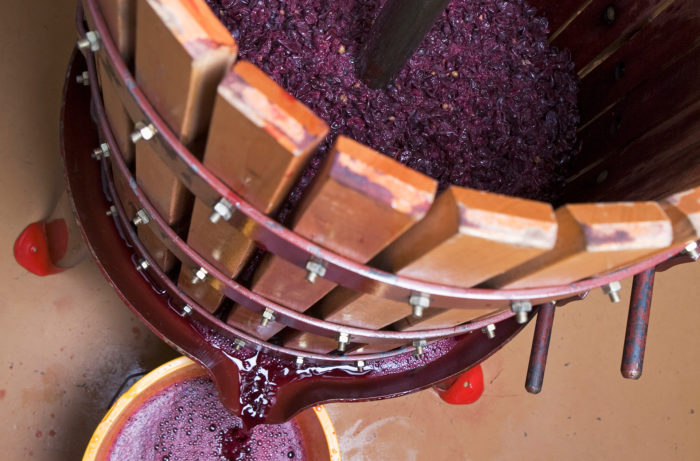
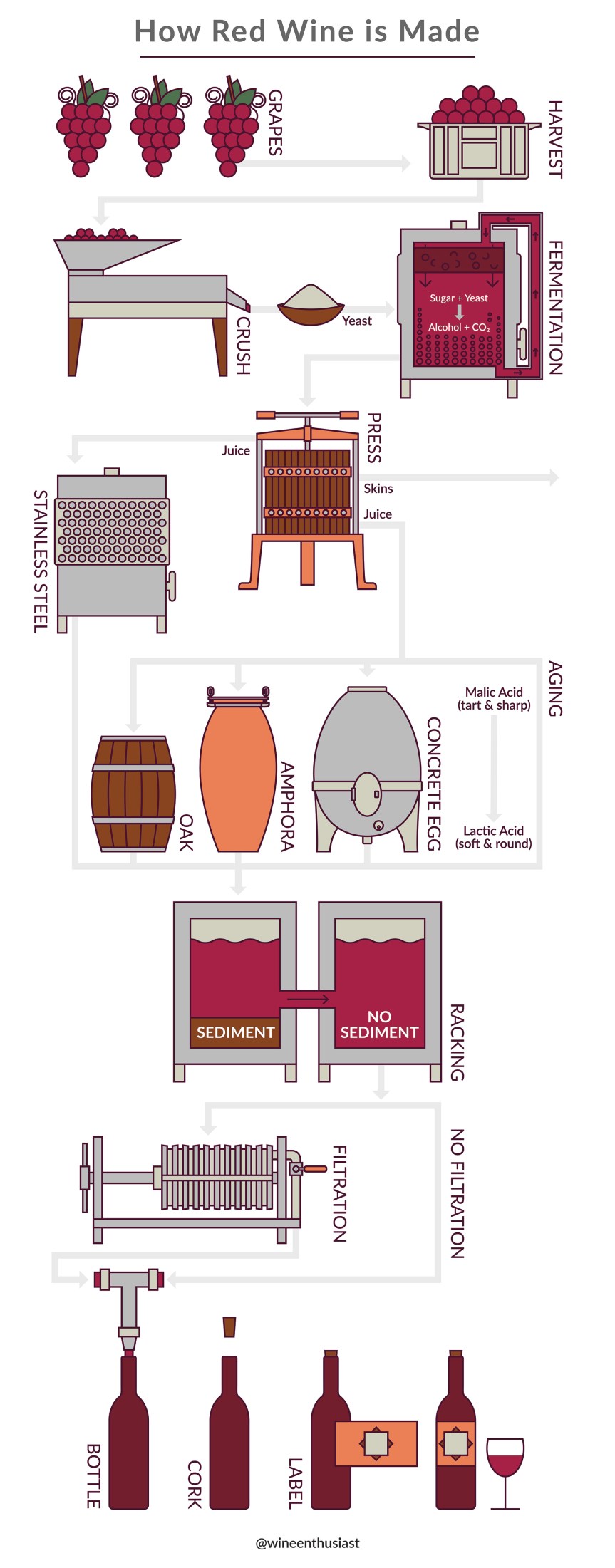
Wineries make red wine today much the same way they did 6,000 years ago in Greece and Persia. Dark-colored grapes are harvested, crushed, fermented, stirred and separated from the skins by a press. Voila! Red wine.

Better containers, presses and cellars have increased quality and efficiency of red wine production many times over, but it’s still essentially a simple process. Red wine production requires no cooking or ingredients besides grapes, yeast and, usually, sulfur dioxide as a preservative.

Red wine is made on the skins

Red wine is made like white wine, but with one major difference. Generally, it ferments with the grape skins and juice combined in a tank or vat. White wines are pressed before fermentation, separating the juice from the skins.

The skin contact in red wine production allows color, flavor and textural compounds to be integrated into the juice, while the yeast converts sugar to alcohol. The skins contain most of the good stuff that gives red wine its color, while the pulp mostly provides the juice.

Harvesting red-wine grapes and the crush

Red wine grapes are ready to harvest in late summer to early fall, several weeks after the initial green color of the grapes has turned to dark red or blue-black, a period called veraison.

Vineyard crews cut the grape bunches or clusters from the vines. That’s either done by hand or a self-propelled machine that shakes or slaps the grapes off their stems and collects the individual berries and juice.

Delivered to the winery, winemakers can also sort out mildewed grapes, unwanted raisins, leaves and debris. Clusters then go through a destemmer/crusher that removes the whole grape berries from the stems and may squeeze them slightly to get the juice flowing. Any juice created at these stages prior to pressing is known as free run. Machine-harvested grapes are already ready to ferment. Continue reading “How Red Wine is Made “

Where to Eat in Paris: The Best 13 New Restaurants to Try Right Now

To make choosing where to eat in Paris as painless as possible, we’ve done the “hard” graft for you by testing out 13 of the newest, most talked-about places in the city. From creative cuisine hailing from Israel to the chef that’s shaking things up at the Eiffel Tower, we’ve got you covered.

1. Shabour, A (Michelin) Star In The Making

Every dish here is testimony to the chefs’ inexhaustible inspiration. And teamed with hospitality that’s rarely seen in trendy Paris restaurants of this caliber, Shabour certainly packs one mighty punch.

With several restaurants under their belt in Jerusalem and Tel Aviv, London and Paris, Shabour, meaning ‘hangover’ in Hebrew, is the clan’s third restaurant and first independent endeavor in the French capital.  Alongside the enigmatic Assaf Granit is his clan, Dan Yosha and Uri Navon in the kitchen, and Tomer Lanzmann as head host and all-round ambiance-setter en salle.

As far as the décor goes, it’s simple. And that’s the way they wanted it. A former jazz club, the space is entirely candlelit. The stone walls and waxed cement floors provide the backdrop for an open kitchen encased in a marvelous jade-green marble counter for diners to perch at, giving the restaurant a perfectly achieved result.

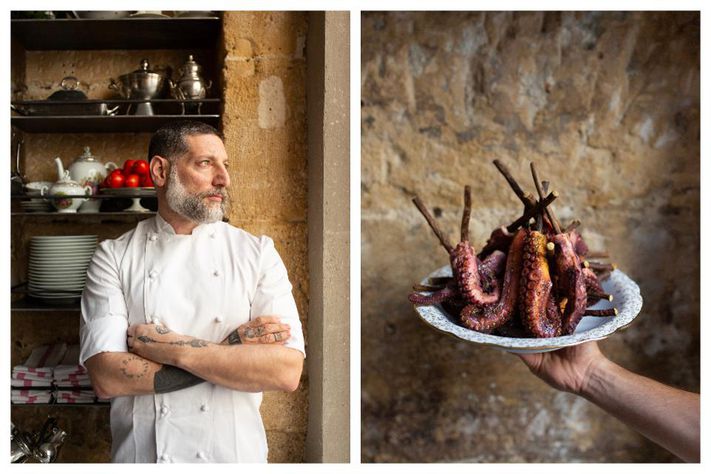
In a silent ritual of swift movements and the occasional hint of a smile in his icy blue eyes, lead maestro Assaf deposits utensils in front of diners in preparation for each dish, his hands, covered in cryptic black tattoos, sporadically emerging from the shadows.

He lays dinky forks on the counter. An oyster appears adorned with zata herbs (similar to wild oregano), apple and shallot juice, all laid on top of a wooden stand like an artwork, ready to be blowtorched before we swallow it, reeling from the burst of flavor as it slowly imparts its notes in our mouths.

Another stand-out dish includes scorched leek plunged in vegetable stock and filled with labanais (yoghurt-like drink) and porcini mushrooms accompanied by a halloumi crumble and stock that’s meant to recall a journey through the woods. And what a journey it is, each dish pulling us deeper into a world unknown where flavor becomes all that matters.

Next up, Assaf lays out a porcelain egg cup, ready to be filled by Dan with four types of egg: poached, marinated for 48 hours in black tea with ginger, relish of carrots and onions, raisins, tahini, Egyptian spinach, salmon eggs, and poutarde. Explosive. As is Uri’s exceptional amuse bouche of escargot-shaped apple roasted with olive oil and arak, and pickled pink and white beetroot stuffed with brie and plum purée, prepped like a “small tower of Babylon,” as he describes it while he rolls it into shape behind the counter in front of us.

A flurry of dishes, each one more sophisticated than the next and interwoven with accents from a faraway land; the genius behind each mouthful is the scattered positioning of the ingredients on the colorful mismatched porcelain plates. The result is that no mouthful is ever the same.

Here, time stalls as the experience takes you to places you’ve never wandered before. When we left some hours later, we were floating – merry from the wine (which flowed) and not uncomfortably bloated from the food. The next morning however, starting the day proved a little less smooth, but then again, we were warned – the restaurant isn’t called Shabour for nothing.

Shabour – 19 Rue Saint-Sauveur, 75002 Paris Continue reading “Where to Eat in Paris: The Best 13 New Restaurants to Try Right Now”

10 Classic French Dishes You Need to Know

Cheese tart with Pears

French cooking is based on a few classic dishes—master these, whether a beginner or not, and you will have a nice collection of classic French dishes.

French cuisine features many delicious appetizers, from simple to complex. A tart is an ideal recipe to start with as it feeds the whole group and you only have to slice it to serve. This amazing recipe for a tart made of Roquefort cheese and caramelized onion is a classic, and the taste is unbelievable. Just be sure that you use the tangy Roquefort cheese—one that is distinctly French—as it is essential and gives the tart its signature French flavor.

Plate of coq au vin with fork and knife

Many traditional French recipes began out of necessity as a way to make cheap foods taste great. Such is the case for this classic chicken dish, which is both hearty and amazing.

Coq au Vin means “rooster in wine” and it was devised as a way to cook the tough meat of the bird. It is a country-style dish now made with chicken that is filled with vegetables. It does require a few steps and many hours of unattended cooking time, but the techniques aren’t that difficult and the end result is worth the effort. This casserole may soon become a new family favorite! [ . . . ]

Continue at ource: 10 Classic French Dishes You Need to Know

Trump’s Cheese Tariffs May Be His Most Normal Trade Policy

If you’re a fan of European cheeses, I’m sorry to report the price outlook is not Gouda.

The U.S. and the European Union have a long-running trade dispute over airplane subsidies. Each side alleges that the other is subsidizing its major commercial-aircraft manufacturer (Boeing and Airbus, respectively) in violation of World Trade Organization rules. The WTO says both sides are right: Boeing and Airbus both receive improper subsidies. Soon, the WTO will say how much in retaliatory tariffs each side may impose to punish the other for these violations. And in preparation for that decision, the U.S. has prepared a list of $25 billion worth of European exports we might subject to 100 percent tariffs.

The list reads like an order sheet from Dean & DeLuca.

Tariffs may be applied to cheeses including Gouda, Stilton, Roquefort, and Parmigiano-Regianno. Olive oil. Olives. Dried cherries. Apricot jam, peach jam, currant jelly, pear juice. Ham, including Proscuitto di Parma, Jamón Ibérico, Jambon de Bayonne and any of the other delicious European hams. Wine. Whiskey. Brandy (e.g., Cognac). If you might buy it to throw a fabulous cocktail party, it may soon be subject to a prohibitive tariff.

Meanwhile, the EU has released its own list of goods it might tariff because of our subsidies to Boeing — it includes live lobsters, orange juice, and rum.

Donald Trump, who doesn’t drink, says you shouldn’t worry about wine tariffs because the best wines are American anyway. But while high tariffs that upset coastal snobs would seem to combine two of Trump’s passions, his strategy of threatening these tariffs is actually one of the more ordinary parts of his trade policy. Long before Trump was president, the U.S. and Europe have exchanged punitive tariffs on luxury and specialty goods as tools to push for resolutions to valid trade grievances [ . . . ]

Read Full story at INTELLIGENCER: Trump’s Cheese Tariffs May Be His Most Normal Trade Policy

How to Taste Wine Like a Pro in Three Easy Steps 

Just taking a sip is not the right way to taste wine. Fortunately, learning the process to taste wine doesn’t take too long.

1. Appearance

First, you hold your glass by the stem, not up around the top as you can often see in movies and TV series about wine. Look at everything: the appearance of the wine, which must be brilliant and clear; the color, whose depth, intensity and nuances give information about the grape variety or varieties, and its evolution which indicates the possible age of the wine. For example, for a red wine with an earthy red color, you would call it “brick,” which indicates that you are dealing with a rather old wine. The same goes for a white the color of old gold.

2. Smell

The next step is to bring out the aromas, rotate the glass a little. Professionals do it with their arms in the air, but a neophyte risks spilling and staining their clothes. Let your arms rest on the table and create a circular movement that will “shake” the wine and allow it to release aromas.

Using your nose, you can perceive any defects: the smell of cork or sometimes something musty, toasted. This is probably what is called reduction, as opposed to oxidation. This is a sign that the wine needs air; a decanter should help free it. The aromas must be clear and expressive. They could be primary and reminiscent of fresh fruit, with hints of vanilla, characteristic of barrel aging, or more or less evolved, attesting to a long stay in the cellar.

3. Flavor

Finally, it is in the mouth that you get a definitive idea of the wine by perceiving, through feedback, the heaviest aromas, and by tasting the flavors. The acidity, sweetness and bitterness (which attest to, among other things, the presence of tannins) constitute the body of the wine. What you’re looking for is an attractive harmony, an equilibrium, and above all, the answer to the only question that is worth asking: do I like this wine?

This article was first published on Le Point

Source: How to Taste Wine Like a Pro in Three Easy Steps – Frenchly

The end to a French cheese tradition?

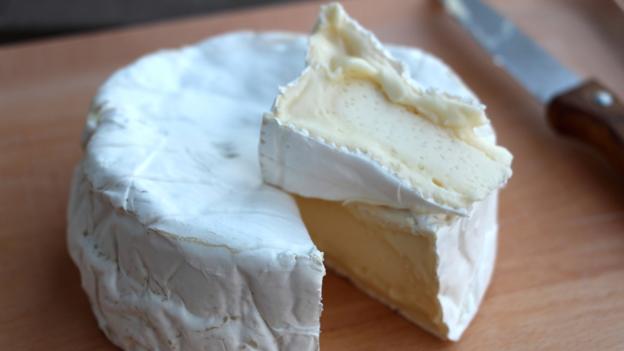
Camembert

After years of lobbying, industrial producers are now allowed to make camembert with pasteurised milk. As a result, one of France’s beloved cheeses may be disappearing – for good.

In the heart of Normandy’s Pays d’Auge region, about an hour’s drive inland from the D-Day beaches on France’s northern coast, lies the 200-person village of Camembert, surrounded by white-and-brown cows grazing in lush green pastures.

It is here that, according to legend, a woman named Marie Harel sheltered a priest who, like many following the French Revolution, was given a choice: swear allegiance to the new Republic or die at the guillotine. The refractory priest elected to flee, escaping to England through Normandy, and encountering Harel along the way. To thank her for her hospitality, the priest ostensibly shared the recipe for brie, a cheese from the region around Paris, which Harel made using local Normande milk and the moulds for washed-rind Livarot, thus inventing a new cheese that, as tradition dictated, she named after the village where she made it: camembert.

While the validity of the legend is impossible to confirm, culinary anthropologist Georges Carantino maintains that it is rooted in fact.

“In any case, it evokes that there was indeed a transmission of the techniques from an area like Brie, where this type of cheese is very old, to [Pays d’Auge], where it is a much more recent addition to the landscape.”

No matter how the technique arrived, the Normandy region that had previously produced only washed-rind cheeses like Livarot or Pont l’Evêque suddenly began making bloomy-rinded cheese like brie in the 18th Century, and camembert has been inextricable from Camembert ever since.

Of course, it would be unfair to say that camembert is merely brie made in Normandy. While the cheeses are made with the same Penicillium camemberti spore and thus boast a similar downy white mould, flavour-wise, camembert exists somewhere between the milder, buttery Brie de Meaux and the rich, meaty Brie de Melun. This can be attributed, at least in part, to the fact that while Brie de Meaux is made primarily with rennet fermentation and Brie de Melun with lactic fermentation, camembert is made with a bit of both – a process facilitated by the rich, raw milk of local Normande cows with which camembert should always be made, at least in the mind of a true turophile.

The result is a cheese that is rich, mushroomy and complex in flavour – and unfortunately, it may be disappearing from the nation’s culinary landscape for good.

Camembert, like many cheeses, is protected by the Institut National de l’Origine et de la Qualité (INAO), a unique French organisation that strictly governs the manufacture of 46 cheeses (and 300 wines) via the French Appellation d’Origine Contrôlée (AOC) and equivalent European Appellation d’Origine Protégée (AOP) labels. This institution aims to protect terroir, the French notion that a product is inextricably linked to the place where it is made, from traditional manufacturing processes down to unique microorganisms in the air.

But the governing of camembert has long been more complex than most. In the 19th Century, thanks to the creation of the small wooden box in which the cheese is still sold today and the simultaneous rise of train transport, camembert became quite easy to stack and ship. As a result, it was soon enjoyed by people from all over France. Since this rise in popularity predated AOP cheese regulations by several decades, camembert fans from Anjou to the Pyrenees began making their own versions, inexorably divorcing camembert from its Norman terroir.

Today, the word camembert refers not to a specific cheese, but rather to a cheese type made the world over – in fact, it was a Quebecois camembert that was dubbed the best in the category worldwide at this year’s World Championship Cheese Contest in the US state of Wisconsin – a snub that French magazine VSD called ‘stinging’ and ‘shameful’.

Despite the loss of the word, locals did finally earn AOC status for the traditional cheese in 1983, when the INAO developed an official charter, not for ‘camembert’ but for the phrase ‘Camembert de Normandie’. The cheese, it was decided, would be obligatorily made in Normandy, with the raw milk of pastured herds of cows ‘in a process of genetic evolution’ towards the Normande breed (a rule that was modified to specify that, at first, 25%, and then, in 2017, 50% of the herd be made up of Normande cattle).

By this point, however, even Normandy camembert no longer belonged to the small, artisanal producers that had once handmade this cheese throughout the region, ladling it into moulds in five distinct layers, as tradition dictates. Industrial giants such as Lactalis had set up shop and wanted their product to sport the AOP label. The caveat? They wanted to use pasteurised milk. Continue reading “The end to a French cheese tradition?”