
Category: Culture
How film was born 125 years ago
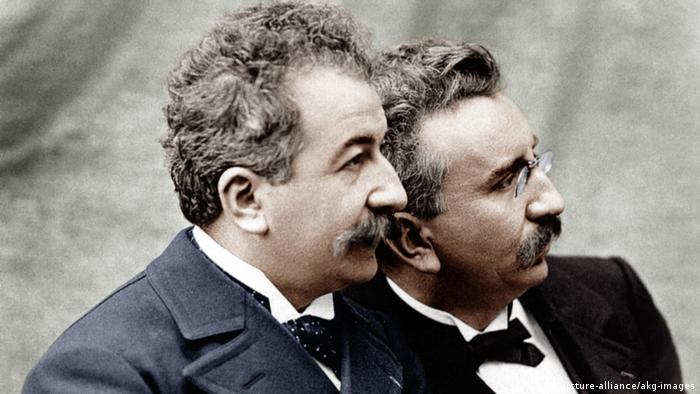
In 1895 the Lumiere brothers held one of the first public film screenings. Viewers simply couldn’t believe the moving magic before their eyes. Today fact, fiction and debate continue to swirl around cinema.
The question of who invented film is something of a question for the ages. Was it really the French brothers Auguste and Louis Lumiere, who on February 13, 1895 patented the cinematograph for showing moving images? Or should the brilliant American inventor Thomas Edison with his peephole viewer be credited? And what about German brothers Max and Emil Skladanowsky, who screened films in Berlin on their own movie projector around the same time as the famous French siblings? There are several other American and British cinema pioneers who also deserve a mention.
At the end of the day, it’s probably a matter of how the advent of film is defined: Can a technological development be considered the starting point or should it instead be the first time a group of people sat in front of a screen as a film danced before their eyes?
And let’s not forget about flip books, which in the mid-19th century used layered still images to create the illusion of movement when the viewer rapidly flipped through them. Could this, too, be considered the start of modern movies?
When diving into the early years of cinematography, one encounters a multitude of inventors and technicians, of places and laboratories in which development and experimentation took place, complete with plenty of trial and error. One thing remains certain: In the last decade of the 19th century photography was taking off, and from it, new as it was, film was born.
There were also others aside from the Lumiere brothers (pictured) who contributed to the start of the film industry, including Thomas Edison
The real inventors of cinema
The Lumiere brothers have a prominent position in most accounts on the history of cinema. They are customarily referred to as the inventors of film, despite the extensive preparatory work done by Thomas Edison and despite film screenings happening in other cities at nearly the same time as those of the brothers.
On December 28, 1895, the first commercial, public screening of the brothers’ films took place in the Grand Cafe in Paris. This evening is widely considered the start of moviegoing.
The Lumieres charged admission, and a few dozen visitors turned up to watch ten short films on the so-called cinematograph machine. The apparatus, which was both camera and projector, had been patented by the brothers a few months earlier. Visitors stared at the moving images in front of them, amazed the projections. They had never seen anything like it before.
 Those who saw ‘Arrival of a Train’ are rumored to have believed the train was going to run them over
Fact or fiction? Panic at a screening
Legend has it that the following year, the audience panicked at the screening of Arrival of a Train at La Ciotat, a short film made by the Lumiere brothers. The film shows a train entering the station of the town of La Ciotat, growing larger and larger as it hurtles towards the viewers. The camera perspective used makes it appear as if they would be run over.
The oft-told story posits that members of the audience, thinking the train was actually entering the cafe, jumped out of their seats and fled in panic. Whether fact or myth, it is nonetheless a beautiful story about people experiencing an important innovation for the first time.
Read more: ‘Parasite’ thrusts Korean film industry onto international center stage
The uncertain future of film
Today, as we remember the Lumiere brothers and their groundbreaking invention, the future of film, and in particular movie-going, provokes plenty of debate and uncertainty. In which direction will cinema develop? Will it even survive? What will happen to the standard feature film format and the shared experience of movie theater screenings in the face of streaming services like Netflix?
Only time will tell — and this leads back to the beginning of film history. It has always been an overwhelming medium, something spectacular and unbelievable that left people speechless above all else.
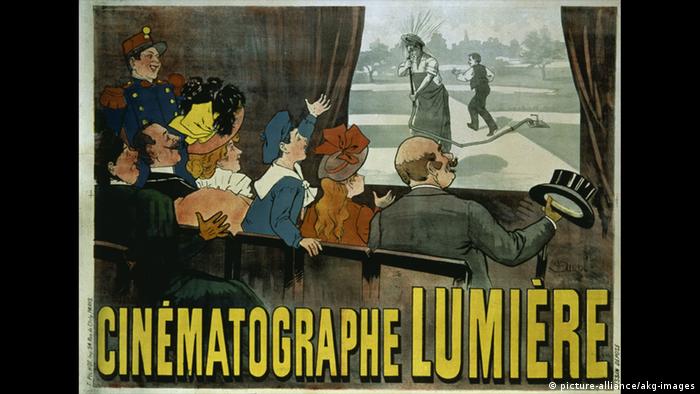 The Lumiere brothers are widely considered to be the forefathers of the film industry
Cinema is meant to overwhelm
“The cinema owes virtually nothing to the scientific spirit,” wrote the influential French film critic Andre Bazin in his legendary book What is Cinema? (1967). The fathers of film are not scholars, but rather “monomaniacs, men driven by an impulse, do it-yourself men or at best ingenious industrialists.”
People still thirst for spectacles, surprises and miracles, so the film industry will likely continue to thrive.
Hollywood still excels at meeting these human demands, and while its blockbusters may not be high art and may not attract everyone, the industry is doing well. It still draws viewers to the theaters and achieved record profits in 2019. You can, of course, watch almost all the films later on your smartphone if you like; in today’s film industry, anything is possible.
Avalon Jazz Band performs Charles Trenet’s “Que reste-t-il de nos amours?”
Pomme, the aspiring singer who goes up

A 23 ans, l’artiste défend en tournée « Les Failles », son enthousiasmant deuxième opus, en lice pour un prix dans la catégorie « Album révélation » aux Victoires de la musique, vendredi .
The early bird woke up at noon. The day before, Monday, January 27, the well-deserved celebration continued late after the first triumph of three Apple concerts in the Parisian hall of La Cigale (before February 28 and April 9, all sold out), accompanied by his news instrumentalists, Clémence Lasme (bass and keyboards) and Caroline Geryl (drums and percussion). Little excess – Claire Pommet, 23, does not drink alcohol – but a lot of friends and laughs to prolong emotions “so strong that I have the impression that a truck drove me on the head ” , laughs the singer, seated at the Edith Piaf bar, close to her little two-room apartment, in the 20 th arrondissement of Paris.
The truck is not ready to stop. Nearly a hundred other concerts should punctuate 2020, in the wake of an exciting second opus, Les Failles , published in November 2019 (and recently reissued, supplemented by five unreleased, under the name Les Failles cachées ), including l shivering acoustics will perhaps win him a Victoire de la musique, Friday, February 14, in the category “Revelation album”. [ . . . ]
Continue at LE MONDEe: Apple, the aspiring singer who goes up
Catherine Ringer: “I don’t like people to know what I think and what I do”
For forty years, the songs of Rita Mitsouko have accompanied us. Today, Catherine Ringer is named as female artist of the year at the Victoires de la Musique for her tour. Catherine Ringer sings Les Rita Mitsouko , which brings together sentimental crowds. Interview with a great secret.
She shakes hands, firmly. Rehearsals have just ended at Studio Bleu, adjoining the New Morning, in the Strasbourg-Saint-Denis district, in Paris. She asks where we are going, the Napoleon? All right, let’s go. But first, she shows us the dancers’ changing rooms, because she loves dancing, firmly there too. We feel assured and fierce, shy and brave. We were warned here and there that Catherine Ringer was no small task. But there was no doubt, from the broken tooth, the strapless dress marked Jean Paul Gaultier in the clip by Marcia Baïla , the unstructured haircuts, the explosive voice, the shimmering clothes, the gesture mixing flamenco with jerky expressions. and robotics, the clash with Gainsbourg on the sofa, the past X.
The Rita Mitsouko, this clever mix of genres, duo of whimsical lovers and pranksters born in 1979, evoking Sailor and Lula as much as Gomez and Morticia Addams, Almodóvar’s movida than the punk of dirty caves, their heads constantly immersed in a vast musical well, without censorship or constraint, digging up sounds to better hack new, creating immense tubes like Marcia Baïla , Andy and C’est comme ça , stacking the levels of readings, seizing the clip format from the start with Philippe Gautier and Jean-Baptiste Mondino, falling in love with free figuration with Robert Combas and Di Rosa, appearing in Soigne ta droite(1987) de Godard, taking care of the funny face and the zinzin, the irony and the mockery, solid because riveted to each other, with some crashes all the same here and there.
Forty years after their formation, thirteen years after the death of Fred Chichin, Catherine Ringer publishes the complete reissue of the Rita Mitsouko, nine albums with new releases and two legendary films shot by Roland Allard in Moscow ( Breakdown in the Cold War, 1989) and in Bombay ( La Vie du rail, 1990). And is named to the Victoires de la musique 2020 in the female artist of the year category. She does not like to tell herself very much, out of a taste for mystery and a certain posture, perhaps also because it is hard to describe the atypism of their tandem in the French rock landscape, from India and halo of success, poetic and stupid of scenes, cartoonesque and follower of the autopastiche. The Rita, quite simply.
You are nominated for the Victoires de la Musique in the female artist of the year category. Do prices matter to you?
Catherine Ringer – Yes and no. It’s nice to know that we are thinking of you, at the same time it is not fundamental. I wonder especially why Aya Nakamura is not there since it is she who has done everything for two years. She has fantastic life energy. His work on language and rhythm is very beautiful. And then I also said to myself: “Well, I am named as a female artist, but I would have liked to be named also for the best album of the year!”
It’s surprising that there are only men in this category, right?
Maybe it’s because they made the best albums of the year. We are not going to make the par everywhere everywhere anyway!
Does it swell you?
These are endless discussions. My first reaction is to say “Where does it end? How about half the young and half the old too ?! ”But I also know that there are glass ceilings to break. I have no definite answer.
Source: Catherine Ringer: “I don’t like people to know what I think and what I do” – Les Inrocks
To ban or not to ban? What future for pesticides and GMOs in the EU?
French Agriculture Minister Didier Guillaume tells Catherine Nicholson why he believes a transition to lower-chemical farming is essential and how he thinks it can be achieved.
Meanwhile, Green MEP – and organic farmer himself – Benoît Biteau tells us why what he learnt converting his father’s farm to greener practices can be replicated.
In our reports, we meet some of the mayors who have banned pesticides around their towns and find out more about the conflict with the farming community. We also meet French farmers who are testing how to reduce their dependence on chemical pesticides
Source: To ban or not to ban? What future for pesticides and GMOs in the EU? (part 1) – Talking Europe

