France’s ‘finest screenwriter ever’ Jean-Claude Carrière dies aged 89

Jean-Claude Carrière

French writer and screenwriter Jean-Claude Carrière, who penned some of the most memorable movies of the last six decades including “The Tin Drum” and “Cyrano de Bergerac”, has died at the age of 89

A prolific writer, Carrière, best known for his work with Luis Bunuel and Milos Forman, created some of the most memorable scenes in European cinema.

Belle de Jour was one of the fruits of his 19-year collaboration with the subversive Spanish director Luis Bunuel, who revelled in shocking audiences.

The pair won an Oscar in 1972 for The Discreet Charm of the Bourgeoisie, adding to the Oscar Carrière had won in 1963 for best short film.

Fascinated by philosophy and belief

Carrière’s work ranged across cultures, religions and historical periods, from Cyrano de Bergerac (1990) — for which Gérard Depardieu gave one of the performances of his career — to Milan Kundera’s The Unbearable Lightness of Being (1988) with Daniel Day-Lewis, to writing a book with the Dalai Lama.

Continue reading “France’s ‘finest screenwriter ever’ Jean-Claude Carrière dies aged 89”

Gaël Faure – En Direct du Théâtre de la Ville

Le Théâtre de la Ville et Les Trois Baudets, Nouvelle Scène musicale en direct du Théâtre de la Ville : une rencontre inédite pour soutenir la création, un temps de solidarité partagée pour garder le lien pendant cette saison particulière et réinventer ensemble.
Chanteur passionné par l’œuvre de l’écrivain Jean Giono, épris comme lui de nature et de voyages immobiles, Gaël Faure présente ici une forme artistique pure en solo Guitare-Voix. En témoigne son dernier album, intitulé « Regain » dont il entremêlera sur scène, chansons et différents passages de livres de l’auteur.
Chants et lectures engagés nous ramènent ainsi à la terre et à l’humain, soutenus par la voix véritable, puissante et envoûtante de Gaël Faure.
💿 🎁 🤩 Pendant le concert, enregistrement en direct de plexivinyles par Dix Lignes De Bling Dix Lignes De Blang.
Une tombola virtuelle permettra à 5 spectateurs d’en remporter un exemplaire unique en cadeau.
GARDEZ VOS YEUX BIEN OUVERTS !
Pendant le direct, le mode d’emploi pour y participer vous sera dévoilé par un affichage en bas de vos écrans.
🎟 Gratuit – Concert sans public dans la salle, retransmis en direct du Théâtre de la Ville – Espace Cardin, sur YouTube, Facebook et sur le site web du Théâtre de la Ville // Un artiste Zamora Productions.
En savoir plus sur #NouvelleScene avec Les Trois Baudets
https://bit.ly/Les_Directs_THDV
Soyons SOLidAIRES : SOUTENEZ LES DIRECTS DU THÉÂTRE DE LA VILLE.
S’informer & faire un don
http://bit.ly/Dons_THDV

How Paris Created a Cycling Boom

It’s no Amsterdam, but the City of Light is catching up.

By Erik Nelson

When Lone Andersen lived in Paris in the 1980s, she says she saw “almost no cyclists. I saw one once and I almost felt that I should take a picture.” Despite the fact that France’s most iconic athletic symbol is a bike race, its capital city has never been known as a biking mecca the way Amsterdam or Copenhagen are.

Today, through a mix of new infrastructure, bike sharing and public transit frustrations, that’s changing. In fact, the city’s deputy mayor for transportation, Christophe Najdovski, recently reported that:

PARIS SAW A 54 PERCENT INCREASE IN CYCLISTS BETWEEN SEPTEMBER 2018 AND SEPTEMBER 2019.

That’s according to counts by digital meters set up at 56 sites around Paris to monitor biking. The Copenhagenize index, a comprehensive assessment of bike-friendliness, gives the French capital high marks for adding exclusive bike lanes and pushing bike sharing. But this year’s index says that with a paltry 5 percent of its commuters biking, Paris is a long way from catching up to Copenhagen’s 62 percent.

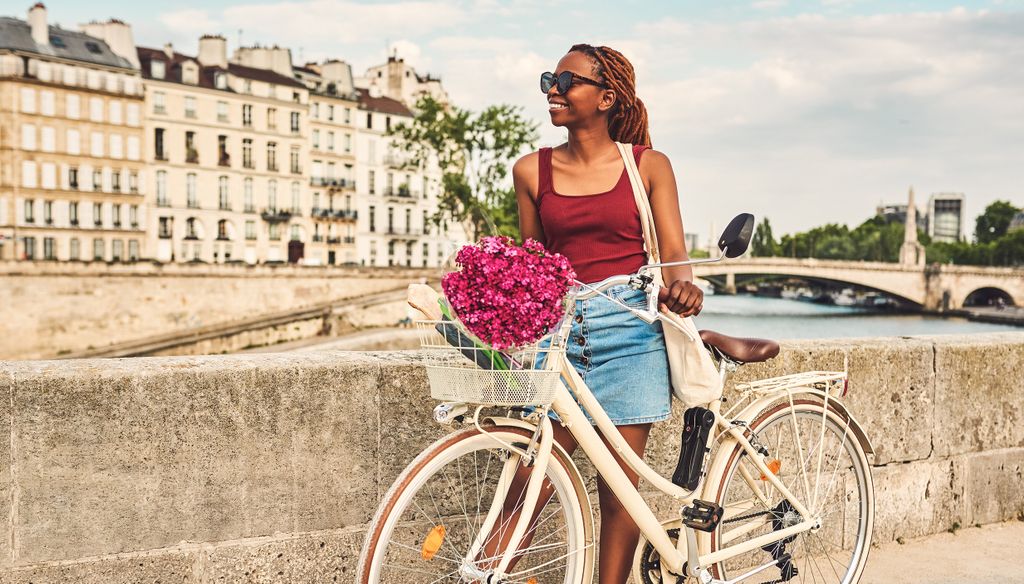
What could account for the explosion? Paris officials told local media that vélotaf — slang for bike commuting — is a big reason for the increase, while Najdovski touts the city’s plan vélo, or bike plan. The plan has realized amenities like the new two-way cycling path along the Seine’s Left Bank, running 1.5 miles from the Quai d’Orsay in the central city to Alma Bridge. It’s among nearly 200 extra miles of bike paths and lanes in the 2015 plan, along with a $780 million bike-sharing system — one that has admittedly been beset by delays and malfunctions.

If you ask longtime Parisian cycling campaigner and municipal cycling adviser Isabelle Lesens, those new commuters aren’t switching from cars. “It’s very well known that people living in Paris are really fed up with the subway because it’s absolutely crowded,” she says. “So when they discovered it could be possible to go by bike, they tried it.” That incentive can only grow with each public transit strike, like the one this week.

And while more liberal municipal governments vow to accommodate cyclists, even more conservative politicians are jumping on the two-wheeled bandwagon, Lesens says, because of the proliferation of app-based bike sharing. They’ve made it possible to be simultaneously bike-friendly and pro-business, while “nobody dares to be opposed to cycling because of the climate problems,” Lesens explains.

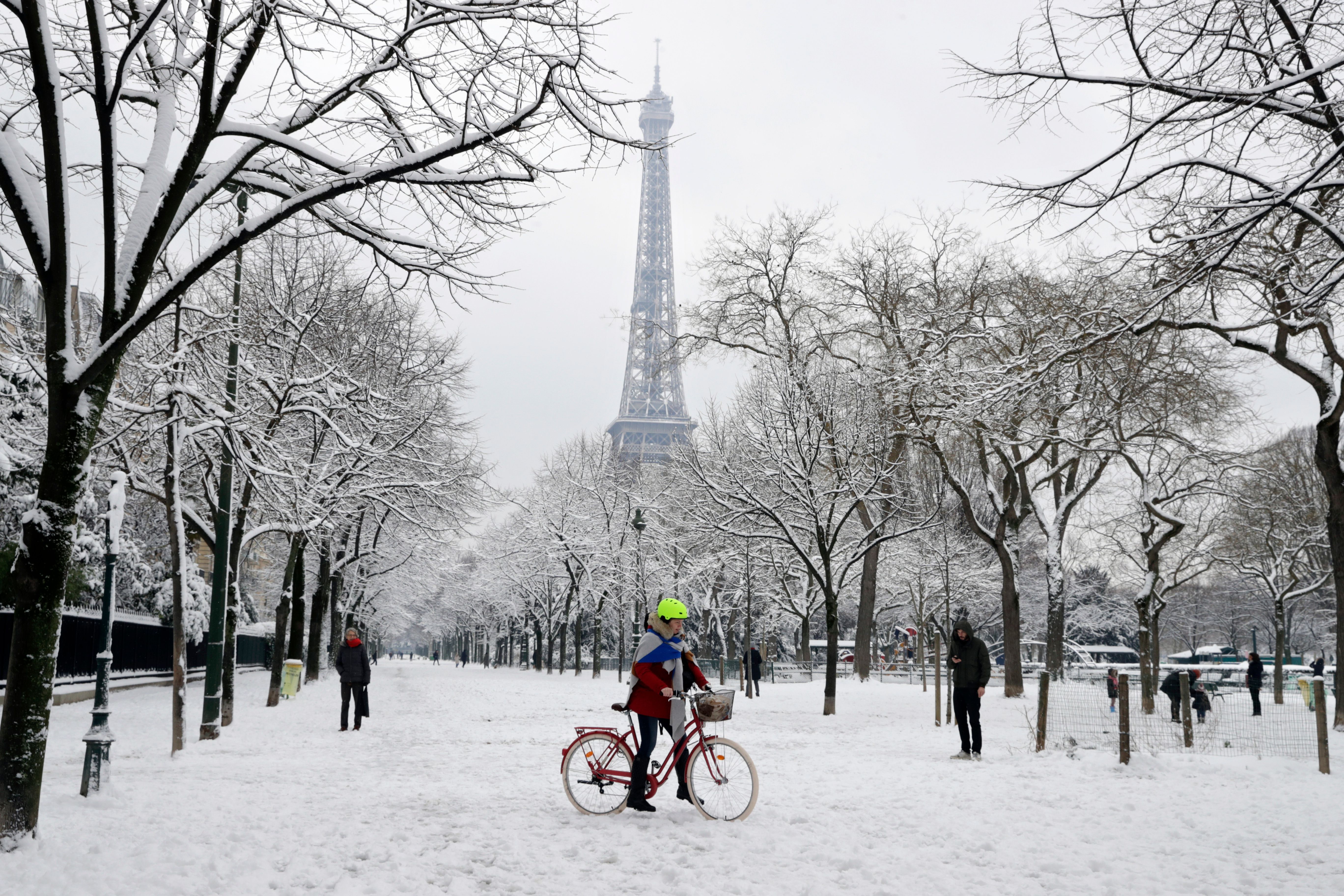
TOPSHOT-FRANCE-WEATHER-SNOW

Still, Paris’ Socialist mayor, Anne Hidalgo, is taking heat in local media for failing to put the mettle to the pedal after completing less than a quarter of the 43 miles of bike pistes separated from cars by curbs that she’d promised in 2015.

Nevertheless, Hidalgo’s determination to “turn Paris into a global cycling capital” seems to be working. In 2013, Paris was ranked 19th on the Copenhagenize index’s list of best cycling cities. This year it’s ranked eighth. Hidalgo has also famously declared war on the electric scooters ubiquitous in the French capital, setting new rules to regulate the machines that riders often abandon in bike lanes.

Cycling in Paris isn’t for everyone, even those who are fit enough to stay balanced and keep pedaling. Frank Andrews, a 26-year-old journalism graduate student, grew up in London and calls the two cities’ biking environments “kind of comically different.”

Back in England, there are rules: “Most of my friends and myself have been fined for running lights,” Andrews says. Not so in Paris, where “it’s a bit survival of the fittest out on those streets.”

It’s easy to see how Andrews, a resident of the 6th Arrondissement, can hold his own on les rues moyennes, commuting with an expensive fixed-wheel bike like ones used in velodromes. Brakes are his only concession to convenience.

Andrews attributes the ridership growth to delivery services and “Uberized” cycling via sharing apps. As for the latter, Andrews sniffs, “I feel like I see them more on their sides, discarded on a bridge.”

And Andersen, now a traffic engineer in Copenhagen, says her more recent forays onto Paris streets haven’t been encouraging: “I have never felt an urge to ride a bike in Paris — simply because I think it is too dangerous.” In April, the prefecture of police released figures indicating bike accidents had increased about 12.5 percent over the previous year, with 147 cyclists hurt (though none killed) in three months.

What the city needs, she believes, is more lanes with solid curb separating bikes from motorized vehicles. “If the infrastructure isn’t there, you will not get people to [cycle] on a large scale because they don’t feel safe,” she says.

The more Paris is willing to sacrifice space occupied by its Citroëns and Peugeots, Andersen adds, the more it’ll be able to coax even the faint of heart to pedal onto the city’s grand boulevards.

Source: How Paris Created a Cycling Boom – OZY | A Modern Media Company

Comme une Française: “Venir De” – Two meanings of this very useful French verb

You may already know the French verb Venir, which means “to come”. But, have you encountered its trickier neighbour, “Venir de”? We’ll explore its different meanings in today’s lesson, and I’ll show you how to use it in everyday French conversation. Take care and stay safe.

😘 from Grenoble, France.

Géraldine

Sir Lancelot: Exploring the History Behind the Legend

There is no doubt that most of us, in our childhoods and later in life, heard all about the stories and legends of King Arthur and his Knights of the Round Table. For many, the stories of Arthur and his exploits were the integral part of growing up, and they continue to be the central aspect of what is a quintessentially British identity. But today, we won’t be focusing on King Arthur. Instead, our story shifts to one of his closest companions – a knight equally dashing and brave, whose legend is the central part of the Arthurian legend: Sir Lancelot. Depicted as one of the most gallant and brave of all the  Knights of the Round Table , Lancelot of the Lake is considered the epitome of that traditional, chivalric  romance that served as an inspiration and an ideal to many over the centuries. Continue reading “Sir Lancelot: Exploring the History Behind the Legend”