Listen to “The French Connection” Ep. 7

This Sunday’s FRENCH CONNECTION on WRIU 90.3 FM celebrates the musical scores from four wonderful French films: Les Choristes from 2011, Amelie from 2001, Ascenseur pour L’échafaud from 1957, and Black Orpheus, from 1959.


( This program originally aired on WRIU, Kingston, 90.3 FM on Sunday, August 17 )

The French Connection 8-17-25

Notes:

Our guest in studio is mon ami Wayne Cresser, host of Picture This: Film Music on the Radio.

FIRST SET: from “Les Choristes” (2011) | Composed by Bruno Coulais; Performed by the Bulgarian Symphony Orchestra, with the boys choir Les Petits Chanteurs de Saint-Marc.


– “Les Avions En Papier”
– “Vois Sur Ton Chemin (Les Choristes)”
– “La Nuit”
– “Compère Guilleri”
– “Lueur D’été”
– “Cerf-Volanther notables”
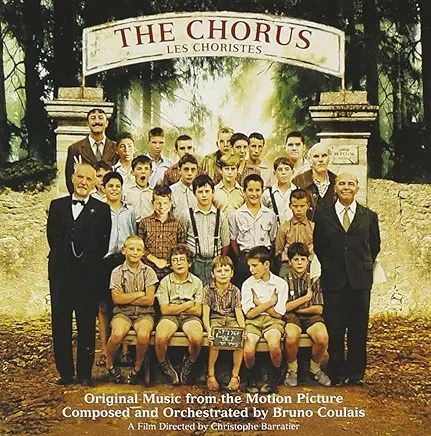
The story of Les Choristes was inspired by the origin of an actual boys’ choir The Little Singers of Paris.

At the 77th Academy Awards, Les Choristes was nominated for Best Foreign Language Film and Best Original Song (the latter for “Vois sur ton chemin“)

Notably, Les Choristes was director Christophe Barratier’s first feature film.


SECOND SET: from “Amelie” (2001) | Composed and performed by Yann Tiersen

– “La valse d’Amélie”

-“Comptine d’un autre été : L’Après-midi”

-“Les Jours tristes” 

-“L’Autre valse d’Amélie”

Amélie is rated #37 among the “50 Greatest Romantic Comedies of All Time” by Rolling Stone magazine, and in 2025, the film ranked number 41 on The New York Times‘ list of “The 100 Best Movies of the 21st Century.” 

Yann Tiersen is a  French- Breton musician and composer. In just two weeks, he composed nineteen pieces for ”Amelie.”

Tiersen just recently released an introspective new album called Rathlin from a Distance | The Liquid Hour.

THIRD SET: “Ascenseur pour l’échafaud” (1957) | Composed and performed by Miles Davis

– “Sur L’autoroute”
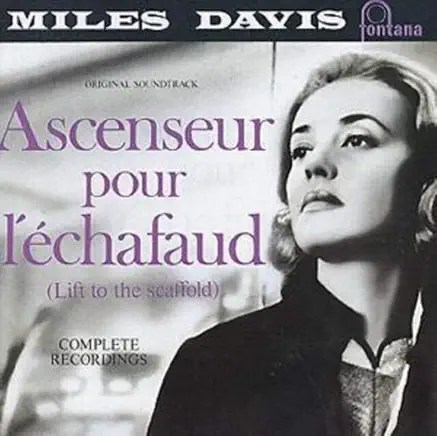
The soundtrack for Ascenseur pour Léchafaud, scored by American trumpeter Miles Davis, became an instant jazz classic, known for its atmospheric, moody, and improvisational style –  perfectly complementing the film noir mood of Louis Malle’s movie.

On December 4,1 957, Davis brought his four sidemen to a French recording studio without any practice or preparation. Once the plot of the film was explained, Miles and his band improvised what would become the classic soundtrack.

The musical ideas explored on Ascenseur pour L’échafaud paved the way for Miles Davis’s later masterpiece, “Kind of Blue”.

FOURTH SET: “Black Orpheus” (1959) | Composed by Antonio Carlos Jobim & Luis Bonfa

-“Manhã de Carnaval”

-“Manhã de Carnaval / La Chanson d’Orphée” performed by Pauline Croze

-“Samba de Orfeu”

Black Orpheus is a 1959 romantic tragedy film directed by French filmmaker Marcel Camus.

The film is particularly notable for its soundtrack by two Brazilian composers: Antônio Carlos Jobim, whose “Manhã de Carnaval” and “Samba de Orfeu” have become classics of bossa nova. 

Black Orpheus won the 1960 Academy Award for Best Foreign Language Film.

CLOSING SONG: Sidney Bechet “Si Tu Vois Ma Mere” (1952)
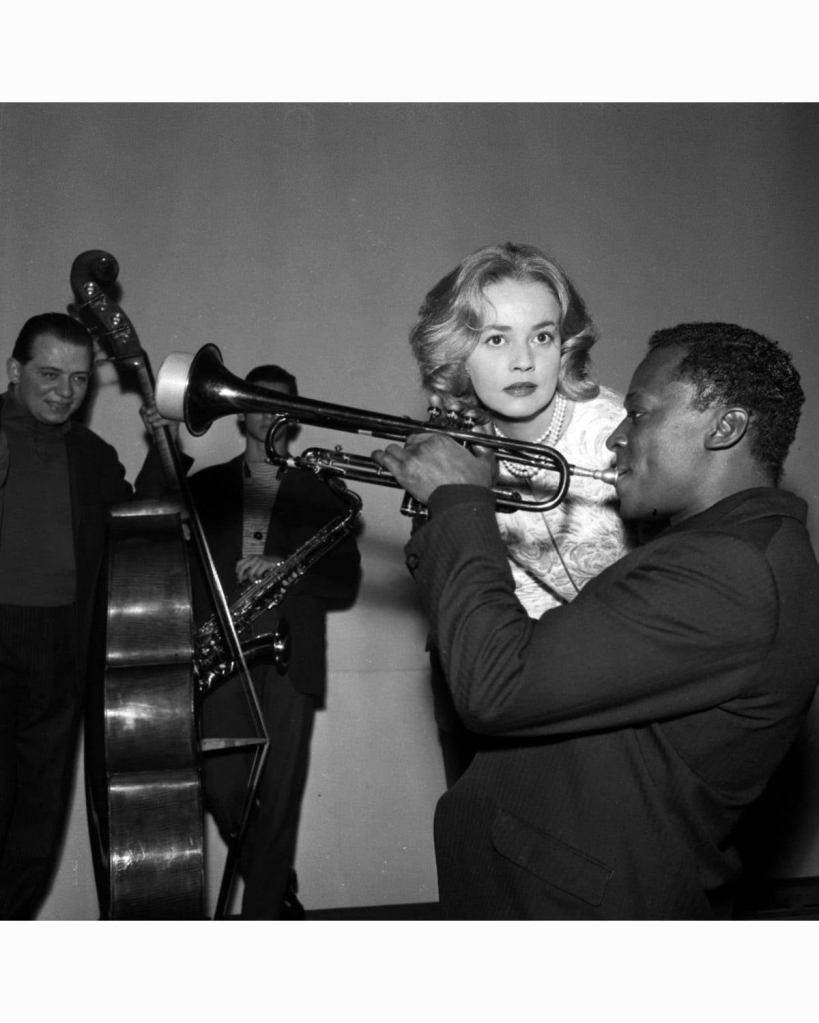
There is no more after… in Saint-Germain-des-Prés… (and no more before either!)

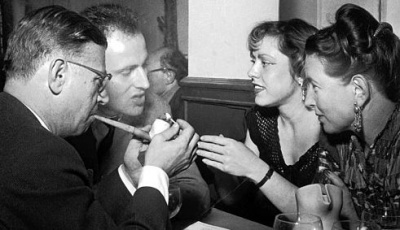
Been to Saint-Germain-des-Pres? Not only does it not exist, but it hardly even briefly existed. Just enough time to forge a media and historiographic myth called for sustainable profitability. This is the thesis supported by the historian Eric Dussault in The invention of Saint-Germain-des-Prés (247 pages, 22 euros, Vendémiaire), probable synthesis of a large-scale university work if we judge by the importance of the sources. He explains the phenomenon by the indifference of cultural historians and by the subordination of history to memory. Because if until 1960 the narration of the epic was well done by journalists, afterwards it concentrated exclusively in the mouth and under the nostalgic pen of actors and witnesses of the time who were authoritative by dint of being taken over. in loop for sixty years without the slightest critical perspective. They are Léo Larguier for his picturesque Saint-Germain-des-Prés, mon village , the Fargue of the unequaled  Pedestrian of Paris , Simone de Beauvoir memorialist ( La Force des choses) and Boris Vian, indispensable master of the premises and author of the Manuel de Saint-Germain-des-Prés guide  (written in 1950 but published in 1974). Continue reading “There is no more after… in Saint-Germain-des-Prés… (and no more before either!)”

The history of Paris as a haven for African-Americans

By Tylisa C. Johnson

I was standing in front of my apartment bookshelf, eyes darting between the shelves, trying to decide which two novels to pack in my carry-on. My eyes landed on James Baldwin’s Nobody Knows My Name. I had to smile.

I was heading to Paris on the eve of Valentine’s Day, in the early days of Black History Month. Alongside a handful of outfits, a conversational repertoire of French, and fading European history lessons, I’d packed a deep curiosity about my African-American ancestry in Paris.

It was Paris where, for decades, countless African-American intellectuals and creatives crossed the Atlantic, hopeful and drawn by the possibility of freedom, an escape from American “Blackness.” For many, it is still sought for its history and culture.
Continue reading “The history of Paris as a haven for African-Americans”

A tour in the footsteps of famous African-Americans in Paris


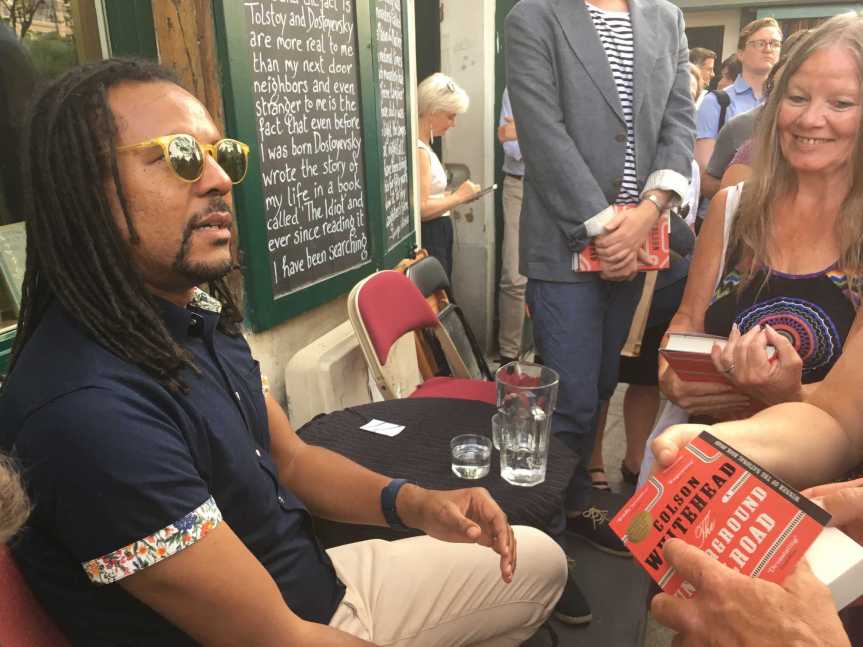
PARIS (AP) – The great African-American writers James Baldwin and Richard Wright began their feud over Wright’s novel “Native Son,” at Cafe Les Deux Magots. Jazz trumpeter Miles Davis held hands with his white girlfriend, French actress Juliette Greco, while strolling along the Seine after hanging out with Picasso. Entertainer Josephine Baker became a megastar at the Theatre des Champs-Elysees. Some travelers to Paris seek selfies with the Eiffel Tower, go to see the Mona Lisa at the Louvre or stroll to the Arc de Triomphe. But you can create a different type of itinerary exploring African-American connections to the City of Light [ . . . ]

Read More: A tour in the footsteps of famous African-Americans in Paris