Colette was one of world’s first ‘liberated’ women…

Head of the Centre d’études Colette tells Samantha David why 21st-century women still need irrepressible and provocative role models like the writer, more than 60 years after she died, to show that anything is possible

More than 60 years after her death, Colette (1873-1954) remains one of France’s most famous female writers, a source of fascination and joy.

Her books, many of which borrowed generously from her own life, are still popular, while a biopic of her life, ‘Colette’ starring Keira Knightley and Dominic West, had its premiere at the Sundance Festival – and has been slated for a limited release in the US in September 2018, before reaching Europe in early 2019.

Born in the provincial backwater of Saint-Sauveur-en-Puisaye (Yonne, Bourgogne) Sidonie-Gabrielle Colette received a remarkably thorough education for a young woman of that era, going to school from the age of six until she was 17.

Colette, her sister and two brothers enjoyed a tranquil, happy childhood; her mother, fiercely feminist and atheist, adored her and taught her literature, while her father taught her the basics of journalism.

Her parents had been quite well off but their fortunes dwindled and by 1891 the family had to move out of their comfortable home into a smaller house in Châtillon-sur-Loing, where Colette met notorious libertine Henry Gauthier-Villars – commonly known as ‘Willy’. [ . . . ]

Continue THE CONNEXION: Colette was one of world’s first ‘liberated’ women…
From Miró to Basquiat and always Picasso- Exhibitions not to be missed in Paris this autumn

Beautiful harvest of major exhibitions this autumn in Paris, with Miró at the Grand Palais, cubism at the Pompidou Center, Nadar at the BnF, Basquiat and Egon Schiele at the Vuitton Foundation, and Picasso again and again: its blue and pink periods at the Museum d’Orsay and a reflection on the concept of a masterpiece at the Picasso Museum.

05 /14
Dorothea Lange at the Jeu de Paume
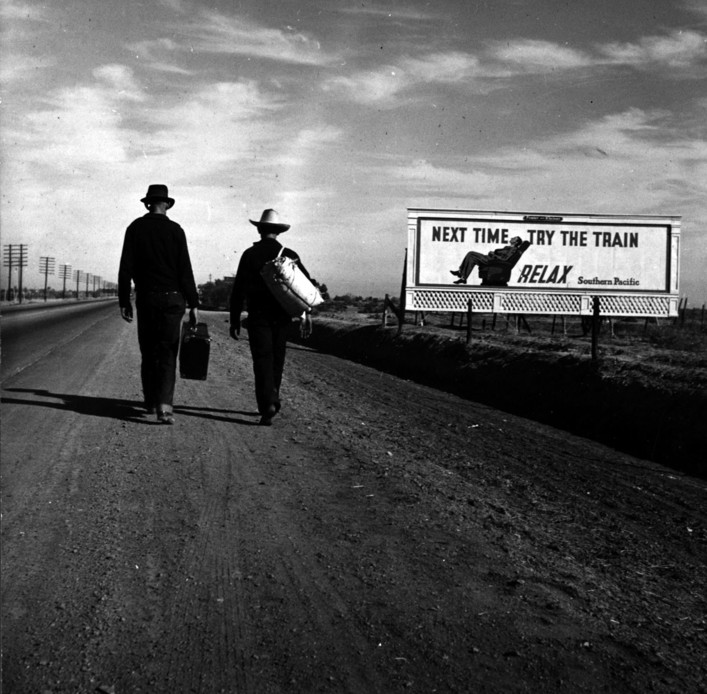
Beyond iconic images like the “Migrant Mother”, the Jeu de Paume showcases more than a hundred vintage prints by Dorothea Lange, from 1933 to 1957. An exhibition that aims to emphasize the emotional strength of the images of the one that was the first female photographer to have a solo exhibition at the MoMA in New York in 1966. Her photos of Japanese Americans interned during the Second World War are shown in France for the first time. From October 16, 2018 to January 27, 2018. Here, Dorothea Lange, “Toward Los Angeles”, 1937

© The Dorothea Lange Collection, the Oakland Museum of California

Continue Reading: From Miró to Basquiat and always Picasso … exhibitions not to be missed in Paris this autumn

6 Operas Based on the Works of Alexandre Dumas-Père

Alexandre Dumas, père, is one of the most famous writers in the history of French literature. Some of his works, notably, “The Three Musketeers” and “The Count of Montecristo” have even transcended his homeland to become fixtures of the international literary canon.Shockingly, it is his son who is better known in the opera world thanks in part to a little-known opera known as “La Traviata,” which is based on Alexandre Dumas-fils’ “La Dame aux Camelias [ . . . ]

Continue reading: 6 Operas Based on the Works of Alexandre Dumas-Père


Read more about SIMONE WEIL on Pas de Merde
Watch Simone Weil documentary

‘A Bite-Sized History of France’ delightfully combines French history with gastronomy

Napoleon’s most famous (and probably apocryphal) quote weaves together war and food: “An army marches on its stomach.” In a few short words, we are led to consider the immense logistics that make war possible, and the humanity of the people who wage it. It’s a fitting quote to introduce A Bite-Sized History of France, a new and impressive book that intertwines stories of gastronomy, culture, war, and revolution.

Each amuse bouche-sized chapter of “A Bite-Sized History of France” tackles a different theme, ranging from the relationship between the revolutionary government and potatoes to the connection between the thoughts of philosopher Jean-Jacques Rousseau and a search for “authentic” French food. The book delves back to the origins of seemingly eternal fixtures of French food culture (chocolate, raw oysters, sweet pastries) and teases out the meaning of their arrival. And it dives into serious historical events ranging from revolutions to sectarian massacres with real conviction, recapping many of the most significant political and military developments in France’s long history as it goes.

Throughout the book, the authors return to certain themes that tie together its many far-flung topics and tastes. Chief among these are the theme of inequality – an examination of how the rich and the poor pursue pleasure and sustenance is at the heart of “A Bite-Sized History of France” and that frame provides a window into economics, inequality, and revolution. Perhaps mostly strikingly, the authors tell the story of a famous Christmas Day feast for wealthy Parisian during the 1870 siege by Prussian troops. Food had seemingly run out, but for those with means, the zoo would serve as a kind of exotic butcher shop:

“[The meal] began with a stuffed donkey’s head, an inelegant successor to the usual porcine centerpieces of prewar banquets. The soup course included elephant consommé. This was followed by kangaroo stew, rack of bear in pepper sauce, and roasted camel à l’anglaise (a cheeky reference to what the French saw as the plainness of English cuisine.) The main course included le chat flanqué de rats (cat flanked by rats) and cuissot de loup, sauce chevreuil(wolf in deer sauce), a wry inversion of the natural order.” Continue reading “‘A Bite-Sized History of France’ delightfully combines French history with gastronomy”

Gauguin Review

The conceptual dullness of the new French biopic Gauguin: Voyage to Tahiti hit me especially hard, since I was fired up to see those Tahitian pictures after a June trip to Paris and the Musee D’Orsay, where many of them reside. Have you been to a highly-touristed art museum lately? It used to be that if you wanted to get close to study the brush strokes it was a guard who’d ask you to step back. Now, it’s people who yell at you for blocking their iPhone photos. The museum’s Postimpressionist area would be a great place to get lost, but, like Paul Gauguin, it ends up making you want to flee civilization for shady pandanus glades halfway around the world — preferably without Gauguin’s raging syphilis.

The syphilis isn’t mentioned by name in Gauguin: Voyage to Tahiti, although Gauguin has an unspecified cough that will obviously be fatal, because in biopics there is no such thing as an inconsequential cough. But as played by the febrile Vincent Cassel, this Gauguin seems too tightly wound for sex. The image of Gauguin the voluptuary eating and screwing and painting naked Tahitian women might be a cliché, but the director, Edouard Deluc, has gone to the other extreme. Although the script is based on Gauguin’s own writing, the film presents him as such a gloomy Gus that he might have swapped souls with his onetime pal Van Gogh.

The movie opens in France, where Gauguin is stricken that his oh-so-proper wife won’t come to Tahiti with the kids — though I imagine she’d have put a crimp in his lifestyle if she had. He does need her family money, since rich people are finding his latest works a mite unruly. He’s also dismayed that none of his fellow painters or acolytes will abandon Paris for distant French Colonial paradises. What Deluc gets right is that Gauguin, like most great artists but few in great-artist biopics, spends most of his time not carousing but sitting in front of canvases. What doesn’t come through is how entwined in Tahiti Gauguin’s various impulses were. The artist tells a doctor friend, “I paint and draw all day long and live in harmony with everything around me,” but you don’t see Buddhist oneness in Cassel’s face, especially as he ages into someone resembling Fagin. Non-transcendental, too, are composer Warren Ellis’s somber cellos and violins [. . . ]

Continue at THE VULTURE: Gauguin Review