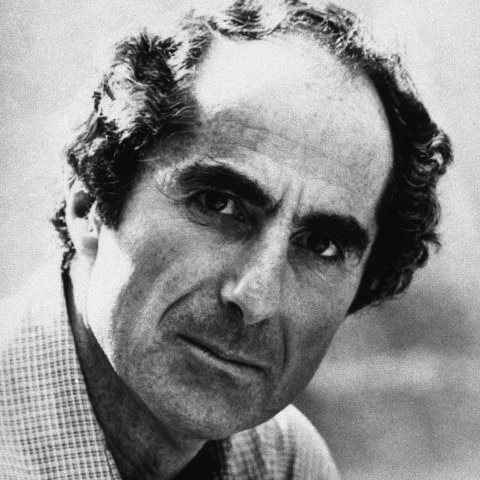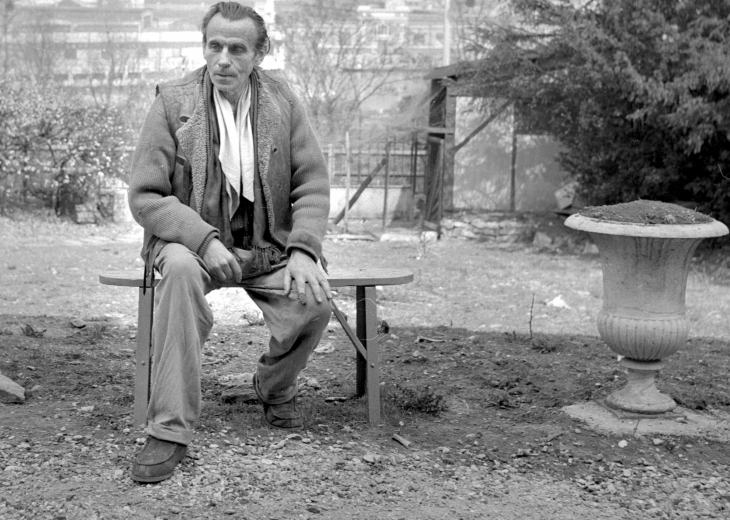
The literature debate tearing apart Paris: should Céline’s racist pamphlets be published?


Louis-Ferdinand Céline was one of France’s greatest novelists – but plans to republish his anti-Semitic writing has dramatically divided Paris.

n a cold but sunny afternoon in late January I paid a visit to the Passage de Choiseul in the commercial heart of Paris. The passage is a covered arcade, one of many such places that were built across the Right Bank of Paris in the early part of the 19th century, and which were effectively the world’s first shopping malls. The Passage de Choiseul is also one of the most important and totemic sites in French literary history. It was the childhood home of the novelist Louis-Ferdinand Céline, arguably the greatest French writer of the 20th century, who still regularly outranks Marcel Proust in readers’ surveys and sales. Most significantly for his admirers, the passage was immortalised by Céline in his two magnificent novels, Journey to the End of the Night andDeath on the Instalment Plan, published in the 1930s. In Céline’s day the place was poor and decrepit and “stank of dogs’ piss”. Nowadays it is expensive and chic. But there is no trace of its most famous literary inhabitant – an extremely unusual fact in France, a country that prides itself on its literature, and where even the meanest provincial town has at least one Avenue Victor Hugo or Lycée Baudelaire.

I bought some pens and a notebook in the upmarket stationery shop just opposite the entrance to number 67, where I knew Céline had lived, and asked the lady behind the counter why there was no trace of the great man. She said that she was often asked this question by Céline’s admirers, who came from all over the world to this place, and that she did not know why there was no commemorative plaque or any other sign that Céline had lived here. She then hesitated, looked around to check that we were alone, and said quietly: “There are many Jews here who control business. They don’t want anyone to remember him.” [ . . . ] More at: The literature debate tearing apart Paris: should Céline’s racist pamphlets be published?

‘The Gourmands’ Way’ review: Six Americans in Paris who changed the way we eat


For Americans growing up in the post-World War II affluence of peace and plenty, convenience cooking, supermarket produce and processed foods formed the basis of [ . . . ]

“The kitchen is a sensual place, and few household activities are more gratifying to the home cook than satisfying the gastronomic whims of a lover or spouse.”

Source: ‘The Gourmands’ Way’ review: Six Americans in Paris who changed the way we eat | Newsday

Vive Les Gourmands! How Six American Expats In Paris Changed How We Eat : The Salt : NPR

Julia Child
Julia Child

Mid-twentieth century Paris evokes images of Left Bank intellectuals earnestly discussing existentialism over demitasses of coffee. But the city was also home to a celebrated food scene that drew gastronomes from around the world. The Gourmands’ Way: Six Americans in Paris and the Birth of a New Gastronomy chronicles the Parisian adventures of beloved TV chef Julia Child, New Yorker writer A. J. Liebling, wine merchant and impresario Alexis Lichine, artist and cookbook writer Richard Olney, novelist M.F.K. Fisher, and companion and muse of Gertrude Stein, Alice B. Toklas.This ragtag band of passionate epicureans dove headlong into French culinary culture, reveling in its sumptuous delicacies. They then brought back many of the recipes and ideas about cooking and eating to the U.S. Roast partridge, calf’s brains gratin, foie gras rissolettes (small patties), epic multi-course banquets washed down with sundry wines, spirits and liqueurs —The Gourmand’s Way bristles with the lavish fare of mid-twentieth century Paris [ . . . ] More: Vive Les Gourmands! How Six American Expats In Paris Changed How We Eat : The Salt : NPR

French author Edouard Louis: Why Macron will lead voters to the far right 

The young literary star defied French elites and social taboos with his best-selling autobiographical novels that portray poverty made invisible in his country. He talks to DW about fiction and a forgotten underclass.

DW: Just like your first novel, “The End of Eddy,” your latest work is also strictly autobiographical. Why?

Edouard Louis: The world is currently saturated with fiction; it’s already structured by lies and fabrications. One of the reasons why people like Chelsea Manning and Julian Assange are persecuted is because they have showed us that governments are lying to us.When the French government claims that we can’t welcome migrants, it’s a lie. Why don’t they just say, “We don’t want to welcome migrants,” instead? That would be the truth…”

ReadFull Story at: French author Edouard Louis: Why Macron will lead voters to the far right | Books | DW | 11.10.2017