Bright and vivid, it’s hard to beat Beaujolais for ‘gluggable’ wines


Caves de Juliénas-Chaintré Villages Cuvée Six, Beaujolais-Villages, France 2018 (from £9.95, nywines.co.ukeynshamcellars.combutlers-winecellar.co.uk) It would be very hard to find a red wine region in the world offering better value for money than Beaujolais at the moment. I don’t just mean that the land north of Lyon provides some of the most reliably drinkable red wines you can find for not much more than a fiver. Wines that are relatively light and, with their soft to non-existent tannin and bright berry thirst-quenching juiciness, are the ideal incarnation of that onomatopoeic wine adjective, gluggable. Chillable, wines such as Tesco Beaujolais Rouge or Sainsbury’s House Beaujolais (both exactly £5). The region also regularly hits a thirst-quenching, prettily-scented spot for a couple of quid more, with “villages” wines, from superior vineyards, such as Morrisons The Best Beaujolais Villages (£6.50 until 4 October), Waitrose Blueprint Beaujolais-Villages 2018 (£7.99) or, in super-succulent, vivid, finger-staining, fresh-off-the-bush style, the Cuvée Six made by a 170-strong co-operative of local growers.

Continue reading “Bright and vivid, it’s hard to beat Beaujolais for ‘gluggable’ wines”

Beaujolais Wine Is Back: What to Look For and How to Drink it

The French wine varietal Beaujolais is making a comeback after decades in the shadow of Burgundy. Here’s what to look for and pairing ideas.

Years ago, while I was tasting exquisite Bordeaux vintages with a high-flying collector, he described Beaujolais in a memorable way: “Sadly stuck in the shadow of Burgundy.” He dismissed it with a wave of his hand. The way he said it, referring to its neighbor to the north, you’d think the region was a sickly Dickensian orphan with no hope.

Until recently, the region struggled mightily from a bad rap—and for good reason. In the 1970s and ’80s, the late, legendary wine merchant Georges Duboeuf created a whole November festival around the release of Beaujolais Nouveau, the entry-level wine named for its being bottled and distributed so soon after harvest.

It succeeded but also created a “crisis,” says Sonja Geoffroy, who works on the winemaking team at the wonderful family-owned Chateau Thivin, in the town of Brouilly (try their Cote de Brouilly). “People didn’t know there was anything beyond Nouveau.” The success created such a demand that many producers planted new versions of Gamay vines that delivered on yield but not quality.

By the late 1990s, Beaujolais was the wine that dared not be sipped in some circles—even though great stuff was still being made by the top producers in the region’s best vineyards. Critics and collectors wouldn’t touch it with a 10-foot wine stem.

Fast-forward to today, when the crus of Beaujolais—the wines from 10 areas in the northern part of the region officially designated as producing the highest quality—are some of the most talked-about bottlings among wine lovers in the know. They can age very well, but most are not made to cellar for more than a decade. We still need something to drink tonight with dinner, right?

Five places to buy French vineyards on a budget

Less prestigious appellations can offer interesting value to those looking to buy French vineyards on a tighter budget, to kick-start a long-held winemaking dream.

Appellation (AOP) vines outside of Champagne cost €74,900 per hectare on average in 2019, but several areas were below €20,000, show figures released this summer by land agency Safer.

If you’re not so bothered about having the AOP status, then non-appellation vines were down at €14,400 on average across France.

It’s also possible to buy land not currently used for vineyards. ‘You would need to apply for planting rights, but you can get them,’ said Kirsten Pollard, of estate agency Maxwell-Baynes, affiliated to Christie’s International Real Estate.

But she said this strategy would be a ‘long way round’, and that buying an existing vineyard can save time and carry fewer risks.

It would be even more important to do your research on the terroir, too.

Pollard, who generally specialises in higher-end properties and covers south-west France, including Cahors and the Dordogne, said that €1.5m might buy you a stone house with several bedrooms, a pool and around 10 to 20ha of vines – albeit perhaps needing some work.

Although it can be ‘quite hard to make money’ from a vineyard at this sort of level, she said it was important to think about potential sales networks.

For example, that might include tapping into the new generation of natural wine bars around the world, or building partnerships with local restaurants.

Pollard highlighted an organic and natural wine estate that she sold a few years ago for €850,000 to a 40-year-old Czech buyer. The property included 15ha of vines near to Cahors but not in an appellation zone.

Some buyers are also looking for ‘hobby’ vineyards that don’t necessary need to turn a commercial profit, as previously reported.

Don’t underestimate the amount of potential work – or cost – involved in running a vineyard, but here are five places to look based on Safer figures.

Languedoc-Roussillon
Buy French vineyards

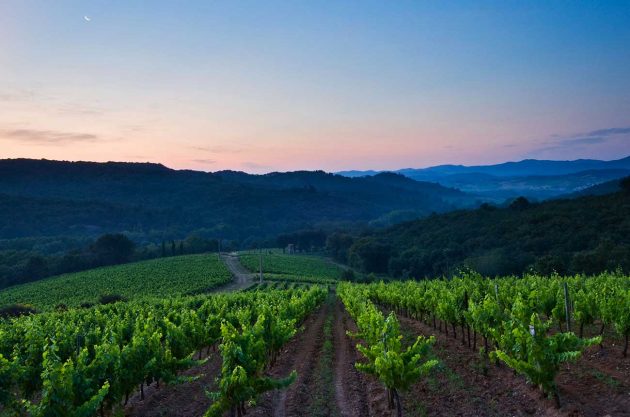
Vines in Corbières at sunrise. Photo credit: Ian Badley / Alamy Stock Photo.

AOP vines in Languedoc-Roussillon cost an average €12,700 per hectare in 2019, up by €200 versus 2018 but still making the vast region one of the cheapest places to buy vines.

However, the region is so big that you’ll find a lot of variation, and you would naturally expect to pay more in one of the area’s more prestigious zones, such as Terrasses du Larzac, La Clape or Pic-St-Loup.

According to Safer, Languedoc has seen a relatively high number of vineyard deals in recent years, compared to other regions.

Prices haven’t risen everywhere, however. The average price of Corbières vines has been around €9,000 for the past few years, for instance.

‘There are many vineyards for sale in Corbières and Minervois because a lot of winegrowers are retiring,’ Aurelia Mistral-Bernard, of the Montpellier branch of estate agency network Vinea Transaction, told Decanter.com recently.

Continue reading “Five places to buy French vineyards on a budget”

Trump Keeps Tariffs on European Wines in Place

Trade Representative says 25 percent duties will remain in place for most French, Spanish and German wines; importers and merchants say the tariffs are killing American jobs

U.S. Trade Representative Robert Lighthizer had no good news for wine consumers last night. The 25 percent tariffs his office (USTR) imposed on most French, German, Spanish and UK wines nearly ten months ago will remain in place for the foreseeable future, forcing wine lovers to pay more and inflicting economic distress on importers, retailers and restaurateurs just as the hospitality industry grapples with the economic downturn triggered by COVID-19. Continue reading “Trump Keeps Tariffs on European Wines in Place”

Is wine really good for you?

The key to deriving health benefits from wine is to drink it in moderation.

If you enjoy a glass of merlot, pinot noir or shiraz, you may be pleased to hear that red wine contains compounds that may also be beneficial to your health.

While red wine has been considered a celebratory and wholesome part of traditional diets in much of Europe for thousands of years, it wasn’t until research identifying the “French Paradox” (the observation that the French had lower rates of heart disease despite their high saturated fat intake, possibly because of their wine consumption) was publicized that Americans started embracing the health qualities of wine. In fact, moderate red wine intake is part of the Mediterranean-style dietary pattern, which is highlighted as one of the three healthy eating patterns recommended by the Dietary Guidelines for Americans.

The Mediterranean-style diet, one of the most widely studied diet patterns in history, has been linked with several health benefits, including lower risks of heart disease, diabetes and neurodegenerative diseases. Numerous clinical studies have linked moderate consumption of red wine with many specific benefits, including reduced risks of stroke, heart disease, diabetes, multiple sclerosis, Alzheimer’s disease, obesity, osteoporosis and infectious diseases. Overall, moderate red-wine consumption is linked with lower oxidative stress and healthier aging, according to researchers. Continue reading “Is wine really good for you?”

Reaching the bottom of the barrel: Coronavirus pandemic batters European wine production


It’s an ancient beverage turned cultural icon, so cherished in France that the legendary Victor Hugo once provocatively wrote: “God made only water – but man made wine”. Aside from being a staple at many family dinner tables, wine is also a massive European industry – and one that’s going through its own coronavirus-induced crisis. This in a sector that was already battling against 25% tariffs imposed by Donald Trump in 2019 that have seen exports slump.

Source: Reaching the bottom of the barrel: Coronavirus pandemic batters European wine production – Talking Europe