
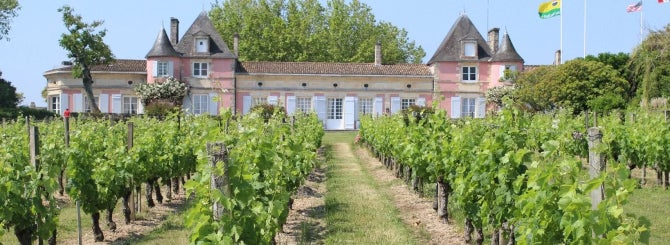
China’s love affair with Bordeaux properties is ending as more investors bring châteaux back into French hands. Read the latest wine news & features on wine-searcher
By James Laurence
In 2011, well-heeled Chinese businessmen made the leap from quaffing Bordeaux to owning Bordeaux.
Château de Viaud in Lalande de Pomerol was the first headline estate to be sold, purchased by a state-run agricultural conglomerate, the COFCO group. Subsequently, more than 150 properties changed hands between 2011 and 2019, including Château Latour-Laguens, Lezongars, Chenu-Lafitte, Richelieu and Monlot. At the time, many predicted this trend would continue for the foreseeable – particularly if the château was pleasing to the eye.
However, the Chinese Communist Party decided in 2019 that enough was enough; restrictions on global capital flows were severely tightened, much to the chagrin of real estate companies like Vineyards-Bordeaux. As a result, the number of transactions plummeted and cash-starved estates had to look elsewhere for salvation. And then Covid-19 happened.
Yet not everyone wept tears over the diminishing influence of outside investors. Bordeaux ain’t no Paris – this is a largely conservative region that has made some concessions to modernity. Nevertheless, a mistrust of a sudden influx of newcomers, bordering on xenophobia, reached fever pitch after several properties were renamed by their new Chinese landlords; the late author Philippe Sollers even wrote to the erstwhile prime minister and Bordeaux mayor, Alain Juppé, to complain about this “sacrilegious” act.
Buy back better
The vineyards in question – Clos Bel Air, Châteaux Senilhac, Tour Saint Pierre and Larteau – were acquired by Mr Chi Keung Tong and his business partner between 2016-17 at a knockdown price; as per usual, families were forced to sell due to the prohibitively high French inheritance taxes (30 percent) and a lack of interest from the surviving children. Within a short time, however, Larteau had been renamed Imperial Rabbit and Senilhac was rebranded as Château Tibetan Antelope. Eyebrows were raised higher than Mont Blanc, and many predicted this obvious gimmick would fail.
It turns out they were right: Chi Keung Tong sold his acquisitions to a French duo in 2022. “Initially, the foreign buyers did invest money to develop their châteaux, however, due to the Covid-19 period and the economic crisis in China, they were not able to continue to run them,” explains co-owner Denis Chazarain.
“Moreover, the renaming of historical châteaux, properties that boasted established reputations and long histories, created confusion for consumers, even in China. The truth is that Chinese consumers look for stately imagery and pedigree – it was commercial suicide to use these ‘funky’ names.”
Denis Chazarain, and his associate David Caillaud, set up the company Les Domaines de l’Emissaire in 2022 – they purchased the four estates for an undisclosed sum that same year. Their first task, after making an initial inspection, was to banish Imperial Rabbit and Tibetan Antelope to the history books and reinstall the original monikers. Then the hard work began.
“Our number-one priority was sourcing good permanent staff – this was a major challenge as the previous owners used third-party providers on an ad hoc basis,” says Chazarain. “Thankfully, we now have a good team in place – individuals who understand the vineyards and the terroir. One of our key objectives was to start working on a parcel-by-parcel basis, rather than the previous approach of simply vinifiying the entire crop.”
The portfolio certainly has real potential. Château Senilhac is a sizable Haut-Médoc estate with clay-limestone soils, while Clos Bel Air (2.3 hectares) offers an authentic slice of Pomerol garagiste winemaking – “We really do make wine in a garage,” enthuses Chazarain – and high-potential sandy/gravel terroir. Meanwhile, Château Tour Saint Pierre comes with 11.5 hectares of prime vineyards that were formerly owned by the mayor of Saint-Émilion; Larteau is classified as a Bordeaux Supérieur, located south of the Dordogne River close to the town of Arveyres. Like Bel Air, these are Merlot-dominant wines that slot nicely into the “affordable Bordeaux” category. Tourism is also a major focus for the owners, with ongoing renovations at Larteau to expand its potential as a wedding/seminar venue.
“We have also invested in the land, replanting around 5 hectares, in order to ensure the long-term sustainability of the vineyards, engaging them also in a process of environmental certification and biodiversity management, in all properties,” says Chazarain.
“In addition, we have upgraded the equipment, both for viticulture and winemaking, renovating the cellar of Clos Bel Air and constructing a brand new one for Tour Saint Pierre in Saint-Émilion Grand Cru. We have also created some new brands, such as a Cabernet Sauvignon rosé called l’Aerial, and a new Merlot wine l’Improbable.”
New markets
Meanwhile, Chazarain is busy planning for the Wine Paris trade fair in February 2024. But, the biggest priority is to expand distribution of Les Domaines de l’Emissaire’s collection of wines in a saturated global market fraught with geopolitical turbulence and falling consumption. Does that worry him?
“Competition is just an opportunity to improve and to be innovative – we believe in the expansion of new markets which are not yet familiar with wine consumption,” he replies.
“We are especially proud of the expansion we see in north Asia; we will complete the investments started in 2023, especially the completion of the new cellar in Tour Saint Pierre in Saint-Émilion and the opening of our renovated rooms in Château Larteau in March 2024. The replanting program continues apace and Wine Paris is the perfect opportunity to showcase our new labels.”
This ongoing project to resuscitate châteaux acquired by hands-off investors, and then left to decline, is likely to become a key theme of 2024. Ten years ago, Château Loudenne was sold to the Chinese group Kweichow Moutai who, it should be said, invested several million euros into the venture. Nevertheless, success eluded the firm and it was purchased by the French businessman Christophe Gouache in 2022.
Source: France Buys Back Bordeaux | Wine-Searcher News & Features
 Pas De Merde