
“Queen Mother”: Manele Labini invites Camelia Jordana and the ghost of Charles Martel in a second film full of fantasy

By Laurence Houot
After taking an ironic look at her country in Un divan à Tunis , the Franco-Tunisian director this time delves into the daily life of an immigrant family struggling in a France where it is sometimes complicated to feel at home. Reine mère , starring Camélia Jordana, Sofiane Zermani and Damien Bonnard, is released in theaters on Wednesday, March 12.
The film opens with a swim in the Mediterranean sparkling with sunshine. The image, like an idyllic vision of origins, is quickly chased away by the return to reality. Barely back from vacation in France, Amel (Camélia Jordana) and her husband Amor (Sofiane Zermani) learn by mail that they will have to leave their home. For Amel, there is no question of changing neighborhoods. She wants the best for her two daughters, who attend a Catholic school very close to their home. It is there, during a history lesson, that Mouna (Rim Monfort) sees the ghost of Charles Martel (Damien Bonnard) appear for the first time.
While her husband, an electrician, supports the entire family, Amel refuses to work. Without a diploma, she could not hope for better than a job as a cleaning lady, unthinkable for this proud woman who repeats over and over that she grew up in a wealthy family in Tunis. Amor, for his part, struggles to the task. An eternal optimist, he does everything, in vain, to satisfy his capricious wife. As for Doumia, she ends up transforming the ghost of Charles Martel into an imaginary friend, who will help her find her place in a world that rejects her.
In 2020, the Franco-Tunisian director told the story of her country, in full transformation, in Un divan à Tunis , through the story of a psychoanalyst returning home. She explores this question of exile, this time on this side of the Mediterranean, with a second film in the form of a tale that has fun deconstructing the mythological figure of Charles Martel.
Lack of consideration and self-deprecation
How do children feel when they are told at school this story of Charles Martel stopping the Arabs in 732? It is by putting herself in the shoes of a young teenager confronted with this experience that the director pulls the threads of this dramatic comedy in the form of a tale.
With dialogues that hit the mark and this nice idea of staging the ghost of Charles Martel, the director explores the question of exile and immigration from the point of view of a teenager, who receives unfiltered messages that are indirectly addressed to her in class, and in her everyday life. Manele Labini highlights the underlying, constitutive violence of institutions towards those who come from elsewhere. From administrative hassles to ordinary racism. Between clumsiness and malice, the film highlights the lack of consideration of which they are victims in many situations of daily life.
But the film does not just pin down (tenderly, but without concessions) France. It also plays on self-mockery through the portrait of Amel, who ends up becoming annoying because she puts so much bad will into it. Downgraded, this whimsical and proud woman wants to keep her dignity, in all circumstances. If she has to do the housework, it will be without an apron and heels on her feet. Even if she is the laughing stock of her friends, characters with joyful verve, who we are pleased to meet intermittently throughout the film, Amel does not let her life be dictated to her.
One myth against another
Manele Labini enjoys staging two mystifications of the past face to face: on the one hand this largely mythological “fable” always told in history books around the figure of Charles Martel, and on the other the self-mystification of a woman who invents a glorious past to better bear the weight of exile. Through this adventure, Amel, like Charles Martel, will try to escape the stories that imprison them. Because how can we live well in the present when the past imprisons us? This universal question runs through this film full of surprises.
The spirited production is carried by the generosity of the actors. The overflowing and sunny character of Amel seems to have been made for Camélia Jordana. Damien Bonnard, chainmail and cigarette in mouth, plays a ghost of iconoclastic Charles Martel, and forms a touching duo with the young Rim Monfort in the role of Mouna, for whom he represents the imaginary friend she needed to confront the invasive nature of her mother, and a hostile school environment. As for the sympathetic character of Amor, he is carried by the luminous Sofiane Zermani.
Even if the line is sometimes a little heavy-handed, this modern tale sheds new light on the unique feeling of exile, and the battles that one must sometimes wage with oneself, with others, and with institutions, to feel at home.
Damien Bonnard, extremely comfortable in his chainmail, shares the bill for this modern tale with Camelia Jordana, perfect in the role of “Queen Mother” made for her.
“Chabada” celebrate the most beautiful ‘chansons’ of the century
All the great French stars took turns on the set of LA FETE DE LA CHANSON FRANCAISE to revisit the most beautiful songs of the century.
A unique show, live music, talented artists and constantly renewed creation.
Claude Lelouch Recalls ‘Chabadabada’ Composer Francis Lai

The 52-year, 35-picture collaboration between Lelouch and Lai was at the heart of a masterclass by the director at the Venice Film Festival
By Melenie Goodfellow | Aug 2024
French director Claude Lelouch first broke out internationally with 1966 romance A Man and a Woman, starring Anouk Aimee and Jean-Louis Trintignant as a widow and widower whose fledgling love story is held back by past personal tragedies.
Nearly 60 years later, the soundtrack by late composer Francis Lai – and in particular its title track, which is often referred to as ‘Chabadabada’ for its catchy refrain – remains as famous, if not more famous, than the Oscar and Cannes Palme d’Or-winning feature
That movie would mark the start of a 52-year, 35-picture collaboration between Lelouch and Lai, which was at the heart of a music-themed masterclass by Lelouch at the Venice Film Festival on Saturday.
The director is at the festival to receive the Cartier Glory To The Filmmaker Award as well as for the premiere of new work Finalement, starring an ensemble cast led by Kad Merad and also featuring Elsa Zylberstain, Michel Boujenah, Sandrine Bonnaire, Barbara Pravi and Françoise Gillard.
Lelouch first met Lai in 1965 having forged strong connections with the music world through his music videos for the likes of Sylvie Vartan, Françoise Hardy and Dionne Warwick, directing her singing ‘Walk On By’ against the Paris skyline in 1964.
“He spent two hours two hours playing me melodies on his accordion and these melodies spoke to me, to my heart, to the essential,” recounted Lelouch. “He was completely self-taught and there was great freedom in his way of playing, in his harmonies and tonalities.”
Lai’s compositions became part of Lelouch’s creative process as a director and he would get the musician-composer to write soundtracks for his films on the basis of his ideas as part of development.
“I recorded the music for all my films before shooting the films, because I really wanted the actors to listen to the soundtrack and I myself needed to listen to it,” he explained.
This even resulted in two separate films coming to fruition on the basis of Lai’s two musical interpretations of the same idea: Love Is A Funny Thing (1969) and One Plus One (2015).
Lelouch explained how he used the score on set of a Love Is A Funny Thing – starring Jean-Paul Belmondo and Annie Girardot as a French composer and actress who meet while working in L.A.
“In the final scene Annie Girardot’s character is waiting for Belmondo’s character at the airport. She (Girardot) didn’t know whether he was going to descend from the plane or not… the camera is on Girardot, and in Girardot’s ear is the music of the film,” he explained.
“What is interesting is that she really didn’t know whether he was going to come down the steps or not. She wasn’t acting. If she had known, she would have still played the scene well… but in real-life we don’t act.”
Lelouch did not make all his films with Lai, collaborating with other composers such as Michel Legrand, and even bringing their talents together on Bolero, the 1981 saga tracking three generations of musicians and dancers from Russia, Germany, France and the U.S.
The director said this had kept their creative relationship fresh.
“It’s true I did cheat on him from time to time,” he joked. “Francis Lee was always delighted when I came home, like a wife who is happy to see her husband come back home.
“That allowed us not to get too used to one another and this liberty also allowed him to work with other directors too… then, when we re-found one another, we wanted to seduce each other once again.”
Source: Claude Lelouch Recalls ‘Chabadabada’ Composer Francis Lai
Doisneau “Bistro Flowers”
Bistro flowers, Paris 1971

The Björn Andrésen Story
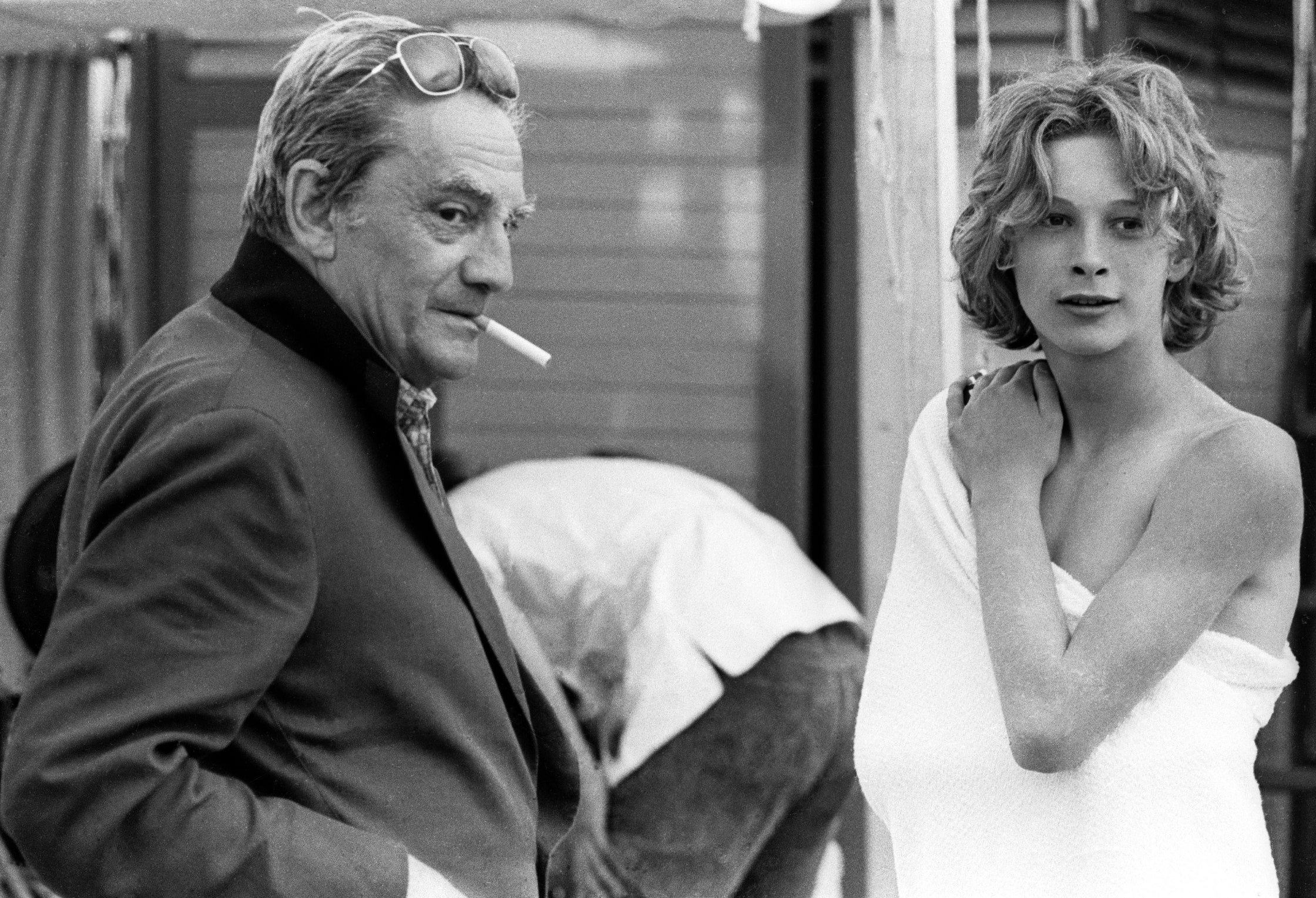
Björn Andrésen’s journey from ‘the most handsome boy in the world’ to a reflective artist reveals the deep and lasting impacts of early fame on his personal and professional life.
By Denise Massone
The label of “most beautiful boy in the world” was attributed to him by Visconti during the London premiere of the film. With the presentation of “Death in Venice” at the Cannes Film Festival, there was a global amplification of this vision. Andrésen’s beauty, defined by the director as “absolute beauty, like the angel of death,” with his delicate features and ethereal aura, captured the attention not only of Visconti but also of the entire crew from the start. For years, the production of the film had been looking for the right person for the role of Tadzio, who had to be played by a very young boy, with pure and androgynous beauty.
The choice of Björn Andrésen was the result of extensive research across Northern and Eastern Europe by Visconti, who viewed many young actors. When Andrésen entered the audition room, held in Stockholm, Visconti no longer needed to look any further: he had found his Tadzio. The photos and immediate filming that the crew took of the fifteen-year-old during the audition, including nude ones, became famous and immediately made the young man very embarrassed.
After the release of “Death in Venice,” Andrésen’s performance was acclaimed, and his physical appearance inspired audiences worldwide, not to mention a whole generation of manga artists in Japan. The most famous Japanese designer to take inspiration from him was Riyoko Ikeda, who took inspiration from Björn’s appearance for the renowned character of Lady Oscar in the manga “The Roses of Versailles”. From that moment, the young actor became a cultural icon and the first Western idol in the history of Japan.
The fame and morbid attention that followed the success of the film were the beginning of a nightmare for Björn, as he became a young teenager left alone, embodying for everyone only an object to be admired, such as a statue or a work of art. There was no slightest interest in who he really was and what he thought.
The 2021 documentary titled “The Most Beautiful Boy in the World,” made by Swedish independent filmmakers Kristina Lindström and Kristian Petri, explores the complexity of Björn’s life and the effects of early fame on his personal and professional life. This documentary film shows how the acclaimed beauty and celebrity influenced his already difficult childhood, marked by the lack of knowledge of his father and the loss of his mother in tragic circumstances, at just eleven years old. Björn lived for some time in boarding school and then went to live with his grandmother, a narrow-minded woman who immediately pushed him toward the world of entertainment to get rich. Björn himself says in the documentary, “My grandmother wanted a famous grandson,” and while the boy always looked for affection from his grandmother, she also pushed him to associate with important wealthy people to profit from her grandson’s beauty. These characters were interested in Björn’s presence as a trophy to display during their social gatherings. From that moment on, the young adolescent’s tendency towards depression and alcoholism was born.
Andrésen struggled for much of his life with the expectations and pressure resulting from his public image, which more often than not confliced with his reality as a boy who needed affection and his desires. After “Death in Venice” he faced periods of darkness and great pain, including family tragedies, a long period of alcoholism, and the incessant difficulty of managing a celebrity that arrived too soon, in solitude. That shade of sadness always present in his gaze became memorable, evident to others in every moment of public or private life, and an expression of his internal struggles.
The young actor, growing up, also explored other art forms such as music, but his identity remained inexorably linked to the iconic character of Tadzio. His life and career, after that role, have been a conflictual path, but also strong possibilities for personal growth and a profound understanding of pain. He had to fight against the public’s obsession with his beauty and against that morbid desire that made him stop being a person in the eyes of the world. Today, remembering what he had to go through in those moments, he refers to the people around him as “bats around him.”
After his short musical period, Andrésen continued to work in cinema and also on television, participating in a variety of projects. Andrèsen’s filmography includes his film debut in “En kärlekshistoria” (1970), followed by a series of Swedish films such as “Bluff Stop” (1977), “Den enfaldige mördaren” (1982), and “Lucifer sensorimmer-gult og sort ” (1990), demonstrating his ability to play different genres and roles. And on television, he participated in “Finding Tadzio” and “Maskrosbarn” (1989).
In recent times, Björn made an appearance in the horror film “Midsommar” (2019), directed by Ari Aster. He managed to bring an unforgettable performance to the screen, which rekindled the interest of filmmakers in his figure as an actor. Björn Andrésen’s career reflects his evolution as a person and as an artist. He has always sought roles that contrasted expectations and distanced him from the eternal image of a boy-object. Despite all his past suffering, the actor has left an indelible mark on the world of cinema and continues to be a major figure in popular culture. Today Björn Andrésen is a man who has found his own wisdom and inner peace. He has managed to acquire a way to live with the past and at the same time accept himself, despite the shadows that have long shrouded his figure. His story represents a powerful warning of how beauty, success, and fame can be both precious gifts and curses if not managed with empathy, the presence of true affection, and balance, and how the entertainment industry can profoundly influence the life of a human being.
 Pas De Merde