Bookended with canonical traditional songs and sung in eerily bright a cappellas, Gamble is a confident, self-produced debut by an exciting new voice. This is Zoé Basha, a Dublin-based French-American singer and guitarist whose folk music swims deftly around country, jazz, French chanson and the blues.
This is a nourishing, impressive 11-song set, with Basha’s voice swooping high and low like the Appalachian mountain music she loves. It begins boldly with Love Is Teasin’, first recorded by Appalachian singer Jean Ritchie and covered by Shirley Collins on her 1954 debut. Basha’s precise enunciation nails her protagonist’s wearisome experience of love, but a friskiness also lurks at the ends of her phrases, her highest notes tremulous with heat. She also masters playfulness on Sweet Papa Hurry Home (a cover of Jack Neville and Jimmie Rodgers’s 1932 country song, Sweet Mama Hurry Home, which shows how naturally the genre’s roots mixed with jazz), sweet suggestiveness on Come Find Me Lonesome, an original tailor-made for a blues club: “Cold is creeping up my spine in the night-time.”
She’s also a nifty collaborator. In her version of the ballad Three Little Babes (with nyckelharpa player Aina Tulier and singer Anna Mieke, with whom she sings in three-part-harmony group Rufous Nightjar), the tale of death and dreams bristles with hunger of horror. But she also writes great originals full of texture and feeling. The best are Dublin Street Corners, a great patchwork of failed dreams in a booze-soaked city (“I’m the one you lie next to in bed / When you’re too tired to try, or so’s you said”) and the chanson-flavoured Traveling Shoes, full of the nonchalant ruminating of a fly-by-night lover. “I can’t leave my heart trailing behind just to greet you in the morning,” Basha sings, as you try to hold tight to these fabulous songs
Could Camembert and Brie disappear? Scientists warn that France’s rich culinary heritage is at risk.
By Poppy Pearce
The very microbes that give some French cheeses their unmistakable flavours and textures are under threat, potentially jeopardising not only France’s food culture but also its economy.
Microbes: the unsung heroes of French cheese
At the heart of traditional cheese-making lies an ecosystem of bacteria and fungi, crucial in shaping everything from Brie’s creamy texture to Camembert’s pungent aroma. However, a recent warning from France’s National Centre for Scientific Research (CNRS) suggests that the genetic diversity of these microbes is shrinking at an alarming rate.
In particular, strains of Penicillium camemberti—the fungus responsible for that distinctive white rind—are now worryingly uniform, making them more vulnerable to disease and environmental changes. Similarly, Penicillium roqueforti, used in blue cheeses like Roquefort, is facing a decline in genetic variation.
Jeanne Ropars, a researcher at the Ecology, Systematics and Evolution laboratory in Gif-sur-Yvette, said: “To date, only four populations of the fungus species P. roqueforti have been known in the world.” (CNRS The Newspaper)
Such a lack of diversity increases the risk of these essential fungi being wiped out by new pathogens or shifts in climate
The loss of Brie and Camembert would be more than just a gastronomic tragedy—it would be a financial disaster. France exported nearly €3.8 billion worth of cheese in 2022, with Camembert and Brie among the biggest contributors. From Michelin-starred restaurants to the humble boulangerie, these cheeses are fundamental to French cuisine.
For many visitors, tasting authentic Brie in a Parisian café or slicing into a gooey Camembert during a countryside picnic is a rite of passage. Cheese tourism is a major industry, drawing food lovers from around the world. Imagine a future where a French picnic lacks its signature cheese—or worse, where a baguette has lost its best friend.
Can science save French cheese?
The good news? Researchers are now racing to protect these microbes before it’s too late. Some scientists are exploring ways to reintroduce genetic diversity into the fungi populations through selective breeding or by searching for lost strains in traditional farmsteads. Others suggest that small-scale producers, who still use raw milk and traditional methods, may hold the key to preserving these vital organisms.
Protecting French cheese isn’t just a job for scientists. Consumers can also play a role by supporting artisanal producers who prioritise microbial diversity over mass production. Opting for traditional, raw-milk cheeses rather than industrially mass-produced versions could help sustain the biodiversity that has made French cheese world-famous.
The future of Brie and Camembert isn’t set in stone. But one thing is certain: if we want to keep enjoying the world’s best cheese, it’s time to act. Because a world without fromage? Is that really a world worth living in?!
Étoile takes a while to find its groove—but when it does, it soars
If you experienced a bit of TV déjà vu when you heard about Étoile, Prime Video’s new ballet dramedy from the creators of The Marvelous Mrs. Maisel and Gilmore Girls, you’d be forgiven. Amy Sherman-Palladino and husband-partner Daniel Palladino already dipped a pointed toe into the world of tutus and turnouts with their 2012 series Bunheads, which starred theater favorite Sutton Foster and Gilmore great Kelly Bishop and ran on ABC Family for one season.
It certainly looks like the Palladinos haven’t shaken their preoccupation with pliés and pirouettes. (Sherman-Palladino started training in classical ballet when she was just four.) Étoilen (French for “star”) follows the professional dancers and artistic staff of two of the world’s most storied ballet companies (one in New York, the other in Paris). With both institutions struggling to fill theater seats in a post-pandemic and tech-possessed society (“Our dancers have abandoned toe shoes for TikToks,” one character bemoans in an early episode), they’ll need a miracle to get the public caring again about the endangered, and admittedly stuffy, art form.
Or, apparently, they just need a savvy marketing move. Geneviève Lavigne—the interim general director of l’Opera Francais and Le Ballet National, played by the ever-chic French actor/musician Charlotte Gainsbourg—proposes they drum up much-needed attention by having her Parisian dance company swap some of its top talent with that of New York City’s Metropolitan Ballet Theater, which is helmed by executive director and Geneviève’s sometimes paramour Jack McMillan (Maisel star Luke Kirby).
Given that the series is populated entirely by neurotic New Yorkers and fussy French folks, it’s no surprise that the single-year swap does not go over well with either company’s main players, especially when word hits that Jack wants to snatch up France’s superstar principal dancer Cheyenne Toussaint (Lou de Laâge). All that melodrama isn’t completely warranted, TBH; in real life, swapping ballet dancers isn’t an entirely uncommon practice among the discipline’s most elite establishments.
But this is a Palladino property, which means everything is heightened. The dialogue is, as always, quicker than a chaîné turn; the takes are long and lush (with all eight episodes directed by the Emmy-winning duo, whose love of the master shot emphatically endures); and the settings and costuming are unsurprisingly sumptuous, especially in Paris. That’s no disrespect to Lincoln Center’s lovely campus; it’s just that France has had a couple extra thousand years to get all ornate and magnifique. (By the way, Geneviève may meta-mock that “This isn’t Emily In Paris, Jack—you can’t see the Eiffel Tower from everywhere,” but rest assured that all of the picturesque landmarks from that Netflix series are accounted for here as well.)
And disciples of the Gilmore gospel will be charmed by the familiar Stars Hollow faces that frequently drop into rotation: There’s the regal Kelly Bishop as Jack’s moneyed mom, Yanic Truesdale as Geneviève’s right-hand man Raphael, Dakin Matthews as a member of the MBT board, and so on.
The whole transatlantic move is complicated, of course, by interpersonal dynamics. Jack hates who’s funding the campaign, the duplicitous dandy Crispin Shamblee (Simon Callow). Cheyenne refuses to partner with any danseur other than Gael (West Side Story’s David Alvarez), who’s been hiding out on a self-imposed farm “sabbatical.” French-born nepo baby Mishi Duplessis (Taïs Vinolo) struggles with her overbearing stage parents upon her return to the Paris company. And the quirky creative chaos—and, evidently, on-the-spectrum diagnosis—of American choreographer Tobias Bell (Gideon Glick) is lost in translation among the French performers, save for male lead Gabin (Ivan du Pontavice). (‘Shippers, take note.
Using real-deal talents (like the New York City Ballet’s Tiler Peck and the Boston Ballet’s John Lam) adds legitimacy to the dramedy’s frequent dance numbers, which are overseen by choreographer Marguerite Derricks. (Each episode lovingly ends with rehearsal footage of actual ballerinas, too.) However, some of the more dance-focused cast members fail to pop against their fellow actors. For example, the supposed heat in the pas de deux between Alvarez’s Gael and De Laâge’s Cheyenne feels barely simmering. Hell, it’s tough for anyone onscreen to match the passion of the French fireball that is Cheyenne: “You feel everything—that’s why you’re such an asshole,” one character shrewdly sums her up. And both Gainsbourg and Kirby are captivating leads but because their characters, like us, are viewers and not doers—lovers of the art form, certainly, but saddled more with navigating the bureaucracy of ballet rather than creating the beauty of it—that means their respective storylines lack the intensity and urgency of their more kinetic company.
Speaking of lack of urgency, the eight episodes do move slowly. With two companies and cities to get acquainted with, it takes a good half season to really get grooving. However, unlike their one-and-done experience with Bunheads, the Palladinos have the benefit of time here—and money, too. Thanks to an overall deal inked with Amazon MGM Studios back in 2019 (boosted by the success of The Marvelous Mrs. Maisel), Étoile was green-lit for two seasons before the curtain could even rise, which means there are plenty more moves to come. Here’s hoping that, story-wise, that adagio speeds up to an allegro in season two.
For a long time, a sector of the Church directed and financed from the US attempted to depose the Vatican leader in order to impose its own identity-based ideology
By Daniel Verdu
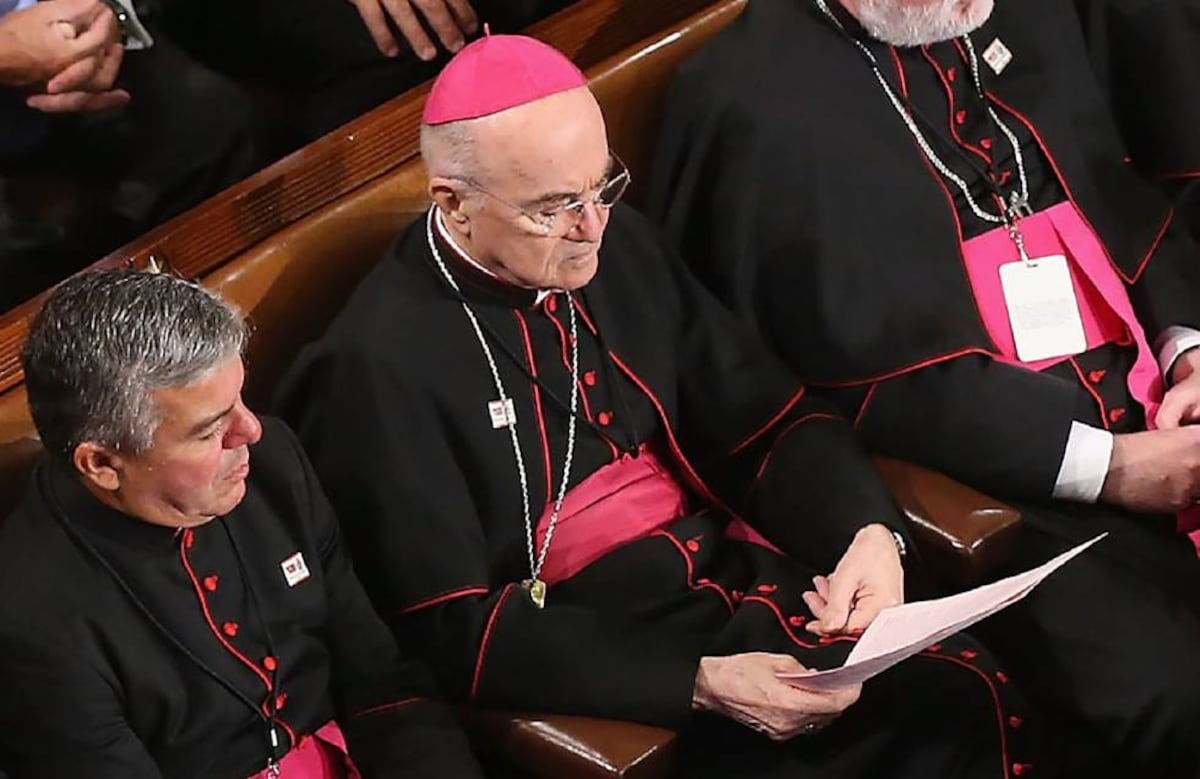
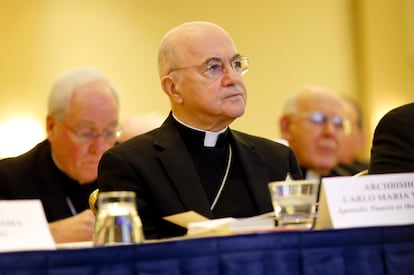
On the morning of August 26, 2018, while the Pope was visiting Ireland with the usual entourage of journalists and Vatican staff, the bomb dropped. Archbishop Carlo Maria Viganò, a former Vatican envoy in Washington between 2011 and 2016 and a heavyweight within the Curia, accused the Pontiff in an 11-page letter of having covered up the abuses of Cardinal Theodore McCarrick, and demanded his resignation. The violent tone of that letter and the accusations it contained were the culmination of a campaign that had begun a few years earlier within the Holy See to overthrow a Pope they considered too progressive, a heretic even. The attempted schism was directed and financed from the United States, where Donald Trump was spending his first term in the White House and in search of a cultural and ideological narrative capable of flourishing on the Judeo-Christian roots of the Western world. And the Vatican, from that perspective, could not be governed by a Pope who was an environmentalist, tolerant of homosexuality, an anti-capitalist, and, above all, extremely belligerent toward the anti-immigration policies that characterized Trump’s first presidency.
In this 2015 file photo, Archbishop Carlo Maria Viganó, Apostolic Nuncio to the U.S., listens to remarks at the U.S. Conference of Catholic Bishops’ annual fall meeting in Baltimore.Patrick Semansky (AP)
There have always been tensions and internal struggles in the history of the Roman Catholic Church. Unity and avoiding schism were an obsession. But never in contemporary history had a Pope been so violently targeted. And, above all, it was completely unusual for the Pontiff’s enemies to come from the traditionalist sector, supposedly the keeper of the essence of Catholicism. Until then, such battles had been fought only by far-right groups like the Society of St. Pius X, founded by the rebel French archbishop Marcel Lefebvre, who was excommunicated in 1988 after ordaining four priests without Rome’s permission.
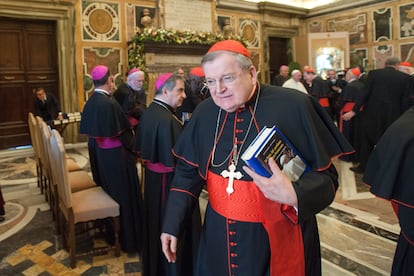
The symptoms had been clear for some time. Steve Bannon, Donald Trump’s chief advisor before his fall from grace, a sort of Elon Musk avant la lettre, settled into the penthouse of the Hotel De Russie on the luxurious Via del Babuino. From there, he began receiving Italian and European leaders who viewed the Pope unfavorably: from Matteo Salvini to Trump himself. Bannon attempted to open a sort of school of populism on the outskirts of Rome, increasing the pressure through sympathetic media. The American Cardinal Raymond Burke became the political arm of this new movement within the Vatican, and together with other cardinals such as the excellent theologian Gerhard Müller, they began to hatch a plan to expose Francis’s alleged lack of intellectual preparation.
Former archbishop of St. Louis Cardinal Raymond Burke leaves the Clementina Hall during the Christmas greetings of the Roman Curia to Pope Francis on December 21, 2017 in the Vatican.Vatican Pool (Getty Images)
“It began early, in the summer of 2013, when it was already clear that many U.S. bishops didn’t recognize him as one of their own,” notes Massimo Faggioli, a professor in the department of theology and religious sciences at Villanova University in Philadelphia. “American conservatives thought that after John Paul II and Benedict XVI, their destiny was forever marked by neoconservatism. And the Pope didn’t allow it. That was his sin,” he adds.
In the United States, there are approximately 72.3 million baptized people, almost a quarter of the population. But the influence of Catholics has grown in recent years. A third of the members of Congress practice that faith, according to a study by the Pew Research Center. Vocations to one of the richest churches in the world have fallen more than anywhere else, and pedophilia scandals, with the now-famous Boston case, wreaked havoc. However, the obsession with the Vatican of the new White House occupants and neoconservative power circles has continued to grow.
One of the impressions that always haunted Bergoglio was that Benedict XVI’s resignation in 2013, despite having been a gesture of generosity and humility, had opened a rift in the Church that the conservative sector seized upon to wage its struggle. The fiction that was established was that if there were two men dressed in white strolling through the Vatican gardens, why not close ranks around the more conservative one? Ratzinger, an excellent theologian, though not skilled in personal relationships, never accepted that role. But some oversights and the influence of his personal secretary, Georg Gänswein, who was at odds with Francis, caused some slip-ups.
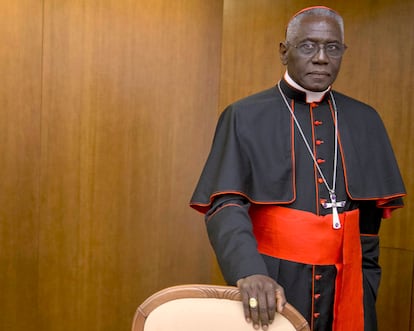
The height of tension came five years ago with the publication of a book that the Pope Emeritus was supposedly co-authoring with the ultra-conservative Cardinal Robert Sarah, in which he strongly opposed optional celibacy and, above all, the ordination of married men (From the Depths of Our Hearts). This was an issue on which Francis was due to address the synod on the Amazon, and which turned the publication into an act of interference.
Cardinal Robert Sarah in Rome on October 14, 2015.Andrew Medichini (AP)
Francis kept up the fight to the bitter end. On February 10, in fact, he sent a letter to the U.S. bishops (195 dioceses) denouncing the Trump administration’s program of mass deportations. The letter infuriated Tom Homan, known as the border czar. “He has a wall around the Vatican, does he not? I wish he’d stick to the Catholic Church and fix that and leave border enforcement to us,” he replied. “He never let himself be intimidated. He responded all those years with appointments, trips, documents. And the things he didn’t do, like the appointment of female priests, it was because he didn’t believe in it,” Faggioli argues.
The Joe Biden administration provided temporary relief, but the American Church itself was already deeply divided. “These are cultural and social universes that have grown in a different way. It’s a Catholicism that is more based on identity. That’s why we now find ourselves at a critical point with this conclave. There is a neoconservative movement that began in the 1980s. And the Vice President of the United States, J. D. Vance, is one of its exponents. They have a long-term strategy to return to a certain traditionalism that will not end with the conclave, no matter what.” In an ironic twist of fate, perhaps his way of dealing with this struggle, Francis dedicated part of his last day on this Earth to receiving Vance at the Vatican.




 Pas De Merde