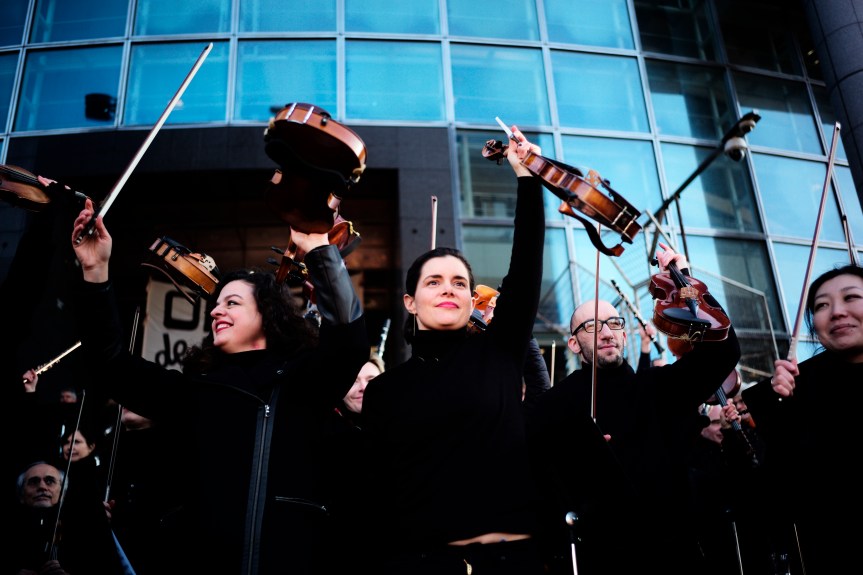
Sour notes for Macron from striking Paris Opera musicians

French President Emmanuel Macron has called for a compromise between his government and unions over plans to change the pension system that have led to sustained strikes — including from Paris Opera musicians who staged a street concert in rebellion.

PARIS – French President Emmanuel Macron has called for a compromise between his government and unions over plans to change the pension system that have led to sustained strikes — including from Paris Opera musicians who staged a street concert in rebellion.

In a spirited, makeshift performance, Paris Opera musicians played excerpts Tuesday from “Carmen” and “Romeo and Juliet” on the front steps of the Opera Bastille, which served as a dramatic reminder of the rocky start to 2020 that awaits Macron.

Tuesday marked the 27th consecutive day of transport strikes. The Versailles Palace, usually a huge tourist draw, said it was closed Tuesday because of strikes, too.

In his televised New Year’s address, Macron said the pension overhaul “will be carried out” but called on his government to “find the path of a quick compromise” as negotiations with unions resume in early January.

Seeking to ease tensions, he suggested people with painful work will be allowed early retirement.

Yet Macron stayed firm on the principles of the reform, including its most decried measure: raising the eligibility age for full pensions from 62 to 64. He insisted that the new system will be fairer and financially sustainable.

“My only compass is our country’s interest,” he said.

Musicians who have put down their instruments since open-ended strikes started Dec. 5 reveled in the chance to play for the crowd that gathered to hear them on Paris’ Place de la Bastille, the site of an infamous prison stormed by a revolutionary mob on July 14, 1789, and then demolished.

“We’re all at the bottom of a deep hole being unable to play since Dec. 5,” said violinist Emilie Belaud.

But, she added, orchestra members are determined to hold firm. The Paris Opera has had to cancel all its scheduled ballets and operas since Dec. 5 — 63 performances in all.

“If the government persists in being stubborn and refusing to negotiate in good conditions, we’ll carry on,” Belaud vowed.

The crowd chanted for the abandonment of the retirement overhaul. They also cried, “We’re united! General strike!”

Macron wants to unify France’s 42 different pension plans into a single one, giving all workers the same general rights. [ . . . ]

Source: Sour notes for Macron from striking Paris Opera musicians

France becomes first country in Europe to ban all five pesticides killing bees 

France will take a radical step towards protecting its dwindling bee population on Saturday by becoming the first country in Europe to ban all five pesticides researchers believe are killing off the insects [ . . . ]

Source: France becomes first country in Europe to ban all five pesticides killing bees 

Les Misérables: Why are the French, who seem to have much, so quick to protest?

Puzzling as it may seem in a country that appears to have so much going for it — fine wines, haute cuisine, high fashion and roughly 1,000 different cheeses — the French are Les Misérables. As author Sylvain Tesson told France Inter radio recently: “France is a paradise inhabited by people who believe they’re in hell.”

Economist Claudia Senik, a professor at the famous Sorbonne University, has studied the French malaise and believes it dates to the 1970s and the end of the “Trente Glorieuses,” the 30 postwar years when France boomed.

“It’s linked to the way the French view the world and their place in it. They have high expectations about the quality of life, freedoms and many values driven by the French Revolution and this sets a high benchmark for satisfaction,” Senik says. “They look back at a golden age when France made the rules of the game, and now we are just another smallish country forced to accept and adapt to rules.”

In her research paper, “The French Unhappiness Puzzle,” Senik found that even when they leave France to live elsewhere in the world, they take their gloominess with them, suggesting it is not France but being French that makes people unhappy.

“I was surprised to discover that since the 1970s the French have been less happy than others in European countries, much less happy than you’d have thought, given their standard of living, lifestyle, life expectancy and wealth,” Senik says. “It’s a problem of culture, not circumstance. It’s the way they feel, their mentality.”

On paper, the French have few reasons to be gloomy: They enjoy free and universal access to an enviable health system ranked first by the World Health Organization, free schools and universities, a maximum 35-hour workweek, six weeks’ annual vacation, paid parental leave and an enviable welfare safety net. Continue reading “Les Misérables: Why are the French, who seem to have much, so quick to protest?” →

French wine, cheese targeted in latest Trump trade fight

French wine tariff

Industry groups are sounding the alarm on President Trump’s proposal to hit $2.4 billion in French goods with tariffs, warning that the latest trade salvo will affect a broad array of goods and its effects fall on U.S. consumers and small businesses.

The administration has proposed tariffs on a wide number of French products, including cheese, sparkling wine and Champagne, beauty products, handbags and home goods, in retaliation for a French tax on online services that targets American tech giants such as Google and Amazon.

Trade watchers warned the scope of the tariffs would be broad and lead to stark price hikes for consumers.

In 2018, the average tariff rate on French imports was 2.9 percent, according to the National Retail Federation (NRF). Under Trump’s tariffs, new taxes could be up to 100 percent for many goods. Continue reading “French wine, cheese targeted in latest Trump trade fight” →