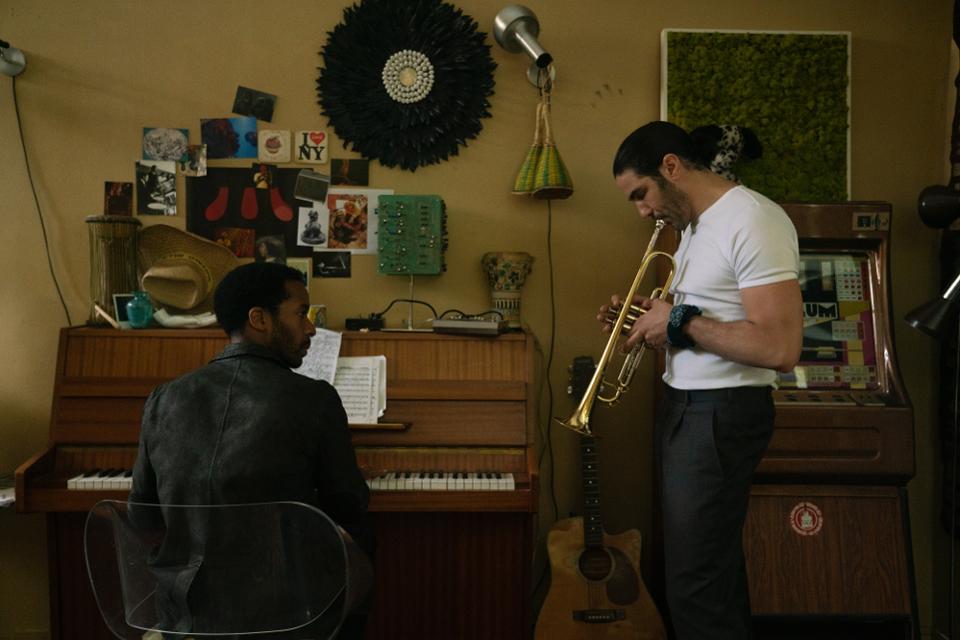
The first two episodes were directed by ‘La La Land’ director Damien Chazelle.
The new mini-series The Eddy has just been released on Netflix. The first two episodes were directed by La La Land director Damien Chazelle. This is no La La Land. The Eddy is certainly not a romance told through musical dancing numbers. It is a series that aspires to be gritty and true to Parisian living, without falling into the stereotypical postcard image of the city of lights.
The Eddy begins in a jazz club. A handheld camera follows a waiter as the house band performs on stage. The camera swirls from one side to the other, framing each band member in some very strange angles until it turns its attention to the audience, and settles on one man in particular, the main character of the series.
A man’s obsession with his designer deerskin jacket causes him to blow his life savings and turn to crime.
Academy Award winner Jean Dujardin (THE ARTIST) is a recent divorcee in the midst of a mid-life identity crisis. In search of a new life and look, he ditches his past in a roadside petrol station and encounters a vintage, fringed deerskin jacket with influential supernatural powers. He relocates to a quiet French alpine village where he is mistaken for an independent filmmaker by an adventurous, enterprising bartender in a sleepy saloon (Adèle Haenel, PORTRAIT OF A LADY ON FIRE) who happens to be an aspiring editor with natural production instincts. The two forge a tenuous allegiance and team up to collaborate on a film inspired by the visionary deerskin jacket
French satire Deerskin was scheduled to screen in movie theaters this week. Instead, it is now opening online and will help theaters with the money earned on streaming views.
The romance of ‘Amélie’ feels like an afterthought because it demands doing – which is the aftermath of thinking
Rahul Desai | The Hindu
I was 21 when I first watched Jean-Pierre Jeunet’s Amélie, a French film about a 23-year-old Parisian waitress. As an introvert, I felt represented: the vivid primary colour palette, Yann Tiersen’s melancholic music, the quirky characters and eccentric vignettes. Amélie had canonised the language of isolation. The portrait of a sad and dreamy frog in a well wore the vibrant energy of a happy beast in the wild. A gaze was reinvented: Mundanity became an adventure of repetition, ordinariness became a playground of possibility, and fantasy became both ailment and cure. Loneliness felt hopeful – more like an acquired superpower than a hereditary disease. For once, silence sung a voice.
Amélie’s infatuation with a strange young man felt like an afterthought. It looked like a token insert, reiterating the long-standing cinematic misconception that a losing protagonist can only be rescued by the emergence of a soulmate. Over time, however, as I’ve struggled with the paradoxical pitfalls of adult companionship, my personal focus has shifted to Amélie Poulain’s love story. Over time, I’ve learned that the madness lies in the failed method of this romance.
Magically make-believe
Introverts are essentially people disappointed with the concept of people. Amélie grew up with neurotic and distant parents. By the time she moved away, she had already taken refuge in a make-believe world where every moment has a feeling. As a waitress working at a cafe, Amélie’s disenchantment with people – their puerile predictability, their wasteful routine – reaches its peak. She is tired of viewing them as bullet points of likes and dislikes. When she finds a box of someone’s old souvenirs, Amélie chooses to rebrand fact as the escapist fiction that kept her adolescence afloat. To inject life with her grammar of imagination, Amélie elevates humanity from noun to adjective. She reunites a reclusive man with memories from his childhood. She plays cupid by triggering an improbable romance between her fragile co-worker and a difficult customer. She fools the bitter concierge into believing that her cheating husband had sent her a conciliatory letter before his death. She inspires her mournful father to travel the world. She even teaches her rude neighbourhood grocer a lesson.
Amélie executes these forged deceptions of destiny like an artist weaving hidden symbols into complex artwork. She affects people, indirectly, in creative ways that marry her introverted spirit of seclusion with her extroverted affection for escapade. And in a manner that renews their faith in fate. She doesn’t simply deliver the souvenirs to the stranger; he is unsuspectingly lured into a phonebooth only to ‘discover’ the box there. She slyly incepts ideas into her colleague and father’s heads with well-timed gossip and globe-trotting gnomes. She painstakingly designs a handwritten letter for her concierge, and rigs her grocer’s house Home Alone-style. By resorting to stunts, Amélie reveals destiny as the domino effect of deflated dreams.
Enter romance
But Nino is the glitch in Amélie’s matrix of little pleasures. Amélie has the power to transform the everydayness of life into an exciting obstacle course of gestures. But that power disappears during her cat-and-mouse search for a soulmate. Her scenes with Nino never play out according to plan. The carefully constructed mystery of their meetings is punctured by the primal spontaneity of the heart. Despite her valiant efforts to choreograph the perfect union, Nino recognizes her at the cafe before she reveals her identity. Another time, Amélie misreads his contact with another waitress. At the photo booth, he is too preoccupied to notice her. And when Nino appears at her doorstep, she hesitates, and bumps into him after a tragedy of errors. The moment is awkward, undesigned, and she seals it with a smattering of tender pecks instead of an all-consuming kiss.
The romance of Amélie feels like an afterthought because it demands doing – which is the aftermath of thinking. For most people, finding love is a dream come true. For introverts, it’s the alarm clock that disrupts their dream. It defies every fibre of their being. It isn’t so much about falling in love as it is about making peace with the disappointment of falling in love. The pursuit rarely matches up to the grandiose visions of pursuit. This chasm is addressed in a wonderful scene towards the end of the film: A dejected Amélie returns to her flat and imagines the life she’s always wanted: She is baking a plumcake, Nino buys some yeast, sprints back upstairs and covertly caresses the bead curtains of her kitchen. But when she actually turns to look, it’s her cat brushing the beads – an image that snaps her back to her lonesome truth. Her lips quiver with dashed desire. Amélie has spent so long dreaming about her reality that she has forgotten to realise her dreams.
Moments later, Nino knocks on her door. Minutes later, she clutches onto his waist as they barrel down the street on his scooter. Amélie gets her happily ever after. Credits roll. It looks rushed, surreal, but for good reason. Now, if this were the final shot of Inception, the frame would cut to black just as the totem begins to wobble on her kitchen table.
Three memories of my youth by Arnaud Desplechin (2015)
As Paul Dédalus leaves Tajikistan to return to Paris, memories of his childhood in Roubaix, of his trip to the USSR when he was a teenager and, above all, of his love for Esther, come back. Paul, whom we follow as a little boy, teenager and adult, never ceases in Three memories of my youth to remember his past, his three bodies – and the story – then becoming one.
His adventures, which oscillate from humor to tragedy, thrill the viewer, constantly brought back, by a game of mirror, to his own previous life. Rewarded at the Directors’ Fortnight in Cannes in 2015 as well as at the César the following year, Desplechin takes us through his art of dialogues and his staging, transfiguring our own memories to make it a labyrinth, between fascination and destruction.
Un amour de jeunesse by Mia Hansen-Løve (2011) and Eden (2014)
Still on the theme of torments of youth, Netflix offers two films by director Mia Hansen-Løve: Eden and Un amour de jeunesse . The second succeeds, through its delicacy and restraint, in telling a love affair, from adolescence to the edge of adulthood, all without ever falling into pompous emotional scenes. Eden , him, signs the virtuoso portrait of a DJ brought to the summit of success in the middle of the French Touch period, a musical movement which, for him, will only be fleeting.
Considered a “masterpiece” by the Inrocks , L’inconnu du lac by Alain Guiraudie is an open-air camera, surrounded by love, sex and death. It is therefore impossible to miss this jewel of French auteur cinema, which, beyond its brilliant staging, explores all possible themes, registers and metaphors.
The recipe is clear and modest: “A lake, a beach, groves, parking, an R25, a few nudist men and three characters” (including Pierre Deladonchamps, wonderful). And if that still does not seem convincing to you, here is the trailer below.
Palme d’Or at the Cannes Festival in 2013, La vie d’Adèle , adapted from the comic strip Blue is a warm color by Julie Maroh. At 15, Adèle is a serious student who questions her sexuality when she first meets the eyes of Emma, a mysterious young woman with blue hair. A great work of the seventh art, bringing to life the idea that literature can lead to self-acceptance, La Vie d’Adèle , a sensual film which borrows all the codes of the learning novel, is part of it ( despite the controversies surrounding its shooting ) of the most beautiful films of French author cinema of the decade.

 The first two episodes were directed by ‘La La Land’ director Damien Chazelle.


