A Conversation with Matthew Fox

A fascinating chat with Matthew Fox, renowned spiritual theologian, popular speaker, author of over 35 books, and an early and influential proponent of Creation Spirituality.

Matthew Fox is an internationally acclaimed spiritual theologian, Episcopal priest, and activist who was a member of the Dominican Order for 34 years. He holds a doctorate, summa cum laude, in the History and Theology of Spirituality from the Institut Catholique de Paris. Fox has devoted 45 years to developing and teaching the tradition of Creation Spirituality, which is Continue reading “A Conversation with Matthew Fox”

Lockdown works in mysterious ways in ‘the most beautiful town in France’

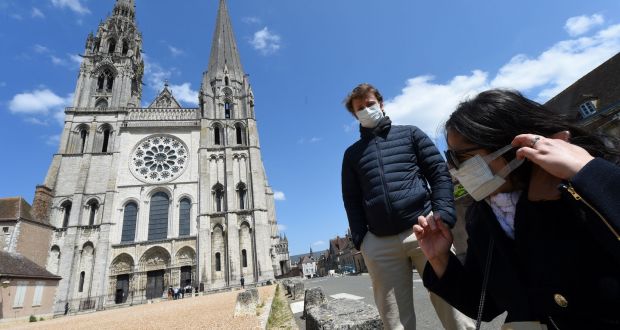
As the cathedral in Chartres reopens, sacred and profane struggle with Covid-19 constraints

The French poet Charles Péguy described Our Lady of Chartres as a star of the sea, rising above oceans of wheatfields on the plains of La Beauce.

It is more prosaic to approach the Gothic masterpiece from the autoroute, but its majesty is nonetheless stunning.

I visited Chartres because it falls within the 100km “perimeter of liberty” accessible to Parisians under Covid-19 regulations.

The cathedral’s website announced that it would reopen to visitors on the afternoon of May 14th. They would be required to wear masks. Fifty could enter at a time, if they observed social distancing.

The rules changed overnight. The prefecture, the arm of the interior ministry which is responsible for religious affairs, grew alarmed at the prospect of Parisians flocking to the beauty spot 86km to the southwest of the capital.

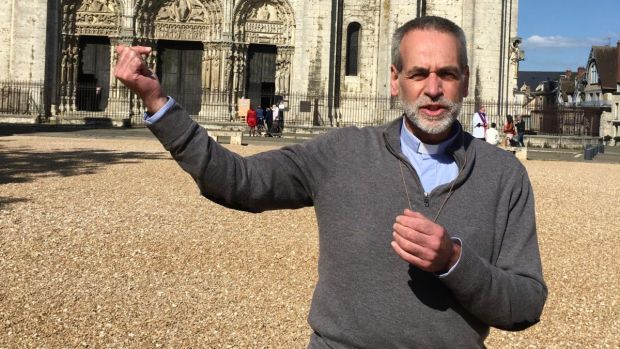
“This is the contradiction we’ve been living with since the beginning of the epidemic,” Fr Emmanuel Blondeau (56), the rector and parish priest, said. “The state says: ‘Stay at home but go to work. We’re lifting the lockdown but don’t move. Don’t go to Chartres, which is the most beautiful town in France.’”

Father Emmanuel Blondeau, rector of Notre Dame de Chartres cathedral on the day the Gothic and Romanesque church reopened to townsfolk and people wishing to pray. Photograph: Tala Skari


They don’t understand what Mass means to Christians. They think it doesn’t matter, but it matters to us

Instead of 50 people, only 10 visitors are allowed to enter the sanctuary at a time. Continue reading “Lockdown works in mysterious ways in ‘the most beautiful town in France’”

Meditations with Matthew Fox: The Tension between Inner and Outer Work

Recently a reader wrote that she felt troubled hearing about contemplation when there are so many people facing crisis including kids who don’t have food…for whom school was their place of safety and where they received hot meals. I think of women stuck home with their abusers. I think of all the people facing eviction, unable to pay bills because our society never believed their lives to be valuable. I think about the farm workers…. 

She asked: “How do we incorporate this tension?”

She is right of course. A moment of apocalypse like we are living through brings plenty of tension with it.  Contemplation needs to lead to action; yet action needs to flow from a deep place of love, goodness and Source.

A crisis like the pandemic becomes a watershed for all the “tensions” we as a society may have refused to face over the years and centuries.  The “sins of our fathers” (and mothers) can pile up—and spill over.

Take slavery and genocide and racism as examples along with ecocide and our neglect and abuse of Mother Earth.

Observe how the rugged individualism mythos that characterizes so much of our value systems can easily take precedence over a sense of the common good. Continue reading “Meditations with Matthew Fox: The Tension between Inner and Outer Work”

Cardinal Dolan’s public flattery of Trump forgets a few things

I wonder whether the U.S. Catholic bishops have crossed a sort of Rubicon recently.

When their Roman predecessor, the general Julius Caesar, brought his army illegally over the Rubicon River, he set in motion the events that ended the Republic and saw him presented with a crown. “The die is cast,” he is reputed to have said as he marched his army toward Rome: there was no going back. What he had done could not be undone and it would change the shape of history.

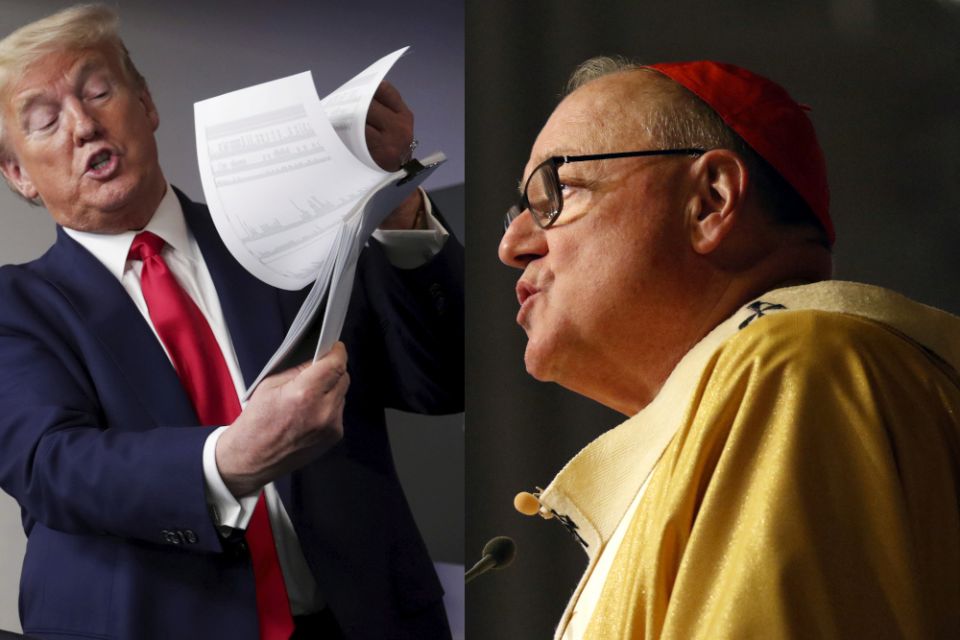
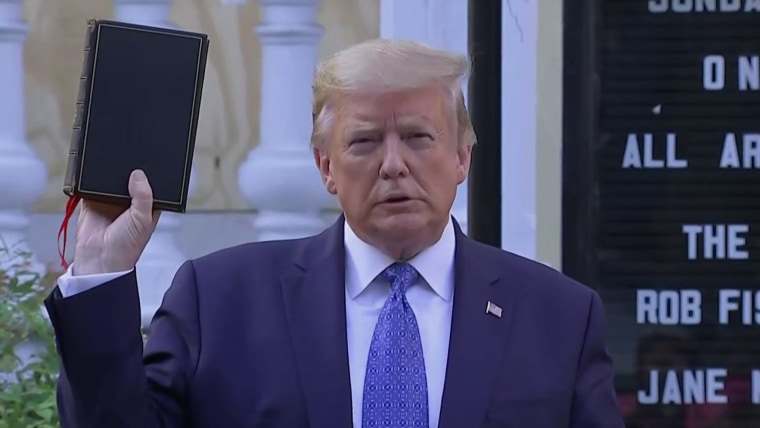
I do not think that New York Cardinal Timothy Dolan is in any danger of being crowned emperor (or, anything else). But I do believe that his public flattery of President Donald Trump from the pulpit of St. Patrick’s Cathedral and on Fox News may prove to be a moment from which American Catholicism cannot turn back.

Smart analysts have interpreted the cardinal’s blandishments as a savvy effort to smooth-talk the president into devoting stimulus funds to help Catholic schools that, no doubt, will struggle in the post-pandemic environment. Maybe that is what the cardinal thinks he is doing. Maybe it even looks smart from one point-of-view. But it seems to me that we have to overlook a lot to see how smart the cardinal is being.

Dolan praised Trump’s sensitivity to the “feelings of the religious community” on Fox News. Think about that.

Cardinal Dolan’s homily praising Donald Trump

Then, think about this. “I think Islam hates us,” or, “The children of Muslim American parents, they’re responsible for a growing number for whatever reason a growing number of terrorist attacks,” or think about what Trump said after the Supreme Court struck down his first travel ban that fulfilled his campaign promise of a “total and complete shutdown of Muslims entering the U.S.” — “Put a commission together. Show me the right way to do it legally.”

Continue reading “Cardinal Dolan’s public flattery of Trump forgets a few things”

Meister Eckhart: “We are all mothers of God”

In this a pre-Covid19 lecture, theologian Matthew Fox discusses German 13th century mystic Meister Eckhart in context of global crises of global warming, “authentic” education, economic inequalities, and ecumenism.

Meister Eckhart (c. 1260 – c. 1328) was a German theologian, philosopher and mystic, born near Gotha,

Eckhart came into prominence during the Avignon Papacy, at a time of increased tensions between monastic orders, diocesan clergy, the Franciscan Order, and Eckhart’s Dominican Order of Preachers. In later life, he was accused of heresy and brought up before the local Franciscan-led Inquisition, and tried as a heretic by Pope John XXII. He seems to have died before his verdict was received.

Since the 19th century, he has received renewed attention. He has acquired a status as a great mystic within contemporary popular spirituality, as well as considerable interest from scholars situating him within the medieval scholastic and philosophical tradition.