Daily Meditations with Matthew Fox: Men in Search of the Divine Feminine

Recently, while lecturing (on Zoom) about the need to balance the sacred feminine with the sacred masculine, a man asked me: “How do you recommend men entertain more the divine feminine?”
It is a good question.

photo by Kelly Sikkema on Unsplash

I offered one answer yesterday in my sharing on Francis of Assisi because he truly stands out as a man who had an amazing balance of the feminine and the masculine.  It is so much in evidence in his poem on Brother Sun as I indicated in the video where I read much of the poem.  He found the divine feminine (but also the masculine) in nature.

So that is one answer: Check nature out.  And look for its feminine aspects—which are everywhere.

It is important to put our hunting-gathering instincts into answering that question, for a patriarchal culture has so flooded us with the uber masculine that we can find, in such a fog, neither the healthy masculine nor the feminine.

This is where praying the feminine names for divinity such as we have been meditating on for weeks becomes a meaningful—and important—exercise.

Such a practice brings the feminine back to one’s own consciousness.

So too is realizing our own mysticism.  Mysticism itself is feminine, as Dorothee Soelle described it.  Mysticism “comes closest to overcoming the hierarchical masculine concept of God….The mystical certainty that nothing can separate us from the love of God grows when we ourselves become one with love by placing ourselves, freely and without guarantee of success, on the side of love.”

The male mystics are very good at this (as are women mystics)

Continue reading “Daily Meditations with Matthew Fox: Men in Search of the Divine Feminine”

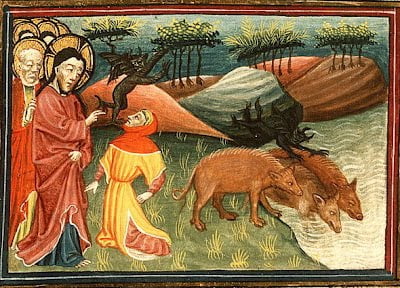
Mon Dieu! Jesus drives the demons into les cochons. Porquoi?

By Monsieur Pas de Merde, Michael Stevenson

“Now there was a herd of many pigs feeding at a distance from them. And the demons begged Him, saying, “If You are going to cast us out, send us into the herd of pigs.” And Jesus said to them, “Go!” And they came out and went into the pigs; and behold, the whole herd rushed down the steep bank into the sea and drowned in the waters.” (Matthew 8:28-33)

Image result for jesus drives demons into swine

Two thoughts about this:

First, why did Jesus have to send the demons into the poor little piggies? They didn’t do anything wrong. I love pigs.

Second, imagine the poor pig farmer the next day: “Who the hell drowned all my piggies? What is my family gonna do for money this year? I’m ruined!”

So – I think Jesus really messed up here. Uncharacteristically.

Say Amen, somebody

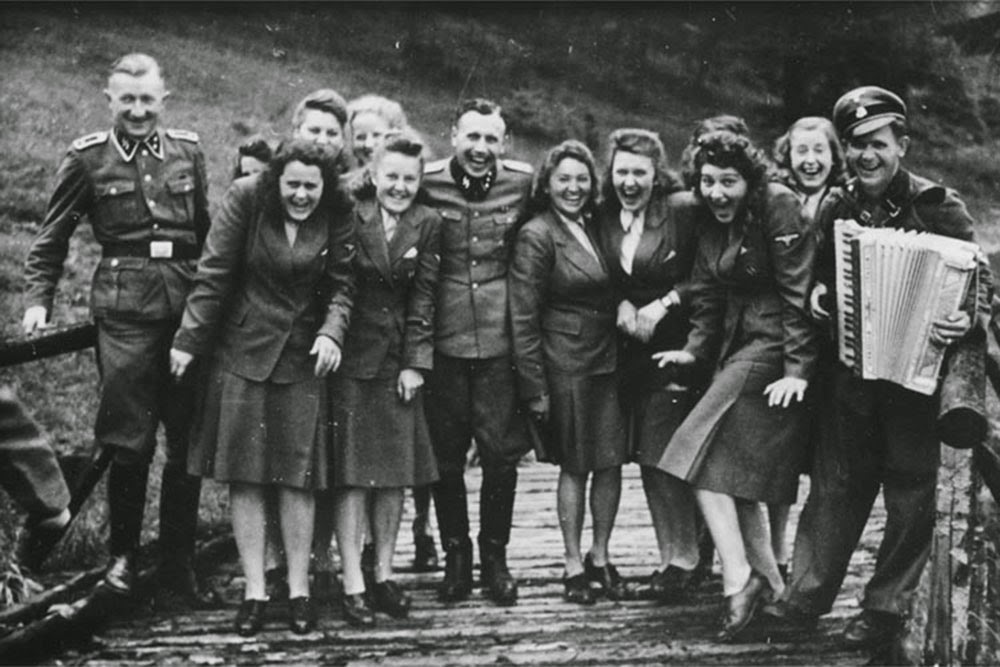
Laughing at Auschwitz – SS auxiliaries poses at a resort for Auschwitz personnel, 1942

The photos show the officers of the Auschwitz relaxing and enjoying themselves, as countless people were being murdered and cremated at the death camp.

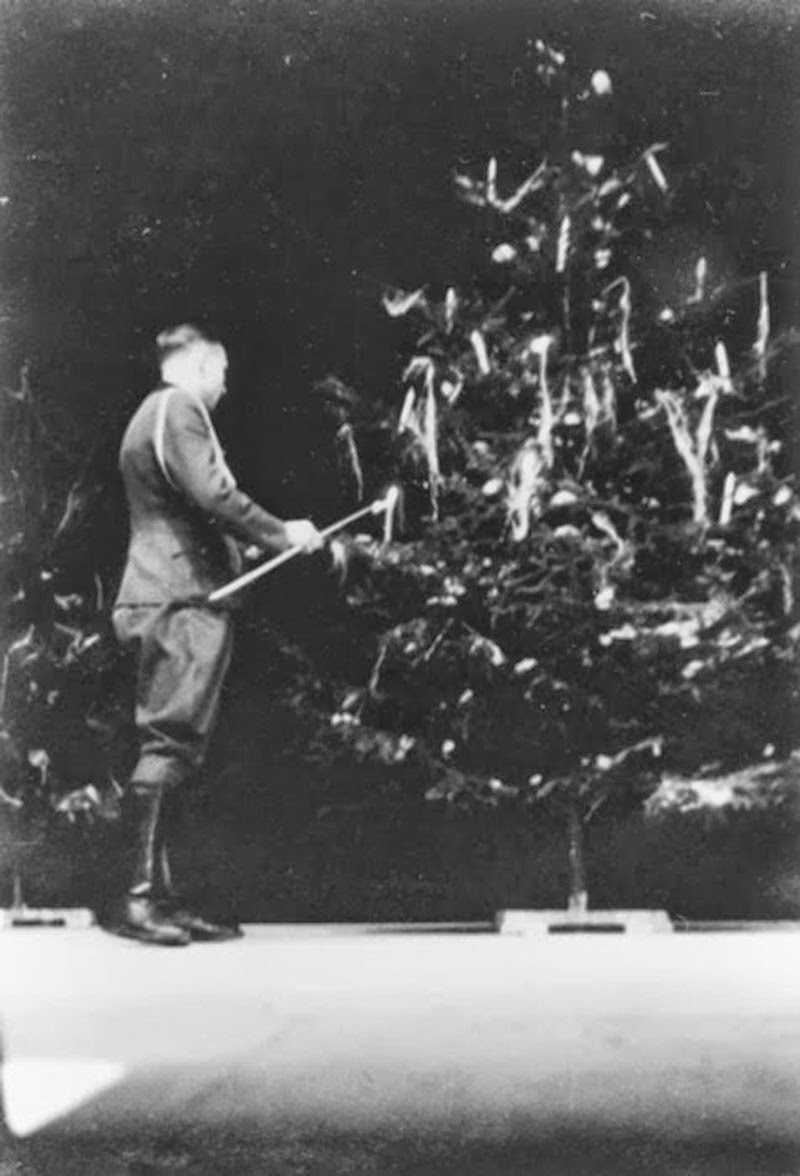
These photos were taken between May and December 1944, and they show the officers and guards of the Auschwitz relaxing and enjoying themselves — as countless people were being murdered and cremated at the nearby death camp. In some of the photos, SS officers can be seen singing. In others they are hunting and in another a man can be seen decorating a Christmas tree in what could only be described as a holiday in hell. The album also contains eight photos of Josef Mengele — some of the very few existing snapshots taken of the concentration camp’s notorious doctor during the time he spent there.

The images are significant because there are few photos available today of the “social life” of the SS officers who were responsible for the mass murder at Auschwitz. These are the first leisure time photos of the concentration camp’s SS officers to be discovered, though similar images do exist for other camps, including Sachsenhausen, Dachau and Buchenwald.

The album belonged to Karl Höcker, the adjutant to the final camp commandant at Auschwitz, Richard Baer. Höcker took the pictures as personal keepsakes. Prior to its liberation by the Allies, Höcker fled Auschwitz. After the war, he worked for years, unrecognized, in a bank. But in 1963 he was forced to answer to charges for his role at Auschwitz at a trial in Frankfurt. In his closing words in the trial, Höcker claimed: “I had no possibility in any way to influence the events and I neither wanted them to happen nor took part in them. I didn’t harm anyone and no one died at Auschwitz because of me”. In the end, though, he was convicted on charges of aiding and abetting the murders of 1,000 Jews and was sentenced to seven years in prison. He was released after serving five years. In 2000, he died at the age of 88.

The photos were made public by the United States National Holocaust Museum in Washington. The museum obtained the photos from a retired US Army intelligence officer, who came across the album in an apartment in Frankfurt and has now given them to the museum. “These unique photographs vividly illustrate the contented world they enjoyed while overseeing a world of unimaginable suffering”, museum director Sara Bloomfield said in a statement. “They offer an important perspective on the psychology of those perpetrating genocide”. The director of the museum’s photographic reference collection, Judith Cohen, said there are no photos depicting anything abhorrent, “and that’s precisely what makes them so horrible”.

Christmas 1944: Karl Höcker lights the candles of a Christmas tree.

Christmas 1944: Karl Höcker lights the candles of a Christmas tree.


See all photos at: Laughing at Auschwitz – SS auxiliaries poses at a resort for Auschwitz personnel, 1942 – Rare Historical Photos

A brief history of ‘O Holy Night,’ the rousing Christmas hymn that garnered mixed reviews

“It might be a good thing to discard this piece whose popularity is becoming unhealthy,” one early critic wrote.

Twenty-six years ago, George W. Hunt, S.J., then editor in chief of America, wrote that “O Holy Night” was one of his favorites among Yuletide songs, modestly adding: “I’ve sung it countless times in choir (the dull second tenor part).”

Our fond memories of “O Holy Night” are closely associated with the familiar English words translated from the original French by the Unitarian minister John Sullivan Dwight. Former director of the school at the 19th-century Brook Farm commune in Massachusetts, Dwight witnessed the conversion to Catholicism of a number of his fellow commune members, including Isaac Hecker—later a Roman Catholic priest and founder of the Paulist Fathers, the first religious community of priests created in North America. Continue reading “A brief history of ‘O Holy Night,’ the rousing Christmas hymn that garnered mixed reviews”