‘Django’: Life — And Music — During Wartime

Though overall, a disappointment – I’m glad I finally got to see Django, which just hit my local cable movie offerings. I’ll first ac-cent-uate the positive, and say actor Reta Kateb makes a dashing Django Reinhardt. I’ll add  that close-ups of Ketab’s guitar fingering is as impressive as … well, Sean Penn’s, anyway. I can forgive even the amount of fabrication in the screenplay. But, by the time Django with his gypsy bandmates and family are planning their escape from Nazi-occupied France in 1943, the movie just seems to run out of gas. (I’d say run out of heart, but the movie’s never has much of that to begin with.) The movie did make me pull out my Django recordings and listen to Minor Swing, Nuages, (the unofficial anthem of the French Resistance) and Sweet Georgia Brown. And that’s always a good thing.

Read the LA Times Review below:
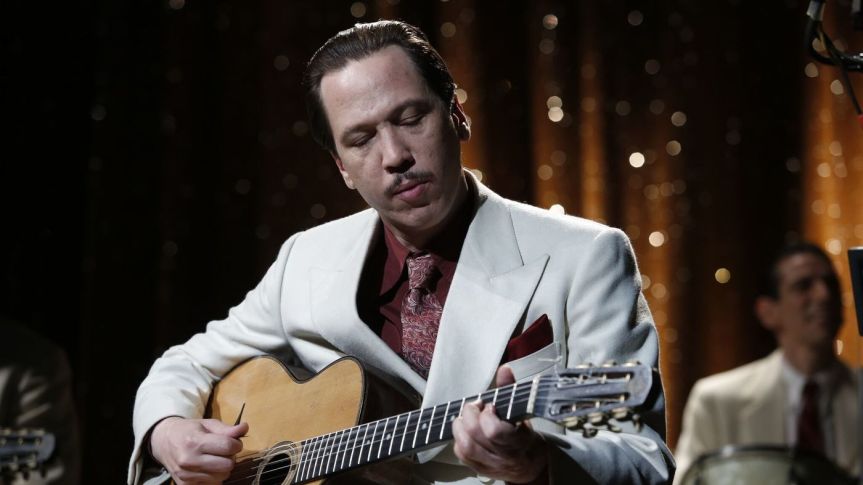
In German-occupied France, guitarist Django Reinhardt (Reda Kateb) awakens to the horrors inflicted upon his people in this musically accomplished but “oversimplified, underfed and overburdened” film.

A bar fight breaks out during a pivotal scene in Django, the musically crisp yet mournful new wartime drama by Étienne Comar. As the fracas unfolds, the band keeps playing, with a blithe bemusement that seems to say: This happens all the time. But these are far from normal times.

The leader of the band is Django Reinhardt, the incomparably gifted Romani jazz guitarist, soulfully embodied by the French-Algerian actor Reda Kateb. He’s biding his time in the French Alps during German occupation, hoping for stealth passage across Lake Geneva into Switzerland. One of the men throwing punches is a Nazi solider, which means the inevitable: a lineup, a lockup and the sternest of warnings. Reinhardt is no good, it would seem, at laying low.

Kateb studied the guitar for a year to prepare for this role, and his work is evident: There’s an unstudied naturalism to the flicker of his fingers across the fretboard, and the film perks up whenever music is playing [ . . . ]

Read Full Review at: ‘Django’: Life — And Music — During Wartime

Epiphany in Europe: Sweetness to Share by Rick Steves

France, not surprisingly, celebrates Epiphany in an edible way. For several days from Christmas until the Feast of Epiphany, the French line up at bakeries to buy the galette des rois — the “Cake of Kings.” They bring these to dinner parties, and enjoy them as snacks and with mid-afternoon tea. The tradition of the treats dates back to the 14th century [ . . .  ]

Read Full Story at: Epiphany in Europe: Sweetness to Share by Rick Steves


Femme Fatale, Fallen Woman, Spy: Looking for the Real Mata Hari

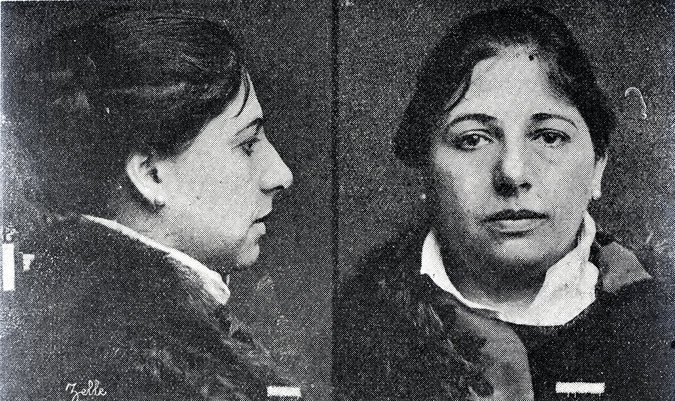
Mata Hari
Mata Hari


In December 1915, Margaretha Zelle, the woman known to all the world as the exotic dancer Mata Hari, was traveling by ship from one of her lovers in Paris to another in The Hague. The international sex symbol was famous for provocative routines in a nude body stocking with a bejeweled bra and golden headdress. Sometimes she would tell people she was a Javanese princess or the daughter of an Indian temple dancer, but only rarely would she reveal that she was Dutch.It was the middle of World War I and her circuitous route took her through British waters, where the authorities stopped the boat to question those on board.After looking at Zelle’s papers, and searching her possessions, they made a note: No evidence of anything had been found on her person, but she was nevertheless a “bold sort of woman who is not above suspicion.”

In the charged atmosphere of the war, this was enough for the authorities to call for her arrest if she ever tried to enter the United Kingdom again. A copy of their report was sent to the French secret service, where it landed on the desk of a French military intelligence officer, George Ladoux [ . . . ] Read full story NY Times


100 Years Since Her Execution, Was Mata Hari a Sexy Spy or a Sexy Scapegoat?

100 Years Since Her Execution, Was Mata Hari a Sexy Spy or a Sexy Scapegoat?At nearly every turn, Margaretha Zelle MacLeod made the wrong choices. Yet she managed to create a persona that continues to dance on the crowded stage of popular culture.

ELLEN HAMPTON10.08.17 12:00 AM ET PARIS—

Her name lives on a century after they stood her in front of a firing squad on Oct. 15, 1917, and watched her die: Mata Hari, treacherous spy, devious liar, a wicked woman to the core. Or was she something else entirely? [ . . . ]

Source: 100 Years Since Her Execution, Was Mata Hari a Sexy Spy or a Sexy Scapegoat?

Historians Imagine What Paris Sounded Like in the 18th Century

Imagine the sounds coming out of a busy blacksmith shop in an alleyway in Paris sometime back in the 18th century: the hammering of wrought iron, the rhythmic whoosh of air as the blacksmith uses a bellows to stoke a fire.

We have no recordings of the actual sounds of Paris in those early days, so to try and make those 18th-century streets and alleys of Paris come to life takes a bit of careful historical research and a little imagination. Continue reading “Historians Imagine What Paris Sounded Like in the 18th Century”