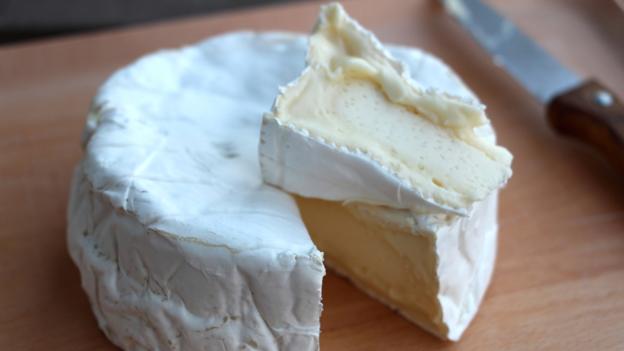
After years of lobbying, industrial producers are now allowed to make camembert with pasteurised milk. As a result, one of France’s beloved cheeses may be disappearing – for good.
In the heart of Normandy’s Pays d’Auge region, about an hour’s drive inland from the D-Day beaches on France’s northern coast, lies the 200-person village of Camembert, surrounded by white-and-brown cows grazing in lush green pastures.
It is here that, according to legend, a woman named Marie Harel sheltered a priest who, like many following the French Revolution, was given a choice: swear allegiance to the new Republic or die at the guillotine. The refractory priest elected to flee, escaping to England through Normandy, and encountering Harel along the way. To thank her for her hospitality, the priest ostensibly shared the recipe for brie, a cheese from the region around Paris, which Harel made using local Normande milk and the moulds for washed-rind Livarot, thus inventing a new cheese that, as tradition dictated, she named after the village where she made it: camembert.
While the validity of the legend is impossible to confirm, culinary anthropologist Georges Carantino maintains that it is rooted in fact.
“In any case, it evokes that there was indeed a transmission of the techniques from an area like Brie, where this type of cheese is very old, to [Pays d’Auge], where it is a much more recent addition to the landscape.”
No matter how the technique arrived, the Normandy region that had previously produced only washed-rind cheeses like Livarot or Pont l’Evêque suddenly began making bloomy-rinded cheese like brie in the 18th Century, and camembert has been inextricable from Camembert ever since.
Of course, it would be unfair to say that camembert is merely brie made in Normandy. While the cheeses are made with the same Penicillium camemberti spore and thus boast a similar downy white mould, flavour-wise, camembert exists somewhere between the milder, buttery Brie de Meaux and the rich, meaty Brie de Melun. This can be attributed, at least in part, to the fact that while Brie de Meaux is made primarily with rennet fermentation and Brie de Melun with lactic fermentation, camembert is made with a bit of both – a process facilitated by the rich, raw milk of local Normande cows with which camembert should always be made, at least in the mind of a true turophile.
The result is a cheese that is rich, mushroomy and complex in flavour – and unfortunately, it may be disappearing from the nation’s culinary landscape for good.
Camembert, like many cheeses, is protected by the Institut National de l’Origine et de la Qualité (INAO), a unique French organisation that strictly governs the manufacture of 46 cheeses (and 300 wines) via the French Appellation d’Origine Contrôlée (AOC) and equivalent European Appellation d’Origine Protégée (AOP) labels. This institution aims to protect terroir, the French notion that a product is inextricably linked to the place where it is made, from traditional manufacturing processes down to unique microorganisms in the air.
But the governing of camembert has long been more complex than most. In the 19th Century, thanks to the creation of the small wooden box in which the cheese is still sold today and the simultaneous rise of train transport, camembert became quite easy to stack and ship. As a result, it was soon enjoyed by people from all over France. Since this rise in popularity predated AOP cheese regulations by several decades, camembert fans from Anjou to the Pyrenees began making their own versions, inexorably divorcing camembert from its Norman terroir.
Today, the word camembert refers not to a specific cheese, but rather to a cheese type made the world over – in fact, it was a Quebecois camembert that was dubbed the best in the category worldwide at this year’s World Championship Cheese Contest in the US state of Wisconsin – a snub that French magazine VSD called ‘stinging’ and ‘shameful’.
Despite the loss of the word, locals did finally earn AOC status for the traditional cheese in 1983, when the INAO developed an official charter, not for ‘camembert’ but for the phrase ‘Camembert de Normandie’. The cheese, it was decided, would be obligatorily made in Normandy, with the raw milk of pastured herds of cows ‘in a process of genetic evolution’ towards the Normande breed (a rule that was modified to specify that, at first, 25%, and then, in 2017, 50% of the herd be made up of Normande cattle).
By this point, however, even Normandy camembert no longer belonged to the small, artisanal producers that had once handmade this cheese throughout the region, ladling it into moulds in five distinct layers, as tradition dictates. Industrial giants such as Lactalis had set up shop and wanted their product to sport the AOP label. The caveat? They wanted to use pasteurised milk. Continue reading “The end to a French cheese tradition?” →





 Pas De Merde