Review “Visages Villages”

As they make their way, sometimes merry, sometimes melancholy, a double-portrait of the artists forms. It’s very moving.

ROGEREBERT.COM

Agnes Varda is almost 90 years old and she is still making films. That alone should be cause for dancing in the streets. But wait, there’s more: Agnes Varda is almost 90 years old and she is still making fantastic films. Searching, compassionate, provocative, funny, sad ones. This is one of them. You should see it, and then go dancing in the streets.

Varda has been making films since 1955, and throughout her career, which saw her as one of the key figures in the French New Wave, she’s been a generous and ingenious collaborator. For this movie, which is part character drama (with real-life characters), part road documentary, and part essay-film, Varda co-signs with the French artist who calls himself JR. A bit over one-third Varda’s age, he always sports a hat and dark glasses. His work is in photography and public art. He travels through Europe in a van that’s a photo booth, creating large-format portraits of people he meets. He goes even larger with some of his other works, creating giant pictures that he then affixes to the sides of buildings, or train cars, or ships. After which he documents that work, and lets nature take its course—the images are generally washed away by time. In this film, one is very dramatically swept off by the tide.

JR’s is a humanist artistic mission; he gets ordinary people to partake in his work, which inevitably delights them. This movie, which has the French title “Visages Villages,” opens with scenes set in various places where, Varda and JR explain in voiceover, they did not meet. (Included is a funny scene at a disco, where a spry Varda—her unusual bowl haircut totally white on top, with a thick ring of vermillion at bottom, a kind of tonsure—dances up a storm at the other end of the floor from JR.) Once each describes the others’ work, and their mutual admiration, they’re off in JR’s van.

Varda’s ideas for photo work bring her to places she visited long ago, and her own earlier films. They visit the village of Cherance, in Normandy, where Nathalie Sarraute, the great writer to whom Varda dedicated her amazing 1985 film, “Vagabond,” lived. They find the well-hidden graves of Henri Cartier-Bresson and his wife, and pay homage. But while they honor the dead, they concentrate on celebrating the living. At one village, they see a row of one-time miners’ houses, waiting to be torn down. The hold up is one woman, the surviving daughter of a miner, who’s staying put. Her portrait, along with vintage images of the miners from the town, is pasted to the houses. The port at Le Havre, a man’s world clotted with ship’s containers, sees its largely unheralded women celebrated with a triptych pasted to a block of stacked containers. An enlarged portrait of Guy Bourdain, a one time collaborator of Varda’s who went on to become a celebrated photographer, is put on a concrete bunker that Germans abandoned in World War II and ended up off a cliff and embedded in a beach. A visit to a goat farm inspires an artwork calling for goats to be permitted to own their own horns.

As they make their way, sometimes merry, sometimes melancholy, a double-portrait of the artists forms. It’s very moving. Varda’s sight, which served her so well so many years, is getting dimmer. At the same time she wonders why JR always wears dark glasses. This habit, she tells him, reminds her of an old friend, Jean-Luc Godard. The resemblance sets up the film’s finale, which is puzzling, heartbreaking, but ultimately celebratory. And wobbles the line between documentary and fiction so strongly that the vibrations will linger in your heart for days afterwards.


Source: ROGEREBERT.COM Faces Places Movie Review & Film Summary (2017) | Roger Ebert

The Best Paris Tips From Our Readers

Bonjour! This week we asked for your Paris tips. Here are some highlights from the 148 responses. If you learn just thing, let it be that Parisians like to say hello.

Say hello

If you think Parisians are rude, it might just be that you’re not saying hello. “It is considered the height of rudeness to not greet anyone-even when you get on a bus,” says Klee. “Anytime you walk into a store, you will be greeted and you must greet the shop-person back,” says Scout’s Honor. “I noticed that even when I was walking down an alley and another person crossed my path, they would say ‘Bonsoir,’” says ceedotkaydot. Add an Au revoir, bonne journee when you leave, says jseb.

And start your conversations in French, even when you know the other person speaks English. Readers all agreed that it’s rude to just start talking to Parisians in English. “The best phrase I know in French is Je suis désolé, je ne parle pas français, says JobiWan. “I’ve seen tourists (mostly American) be treated as annoying tourists because they are pushy and demanding, and yet when I approach the same vendors and tell them I don’t speak French (in French), they are much more polite and accommodating.

Even those that don’t speak English are very pleasant and try to work with you.”

You can push it further, says TheMonkeyKing: “We found ourselves to be instant hits in small neighborhood cafes where we badly mangled local French but in their laughter appreciated our efforts. One place poured us extra wine and another one gave use free desserts with our dinner. If you can sneak in a malaprop, you’ll become their darling.”

Walk if you can

While the metro is top-notch, Paris is best seen above ground. Sinisterblogger elaborates:

Walk everywhere and don’t be afraid to get lost. If you get lost, hop on the Metro (there’ll be a station nearby). It’s very, very easy. But make a point to get lost. Just wander. Find a cafe off the beaten path, away from the tourists, sit, drink wine, people watch.

Aimawayfromface3 agrees:

Plan less and wander more. Paris is filled with little micro-neighborhoods and interesting streets. Be sure to take at least one day to just wander about without any real plans or direction. I happened upon an old raised railway line (Promenade Plantee) that they turned into a park. (Similar to the High Line Park in Manhattan)

Papa Van Twee learned this the hard way, after his tour bus broke down. “The next day we skipped the bus, and just walked. It was a lot more fun that way. You can’t get to know a city until you’ve walked it, and Paris is a wonderful city to get to know.”

Avoid scams

“Ignore anyone approaching you with a clipboard asking if you speak English, or anyone with a poorly made friendship bracelet in their hand,” says Kevin Lee Drum.

“I do not feel that the city is generally unsafe, but keep an eye on your valuables, there are many pickpockets,” says Frederi. [ . . . ]

More at Source: LIFEHACKER The Best Paris Tips From Our Readers

Exports of rosé from Provence boom thanks to American wine lovers


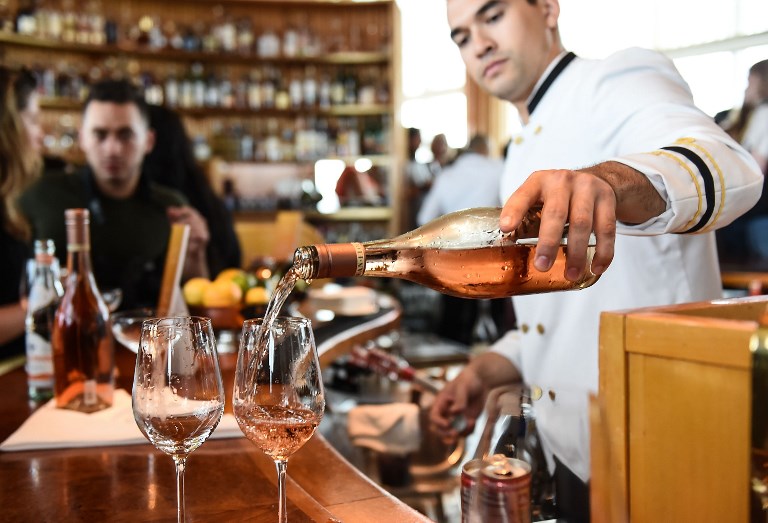
Exports of rosé wine from Provence have shot up and it’s largely because Americans have a growing thirst for the pink drink. But why is that?

THE LOCAL

The popularity of the drink which was mocked just 20 years ago has reached new heights abroad.

And that’s particularly true in the US, with the country accounting for a whopping 50 percent of exports of the Provencal rosé wine last year.
“The phenomenon of the internationalization of rosé wines from Provence is accelerating,” said Brice Eymard, leader of France’s Provence Wine Council (CIVP) during a press conference in Paris on Thursday.
“Until 2010-2011, we exported very little, France was the main producer and consumer, but we now see the share of exports sharply accelerating,”  [ . . . }

Source: THE LOCAL Exports of rosé from Provence boom thanks to American wine lovers – The Local

The British have Brexit. We French have our wine delusion

Sure, it occasionally leaves us horizontal, but it’s a proud part of our identity, says freelance journalist Marie Le Conte

If you want to become – or remain – the president of France, you have to touch a cow.

François Hollande touched a cow; Nicolas Sarkozy touched a cow; Jacques Chirac touched more cows than anyone can remember; and every party leader or Elysée hopeful has had to touch a cow at one point or other. It cannot be any cow: the ceremonial patting must occur at the Paris International Agricultural Show, an annual event that does exactly what it says on the tin, and is attended by every French politician worth their salt.

The fair often becomes the scene of minor gaffes as senior politicos trip over themselves to show just how provincial and normal they are, with predictable results – a particularly amusing example in 2015 involved the then prime minister, Manuel Valls, getting thoroughly sloshed.


“From the liver’s point of view, wine really is alcohol!” was the title of the letter, which pointed out that nearly 60% of all alcohol consumed in France is in wine, and that alcohol kills around 50,000 people a year in the country.

Emmanuel Macron didn’t appear drunk at the agriculture show last week, but alcohol did end up causing him a headache. Speaking to journalists from the regional press, the president admitted to drinking wine every day “with lunch and dinner”, and being a staunch believer in his predecessor Georges Pompidou’s saying: “Don’t piss off the French.”

“It is a danger to public health when young people binge-drink spirits or beer,” he added, “but wine isn’t the issue.” He then confirmed that his administration had no ambitions to make the Loi Évin, a law passed in 1991 putting restrictions on alcohol and tobacco, any stricter than it already is.

This clearly didn’t go far enough for Christophe Castaner, the secretary of state for parliamentary relations, who took it upon himself to add in a TV interview: “Let’s not get carried away – there’s alcohol in wine, but it’s not strong alcohol. Wine is a part of our culture, our tradition, our national identity. It’s not our enemy.”

Shockingly, this didn’t please everyone. In an open letter published by the newspaper Le Figaro on Monday, nine health professionals politely but firmly reminded the head of state and his minister that wine is – believe it or not – an alcoholic beverage like any other.

“From the liver’s point of view, wine really is alcohol!” was the title of the letter, which pointed out that nearly 60% of all alcohol consumed in France is in wine, and that alcohol kills around 50,000 people a year in the country.

That this needed to be said is quite remarkable, but perhaps unsurprising; behind that glass of red sipped at a family dinner lies an interesting quirk of the French, and how we like to see ourselves.

You see, French people are civilised. They care about the food they eat and the bottles they carefully pick to go with it. They look down on anyone unsophisticated enough to suggest that their habits might not be as refined as they think.

Sure, they might occasionally drink more wine than the food can soak up and find themselves horizontal, but they don’t get drunk like the British do. Over the Channel lies a an island of feral binge drinkers who do shots and throw up on themselves and pass out in public. Isn’t it ghastly? Like retired people showing their slides after a holiday, French expats in the UK and holidaymakers who have been there catalogue instances of the British binge culture –it’s almost a national sport.

Of course, data collected by the World Health Organisation in 2015 shows that French people drink nearly as much as their British counterparts – 11.6 litres of pure alcohol per capita compared with 12 – but this doesn’t matter.

Every country has their very own national delusions – Brexit certainly counts as one – and France is no exception.

In a way, Macron embodies a lot of ours. He arrogantly charmed his way into the presidency, frequently pontificates about philosophy, unashamedly talks about his love of classical novels and poetry, and is passionate to the point of absurdity about the French language.

France isn’t, in reality, the France we know from the movies, and everyone knows it deep down. But it doesn’t hurt to pretend once in a while. However, deciding that wine simply isn’t a normal alcoholic beverage because it happens to be quintessentially Gallic is not harmless, and though the current crop of politicians are knee-deep in patriotic cliches, future generations might finally decide to put health before tradition.

They just need to make sure they touch a cow first, if they want anyone to pay attention.

• Marie Le Conte is a French freelance journalist living in London | Source: The British have Brexit. We French have our wine delusion | Marie Le Conte | Opinion | The Guardian