By Erin S. Bromage, Ph.D., Associate Professor of Biology at the University of Massachusetts Dartmouth.
It seems many people are breathing some relief, and I’m not sure why. An epidemic curve has a relatively predictable upslope and once the peak is reached, the back slope can also be predicted. We have robust data from the outbreaks in China and Italy, that shows the backside of the mortality curve declines slowly, with deaths persisting for months. Assuming we have just crested in deaths at 70k, it is possible that we lose another 70,000 people over the next 6 weeks as we come off that peak. That’s what’s going to happen with a lockdown.
As states reopen, and we give the virus more fuel, all bets are off. I understand the reasons for reopening the economy, but I’ve said before, if you don’t solve the biology, the economy won’t recover.
There are very few states that have demonstrated a sustained decline in numbers of new infections. Indeed, as of May 3rd the majority are still increasing and reopening. As a simple example of the USA trend, when you take out the data from New York and just look at the rest of the USA, daily case numbers are increasing. Bottom line: the only reason the total USA new case numbers look flat right now is because the New York City epidemic was so large and now it is being contained.
So throughout most of the country we are going to add fuel to the viral fire by reopening. It’s going to happen if I like it or not, so my goal here is to try to guide you away from situations of high risk.
Where are people getting sick?
We know most people get infected in their own home. A household member contracts the virus in the community and brings it into the house where sustained contact between household members leads to infection. Continue reading “The Risks – Know Them – Avoid Them”→
On the sidewalks of the Marais, the vibrant central Paris neighbourhood that is both quaint and chic, local residents, merchants and workers enjoyed each other’s company on the first day of the easing of France’s Covid-19 lockdown. FRANCE 24 reports.
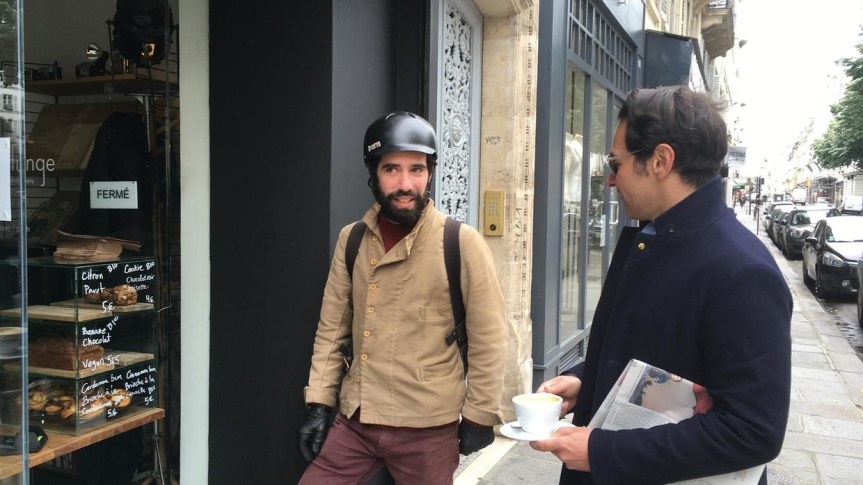
A little after 11am on Monday, Frank Barron, 40, was enjoying a latté at Fringe, a small coffeeshop on the Rue de Turenne, for the first time in almost two months. He had to stand on the sidewalk, but his drink, with an artful, leaf-like design on its surface, came in a ceramic mug.
Barron told FRANCE 24 that making coffee at home, which he’s been doing since France’s lockdown began on March 17, isn’t the same as drinking it at a neighbourhood spot. But that isn’t just because of the java – it’s also due to the camaraderie with neighbours.
Barron was standing next to Cyril Muller, 38, another resident of the Marais, a neighbourhood that consists of parts of Paris’s 3rd and 4th arrondissements (districts) and is known for its quaint streets and compact museums, art galleries and boutiques. The Picasso Museum is here; so is, arguably, the best falafel in town.
Muller, a spice distributer, said that streetside conversations are an important part of city life.
“I missed it,” he said. “Everyone needs to meet to talk.”
Standing behind a barrier of a table and a pastry shelf, Fringe owner Jeff Hargrove, 56, said it felt strange to be able to serve customers at the door, but not inside.
“Our place is more welcoming, cozy, but we have to keep these distances,” he said.
Hargrove won’t be able to seat customers until the French government allows cafés and restaurants throughout the country, including the wider Paris region, where it says that Covid-19 is still actively circulating, to fully reopen.
For now, it makes him happy to see his customers, many of whom are local residents, at a distance.
“Actually, I’ve not had anyone I don’t know,” he said.
A few doors further up, Jonathan Benhamou, 32, a salesman at Danyberd, a men’s clothing store, said that two of his regular customers had already visited since the shop opened.
“They gained weight, so they had to buy new suits,” he said.
Out on the sidewalk, a man and a woman stopped, arched their bodies back and smiled in recognition, and a cheerful conversation ensued.
The man, James Rose, 56, – who happened to be Barron’s partner – said that “seeing friends for real” was pleasing after so long.
Thank-you messages
Nadège Maguet, 54, a local postal worker walking by, said she has been seeing residents along her routes for 25 years.
“I know their children, their grandparents. All the family,” she said.
During the lockdown, Maguet played music on her cellphone as she wheeled her cart, which sometimes prompted people to open their windows and say hello.
Children living in the Marais made her colourful pictures to thank her for delivering the mail. One picture, which she displayed on her phone, showed a yellow shooting star on a light blue background with a large-lettered “Merci” (Thank you), and a smaller “Nadège” above a heart.
Maguet said that Monday’s greater number of face-to-face exchanges made her feel good.
“It’s human,” she said.
Around the corner on Rue des Filles du Calvaire, César Levy, 38, sat amid abstract metal sculptures and minimalist paintings in 193 Gallery, the exhibition space he opened two years ago.
The latest show opened about two weeks before the lockdown began, so Lévy decided to extend its duration. He spent part of his time in lockdown digitalising the gallery’s catalogue, and hopes that collectors will return this week.
“Psychologically, to not see the collectors, the artists for two months, it’s very hard,” he said.
‘Interesting’ haircuts
Across the neighbourhood on the Rue des Rosiers, Hanna Abergel, 65, the owner of a Middle Eastern restaurant bearing her name, lamented the absence of tourists, who she said were her main customers.
“It’s sad,” she said.
But her partner, Guy, 61, made sandwiches for a group of three teenagers and for Marais residents Valérie Geoffrey, 49, and Betty Lachgar, 44.
“They have to get back into the habit,” he said.
On the busy Rue de Bretagne, where many specialty food shops were open during the lockdown, one hair salon was so busy that no one had time to talk. On the quieter Rue des Archives, hairdresser Françoise Myoho shared her opinion of post-lockdown tresses.
“Catastrophic!” she said. But she acknowledged that some of her customers had achieved “interesting” results by taking scissors into their own hands.
A funny walker on Square Verdun, this Sunday at dawn, who did not wait for the deconfinement to get a little closer to humans. But by keeping the snout on the spot and social distancing!
I know, but what do you want me to do? I mean, seriously Jon, let’s get real, what do you want me to do?
Anthony Fauci, who to many watching the now-regular White House press briefings on the pandemic has become the scientific voice of reason about how to respond to the new coronavirus, runs from place to place in normal times and works long hours. Now, the director of National Institute of Allergy and Infectious Diseases has even less time to sleep and travels at warp speed, typically racing daily from his office north of Washington, D.C., to his home in the capital, and then to the White House to gather with the Coronavirus Task Force in the Situation Room. He then usually flanks President Donald Trump addressing the media—and when he isn’t there, concerned tweets begin immediately. Shortly before he planned to head to the White House for a task force meeting today, he phoned ScienceInsider for a speedy chat. This interview has been edited for brevity and clarity.
Q: The first question everyone has is how are you?
Harvard’s Global Health Institute proposes that the U.S. should be doing more than 900,000 tests per day as a country. This projection, released Thursday, is a big jump from its earlier projection of testing need, which had been between 500,000 and 600,000 daily.




 Pas De Merde