
View this post on InstagramA post shared by Paris Match (@parismatch_magazine) on
Category: Arts
Paris’ Pompidou Centre hosts a May 68 happening, 50 years on
The Pompidou Centre in Paris hosts the ‘Mai 68 Assemblée Générale’ happening to mark the 50th anniversary of May 68 in France. The event runs until 20 May.
In May-June 1968 massive student protests and strikes across France nearly brought down President Charles de Gaulle and his government.
Fifty years on, the Pompidou Centre hosts in Paris a happening called ‘Mai 68 Assemblée Générale’.
May 68 posters and slogans
Graphist artist Philippe Lakits will reinterpret the slogans and posters of May 68 in a 60 metre long frieze designed for the event.
The May 68 slogans have had a powerful impact in a France without newspapers, radio or television, which were all on strike at the time.
Most of the May 68 posters were produced in the Ateliers populaires (People’s Workshops) that art and graphic design students will try to revive in the Pompidou Centre Forum.
According to the event organiser Romain Lacroix, the main May 68 topics on the posters are nowadays ‘somehow irrelevant:
Feminism was hardly touched on, now it’s much more to the fore. Ecology was also neglected, even if the Larzac became an issue… these are issues that are of interest to the younger generation.
Besides the picture frieze, debates and conferences will take place in a mobile lecture hall designed by Olivier Vadrot.
Georges Pompidou and May 68
The Pompidou Centre has a specific link to May 68.
Georges Pompidou, who was General de Gaulle’s prime minister at the time, managed the crisis while he was bringing it to political closure.
In 1969 after being elected president, Pompidou decided to to have an arts centre built which opened ten years later in 1977.
We can see clearly how it’s a question of how to make protest part of the museum. It’s due to the fact that the first artists whose works were shown at the Pompidou Centre in 1977 were those demonstrating on the streets in 68. [ . . . ]
Continue at Source: Paris’ Pompidou Centre hosts a May 68 happening, 50 years on – culture – RFI
It’s time to reclaim the legacy of Simone de Beauvoir and see feminism for what it is

In the shadow of the horrific alleged rape in Unnao and alleged rape and murder in Kathua, and worldwide acknowledgment of workplace harassment of women (#MeToo, #TimesUp), feminism has an important role to play
“One is not born, but rather, becomes a woman,” wrote Simone de Beauvoir in her seminal book The Second Sex. At the time, the book was considered so radical that the Vatican put it on the Index Librorum Prohibitorum (index of prohibited books). Beauvoir died at the age of 78 on this day 32 years ago, leaving behind a legacy of revolutionary thinking, activism, and having spurred the beginning of the ‘second wave’ of feminism.
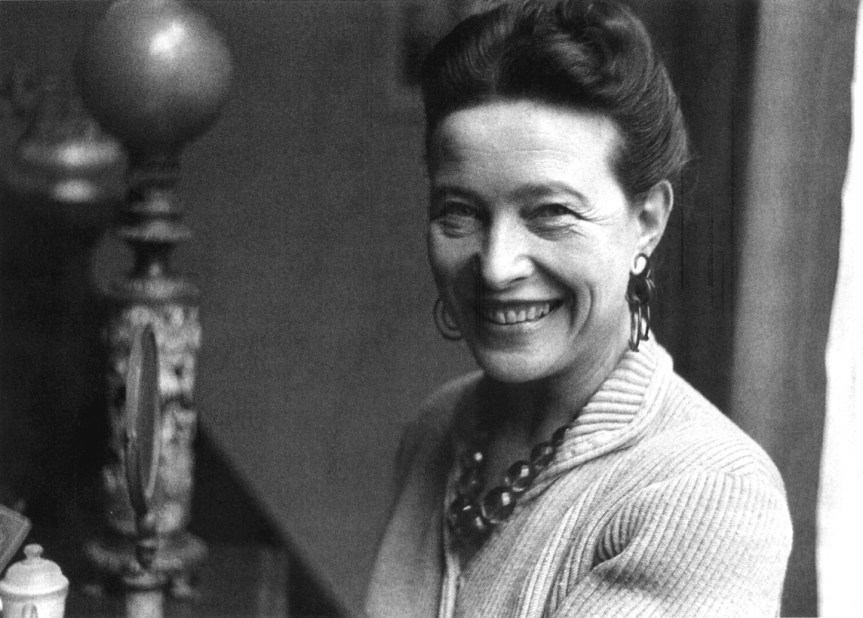
As an existentialist, Beauvoir believed that human beings create their own values through their consciousness, and not simply by some inborn “essence”. She drew upon this philosophy to describe the sex-gender distinction, in which she explains that there is a difference between biological sex assigned to a child at birth, and the social and historical construction of gender and the stereotypes that become associated with them. Her argument is that all children are born the same way, but become conditioned by the society around them to think that men must behave a certain way and women in certain others. She calls women the ‘second sex’ because historically, women have always been defined in relation to men, as though the male was the ideal — that women could only aspire to be, but can never really become [ . . . ]
Continue reading at: It’s time to reclaim the legacy of Simone de Beauvoir and see feminism for what it is | editorials | Hindustan Times
Commemorating the Global May ’68 Events
 Fifty years after the transformative May ’68 student-led protests in France, universities and cultural institutions across the country are presenting diverse programs and events that revisit the spirit of the ’60s in all of its facets, from revolution to social activism and more. Check back here periodically for an updated listing of events.
Read More: Commemorating the Global May ’68 Events | French Culture
“Jane and Serge: family album”: the mythical photos of Birkin and Gainsbourg by Andrew Birkin

“Jane and Serge: family album”: the few words that define the new exhibition of the Museum of Fine Arts in Calais perfectly summarize the relationship of the iconic couple. A man, a woman, a family in the broadest sense, the 1960s, freedom and love, all told in about sixty photos captured by Andrew Birkin, Jane’s brother.
More story and video at Source: “Jane et Serge : album de famille” : les photos mythiques de Birkin et Gainsbourg par Andrew Birkin
The French Writer Who Started The Realism Movement

Realism in literature has its origins in 19th century Europe. The French writer who is credited as having created the Realist movement is Honoré de Balzac. But, what is realism in literature and how did Balzac help to start it? In this article, we will go deeply into answering these two interrelated questions.
The best way to begin to understand realism in literature is by defining the term realism. As its most simple and broad, realism is a representation of reality.
Before the 19th century, writers were not interested in representing everyday life in their works. It is important to note, before we go any further that, realism is not the same as plausibility. Realism is the representation of everyday experiences and activities of the characters whereas plausibility means created a plot that has internal coherence.
So, when we say that before the 1800s writers did not depict everyday life in their work, it does not mean that everything produced before then was in the realm of fantasy. It is simply, that writers did not often write about ordinary people leading ordinary lives, at least not in the level of detail as some did from the 19th century.
But depicting everyday life is not enough for realism, this depiction must lack any romanticizing
Although Realism began in painting and literature (prose and plays) and then, in the twentieth century, to cinema.
Continue reading “The French Writer Who Started The Realism Movement”

