Paris, day two: Walker Evans exhibit at the Pompidou

Today we visited Paris’ Pompidou Museum for their new exhibit of the great American photographer, Walker Evans. Awesome event, brilliant photography. My wife expressed how crazy it is to travel to France to better appreciate an artist so quintessentially American.


Walker Evans (1903-1975) is one of the most important American photographers of the 20th century . His photographs of America in crisis in the 1930s, his projects published in Fortune magazine in the 1940s and 1950s and his “documentary style” have influenced generations of photographers and artists. By his attention to the details of everyday life, to the urban banality and the people of little, it has largely contributed to define the visibility of American culture of the 20th century. Some of his photographs have become icons.

A retrospective of the work of Evans, the exhibition presented by the Center Pompidou proposes a thematic approach and unpublished through three hundred photographs of time. It highlights the obsession of the photographer for certain subjects such as roadside architecture, storefronts, signs, typographical signs or faces. It invites the public to better understand what is undoubtedly the heart of Walker Evans’ work: the passionate search for the fundamental characteristics of American vernacular culture. In an interview in 1971, the photographer explains this appeal in these terms: “You do not want your work to come from art; You want it to originate in life? It is in the street. I do not feel at ease in a museum anymore. I do not want to visit them. I do not want anyone to tell me anything. I do not want to see “accomplished” art. I am interested in what is called the vernacular. For example, the architecture accomplished, I mean , does not interest me, I prefer to seek the American vernacular. “

In the United States, the vernacular defines forms of popular expression used by ordinary people for utilitarian purposes: everything that is created outside art, outside the circuits of production and legitimation, everything that ends up Constitute a specifically American culture. These are all small details of the everyday environment revealing a form of “americanism”: the wooden barracks of the roadside, how the merchant disposes of the goods in his shop window, the silhouette of the Ford T, typography Pseudo-cursive of the Coca-Cola banners. It is a central notion to understand American culture. The vernacular was present in the literature as early as the 19th century, but it was only at the end of the 1920s that it was the subject of an initial analysis in the field of architecture.

After an introduction devoted to the modernist beginnings of Evans, the exhibition brings together, in a first part, the main subjects that Evans has never stopped tracking: the typography of a sign, a display, a shop front … Then, the journey reveals how Evans himself adopted the operating modes or the visual forms of vernacular photography by becoming, during a project, architectural, catalog, street photographer, while explicitly claiming an approach artist.
This exhibition is the first major retrospective devoted to the work of Walker Evans in a French museum. She retraces, from the first photographs of the late 1920s to the Polaroids of the 1970s, The entire career of the artist through an unprecedented collection of period photographs from the most important American public collections (Metropolitan Museum and Museum of Modern Art in New York, J. Paul Getty Museum in Los Angeles, Art Institute Of Chicago, the National Gallery of Art in Washington, etc.) and about fifteen private collectors. Through a hundred documents and objects, it also places a great deal of importance on the whole of postcards, enamelled plates, cut-out images and ephemera graphics that Walker Evans has collected throughout his life. ) And about fifteen private collectors. Through a hundred documents and objects, it also places a great deal of importance on the whole of postcards, enamelled plates, cut-out images and ephemera graphics that Walker Evans has collected throughout his life. ) And about fifteen private collectors. Through a hundred documents and objects, it also places a great deal of importance on the whole of postcards, enamelled plates, cut-out images and ephemera graphics that Walker Evans has collected throughout his life.

IMG_2847

Not Walker Evans.

Fear and hope

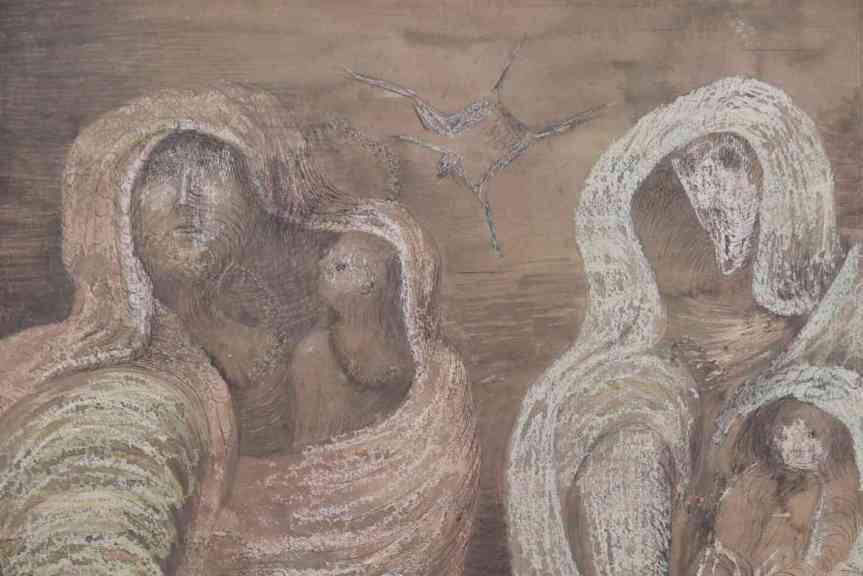
Henry Moore (1898-1986), Refugees, Tyssen Museum, Madrid, detail

Are the two verbs opposed? Given the enormous challenges the world has to face (among other things: the announced death of the planet, the vast migratory movement that is still in its infancy, the destructive identity withdrawal, the new poverty engendered by a type of globalization ), Fear can make us flee, incite us to melt into the mass, to wait and, above all, not to take responsibility. But it can also provoke the opposite. We mobilize, oblige us to understand and analyze the issues, roll up our sleeves and take our responsibilities. More than ever, we are at the juncture between two worlds, the old and the new: there is an urgent need for a return to politics.
Christmas announces peace; It is to be constructed. By refusing that events decide for us, that others think for us. By creating opportunities for reflection, listening to others, questioning, exchanging at the risk of dispute, but benefiting from learning from them and moving forward together, deciding what is to come and living Of hope.
Daniel Duigou / Saint Merry

Source: Fear and hope – Saint-Merry

Are the French rude? Wherever you go, there you are

This ridiculous article from the New York Daily News really ticked me off,  for several reasons. Firstly, if there are any people who should be sensitive to an underserved reputation for rudeness, it should be New Yorkers. I’ve dined in Paris and New York, chatted with waiters, and asked for help from strangers in both cities. My own experience is that Parisians and New Yorkers are for the most part friendly and accommodating to visitors, mainly because they are so proud of their city, I think. Secondly, if this NY Daily News reporter had a bad experience in a Paris restaurant, how unfair is it to label “the French” as rude?  I once received a smart-ass remark from a waitress at the Carnegie Deli, but I didn’t blame every New Yorker from Times Square to the Catskills.  Worse, what if I blamed “the Americans” because Sophie the waitress was having a bad hair day? I’ve always liked the saying, “Wherever you go, there you are!” 
Read this story below from the New York Daily News, and please comment. I’d like to know what you think!
[ Mike Stevenson / Pas De Merde]

The French were so rude to me in Paris that I had to seek out American eateries | NY Daily News

I went to Paris, but ate like a New Yorker.

Blame the French. My first experience in the City of Light was met with a wave of rudeness — particularly in restaurants — despite how reluctant I was to believe the stereotype that the French are cold.

It’s tough being an American in Paris. Especially when the only French words you know are “Bonjour,” “Merci” and “Au Revoir.”

My sister and I made an effort to greet everyone we met with the proper pleasantry in French, but despite our attempts at speaking the language, we weren’t exactly treated hospitably. [ . . .  ]

Read more of this nonsense at:http://www.nydailynews.com/life-style/french-rude-paris-opted-american-food-article-1.2928043

Dubuffet Drawings at the Morgan Library

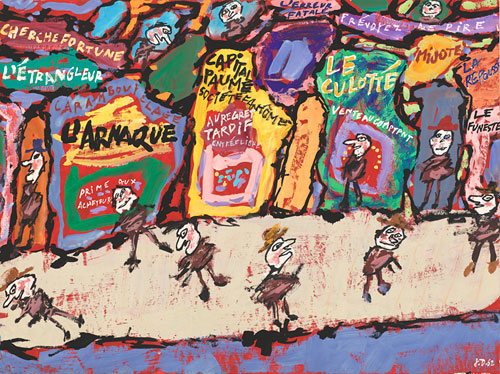
If you live in or near New York’s Madison Avenue, there’s only a few days remaining to see this exhibit at the Morgan Library (closes January 2) I love the drawing below – Jean Dubuffet’s L’Arnaque (The Swindle), 1962.
[ Mike Stevenson / Pas De Merde]

A leading French artist of the twentieth century, Jean Dubuffet (1901–1985) eschewed traditional notions of beauty in art in favor of what he perceived as more authentic forms of expression, inspired by graffiti, children’s drawings, and the creations of psychiatric patients. Drawing played a major role in his development as he explored on paper new subjects and techniques and experimented with non-traditional tools and modes of application.

Source: Dubuffet Drawings, 1935–1962 at the Morgan Library | French Culture

Girl’s Paris note gets reply from Louvre

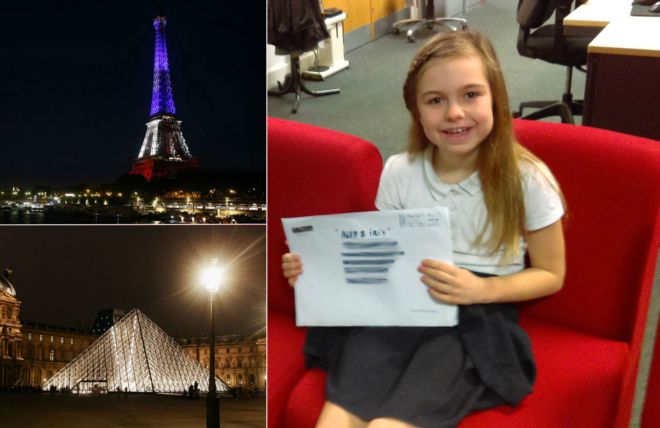
An eight-year-old girl who sent a letter addressed simply to “somewhere in Paris, any house” has received a reply from the Louvre Museum.

Iris Corbett, from West Bridgford, Nottinghamshire, wrote the note as she wanted to find out about the French capital.
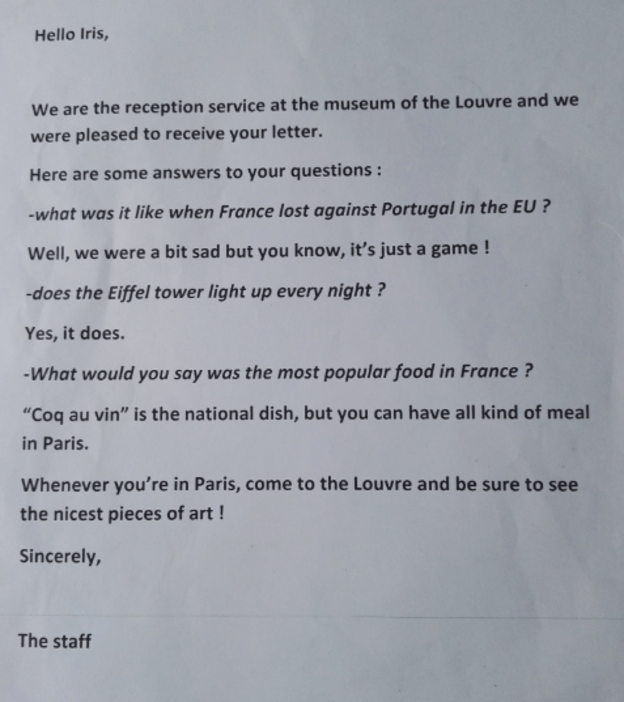
She asked about about food, the Eiffel Tower and what the city was like after France’s Euro 2016 final loss.

The Louvre responded with answers to all her questions.
Latest updates and more from around Nottinghamshire
The letter comes in a week when a similarly vaguely-addressed Christmas card found its way to the intended recipient in Suffolk.
Iris got the idea for her letter having seen her brother let go of a balloon and thinking it might end up in China.
Iris’s mother, Helena Tyce, said she was really pleased her daughter’s note received a reply.

She said: “Kids have these fantastic, creative ideas; you follow them through and nothing happens.

“I didn’t expect anything back, I really didn’t, we were so surprised and thrilled.”

The family are now planning “an adventure” on the Eurostar to visit Paris during the next school holidays.

Source: West Bridgford girl’s Paris note gets reply from Louvre – BBC News

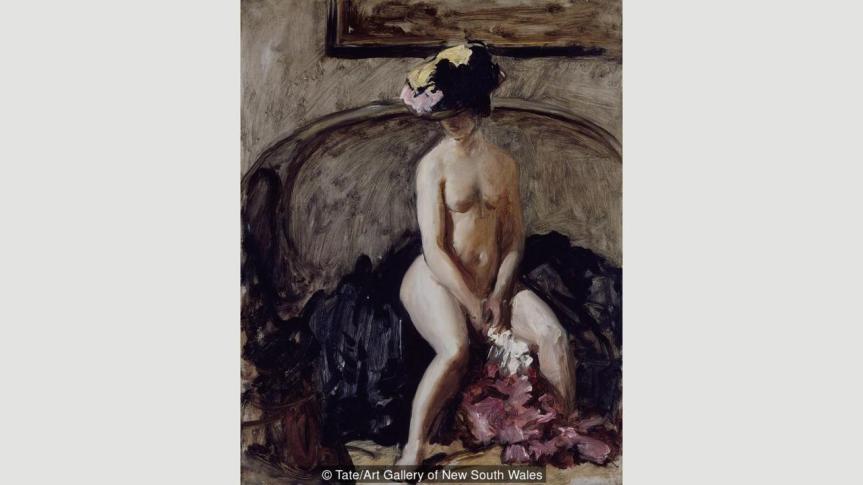
Why the nude still shocks

A new exhibition explores art’s long fascination with the naked form. Why do representations of the human body continue to cause controversy? Sam Rigby finds out.

The nude has fascinated artists and viewers alike for centuries – even today it continues to be a subject that triggers debate and controversy. The unclothed human body is one of art’s greatest subjects. It has appeared in almost every major art movement from Cubism to Abstract Expressionism to the political art of more recent times. Why does the nude continue to fascinate us? That’s the question posed by a new exhibition, Nude, at the Art Gallery of New South Wales in Sydney, which opened earlier this month. It brings together 100 portrayals of the nude from the Tate’s collection, including paintings, sculptures, photographs and prints from the late 1700s through to the present day.

[ . . . ]

Continue at the Source: BBC – Culture – Why the nude still shocks