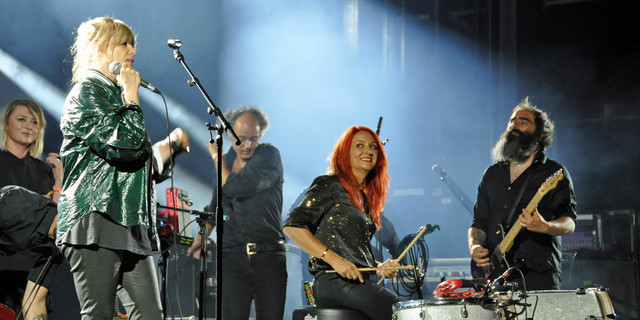
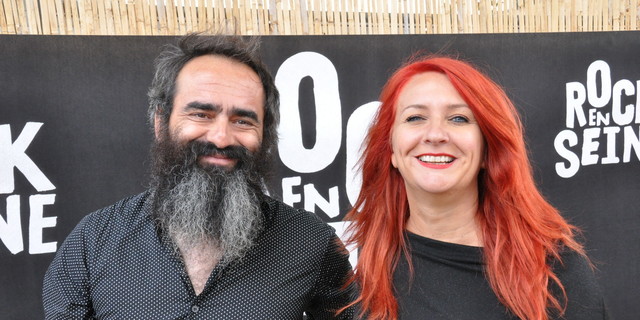
Real favorite of the first day of Rock in Seine, Limiñanas signed a concert of a beautiful energy with a lot of warmth and commitment. We took the opportunity to meet Lionel and Marie, the leaders of this unique formation. History to understand also how this couple and its musicians have become the French rock band the most seen of the moment.
This concert was a bit of consolation for rock fans frustrated by the programming of the first day of Rock en Seine. In the particular context of a park of St. Cloud half empty – see our article on the battle of Paris festivals – those who did not give in to the temptation to go see the phenomenon Die Antwoord at the same time on the big scene, have not regretted it.
Hot riffs, a psychedelic phosphorescent guitar, a trance rhythm, a man of old-fashioned elegance who dances alone in the background, an incandescent recovery of “Gloria”: here are some ingredients of the recipe for a good concert of Limiñanas .
Emmanuelle Seigner even made a surprise appearance at the time of the title “Shadow People” she sings on their last album. The invitations of this kind are at the heart of the project of the group as we explained Lionel and Marie a little earlier in the afternoon.
Your latest album ” Shadow people” offers great collaborations with other musicians (Emmanuelle Seigner, Anton Newcombe, Bertrand Belin, Peter Hook). How important are encounters in your career and how you make music?
Lionel:Our group comes from a meeting, the one with Pascal Comelade who participated in our first two albums. He had originally invited me to record guitars on a record (“A Freak Serenade”). I was expecting to play with a band but he was alone with the sound engineer. I had found it amazing to record my guitar parts because I came from an ultra-codified garage rock environment, used to playing in a group. It really opened my mind. I thought it was a way to get around the problem of groups breaking their mouths because of one or the other who can not or does not want to play anymore. It’s a way to control the process from A to Z.
You have experienced many musical experiences before the success of Limiñanas. How to explain that this training, based around a couple, worked?
It is precisely because we have given up the democratic process of the classical group. We decided to make the music that we wanted to really produce, both, as we want, and at our own pace. We are big bosses (laughs). We love to rehearse and spend a lot of time in the studio at home.
When you are working on your new songs at home near Perpignan, are you the type to tie everything up or do you leave a little freedom for the invited musicians?
There is always a bit of frustration to leave air in the music but we have to do it. When we worked for the first time with Peter Hook (bass player New Order), we made music by mail by sending recorded tracks. Marie had encouraged me to send very simple and sober versions to give her room to intervene. And it worked: he made several bass tracks, lots of choirs, and in the end much more work than originally thought!
Anton Newcombe’s Brian Jonestown Massacre who produced your latest album came into contact with you through Twitter before working with you. At the beginning, you have been spotted by American labels via MySpace … It’s a must, the social networks, for the success of a group today?
I think what’s really important is first and foremost things. We can then share them. If we can give advice to a young group, it is first that he does not care that it works. You have to make music for yourself first, be proud of what you do and make no concessions. At first we were criticized because we liked both New Wave English and Cramps, which was inconceivable for the purists of the time. You do not have to listen to anyone and first make your own music. Social networks can then become an important ally. But we, we are a little morons in the matter (laughs). The tweet of Anton Newcombe, it is a friend journalist of the World who told us about it, we had not even seen it!
A little “battery” question for Marie: why do not you use a hi-hat or a cymbal on stage?
Marie : It’s only for sound, to make room for all the little instruments that are there. In our group, the tambourine is very important. If we put cymbals we do not hear anything! Neither the tambourine nor the little pianos. And then it also allows to stay in a sort of tribal trance throughout the set.
How do you work your texts? Your themes are very broad. You are able to make a song on a fuzz effect pedal for or on a simple cooking recipe …
Lionel: For the cooking recipe, we did not invent anything, it is the recipe of Migas of my Grandma. I advise you to find the 45! If you apply the words to the letter, you will have your lunch. Because it’s not something to eat at night, it’s too heavy (laughs). It’s fried semolina in Spanish sausage fat! Texts are what asks us the most work. The choice to write in French does not make things easier. We can be ridiculous when it is badly written. I sign most of the texts, my older brother Serge also offers them from time to time … And then there is Bertrand Belin, who wrote “Dimanche” on our last album that I really like. He is an author who has a unique way of telling stories.
During this tour, you play in all kinds of venues and big festivals this summer like here in Rock en Seine. How do you adapt to these different atmospheres?
We worked a lot on the setlist, which we simply adapt according to the duration we are given. Our concerts are very fragile numbers because very electric and we are seven on stage. It’s repetitive music based on riffs played sometimes in loops and if one of us at a galley on stage, it compromises everything! We are really grateful to our friends who have been with us for a very long time. They followed us into our galleys when the group did not interest anyone. It’s really cool for all of us to have this recognition from the public today.
Source: Limiñanas in Rock en Seine: “Our concerts are very fragile numbers”


