Michael Stevenson, aka Dai Bando, Johnny Foreigner, Monsieur Pas De Merde, is a blogger of French and British culture. His blogs "Pas De Merde" and "The Hobbledehoy" have been called "marvelous" by some, and "meh" by others.
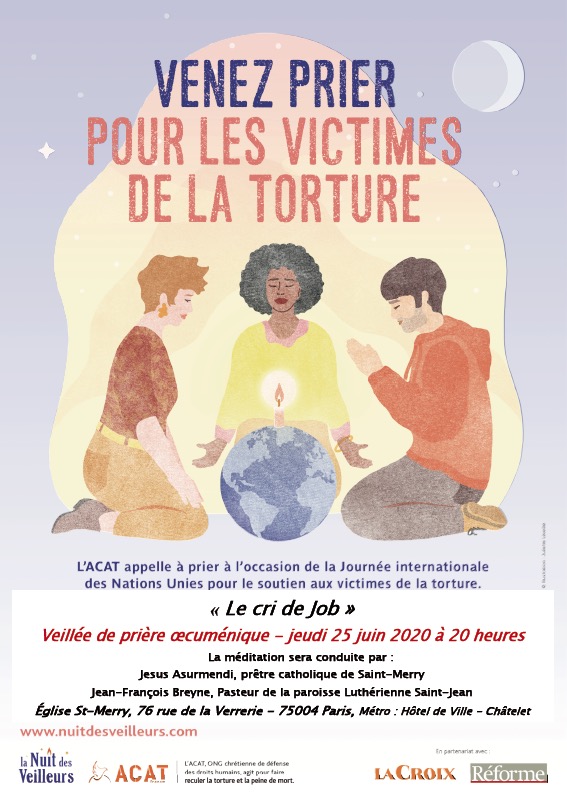
L’ACAT appelle à prier à l’occasion de la Journée Internationale des Nations Unies pour le soutien aux victimes de la torture. Cet événement rassemble chrétiens du monde entier et sympathisants…
ACAT calls to pray on the occasion of the United Nations International Day in support of the victims of torture. This event brings together Christians from around the world and supporters of all generations committed to the defense of human rights.
If you cannot come, know that the celebration will be accessible live from your internet browser at this address: https://zoom.us/j/7522757236 or if you go to zoom, indicating the meeting ID: 752 275 7236
Originally written in 1960 by Jack Diéval with French lyrics by Michel Rivgauche the song that would bcome “Parlez-moi de lui” was first introduced as ‘J’ai le mal de toi’.
In June 1965 the English rendering was retitled to “The Way of Love” and was issued in the UK as a single by Kathy Kirby.
“The Way of Love” failed to reach the UK Top 50 but became a regional hit in the United States reaching #88 nationally.
In 1966 a new French version, also by lyricist Michel Rivgauche, was recorded by Dalida as “Parlez-moi de lui” (“Tell me about him”). This rendition slightly alters the original melody. This adaptation was covered by Françoise Hardy on her 1968 album Françoise Hardy .
The most well-known version of “The Way of Love” was recorded by Cher. Her version spent three weeks within the top ten of the Billboard Hot 100, reaching a peak of number 7 and ultimately selling almost one million copies. Billboard ranked it as the No. 62 song for 1972.
This week, Rolling Stone Hebdo went to meet sound architect Rodolphe Burger. Our journalist Eric Delon discussed all the passion of the Alsatian musician.
If he is declared the loser, who knows what the limits are for a commander in chief who’s already exhorted his followers to “LIBERATE VIRGINIA”?
Last week, President Donald Trump assured the nation that he will leave office if he loses in November. “Certainly, if I don’t win, I don’t win,” he told Fox News. He continued, “You go on, do other things.”
Call me crazy, but I don’t believe him.
John Bolton, Trump’s former national security adviser, just revealed in his forthcoming book that President Trump told Xi Jinping, the authoritarian leader of China, that the two-term constitutional limit should be repealed for him, and asked his Chinese counterpart to interfere in our 2020 election to help him win.
French President Emmanuel Macron has met Prince Charles in London ahead of crunch quarantine talks with Boris Johnson later. They appeared to only be around 1m apart – as is the rule in France.
The French President and Duchess of Cornwall pressed their hands together to greet each other instead of shaking them. The trio then traveled to Carlton Gardens in central London for a short ceremony to commemorate the wartime President Charles De Gaulle, near where he made his famous speech on BBC radio which inspired the French resistance while under Nazi occupation.
Macron laid wreaths at the statues of King George VI and Queen Elizabeth before giving a short address praising Britain and wartime hero PM Winston Churchill.
The French President said this afternoon: “On the 18 June 1940, Churchill and de Gaulle sounded the words of resistance and hope. “The French army had been defeated in only six weeks, there was despair. But already a patriotic pride and a sense of honour and a strong will to resist lit up french hearts, and especially that of General De Gaulle.
“He refused defeat and he decided to carry on the fight. “He had to find somewhere to shelter, a place for his exile. That was London. The hope was embodied by the last European country able to carry on fighting.
“Winston Churchill refused to give in and did not give in. “He said he had nothing to offer but blood, sweat and tear but he offered so much more. “Determination, faith in victory, honour and pride.”