
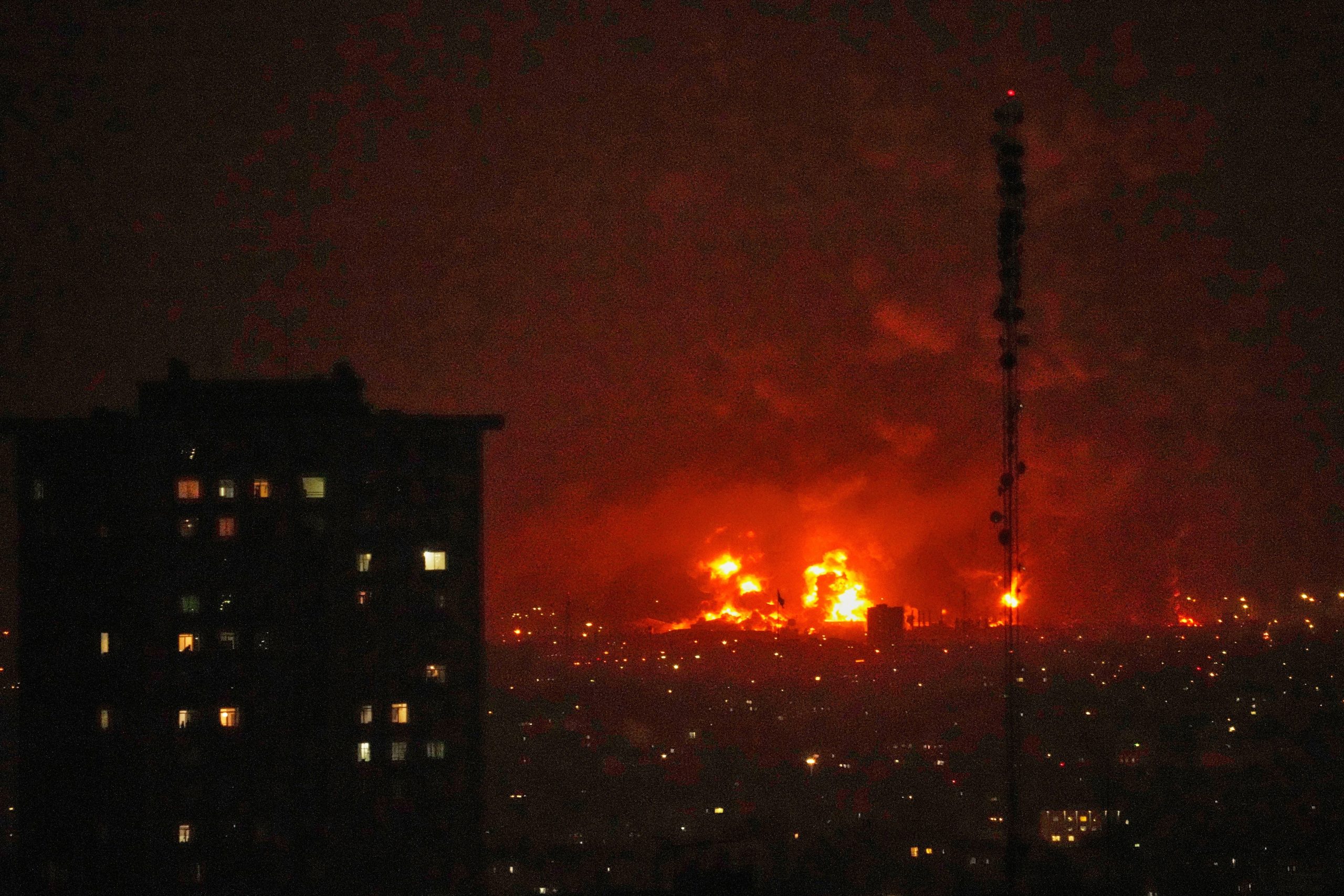
“A real war with real death and real suffering being treated like it’s a video game—it’s sickening,” Cardinal Blase Cupich said.
by
Following the United States and Israel’s overnight missile barrage of Iran on Feb. 28 and the widening war across the Middle East, a number of U.S. bishops have spoken out in opposition to the war.
They underscored an urgent need for peace and a return to diplomacy, denounced as unjust American and Israeli military aggression and expressed deep concern for the millions in the region affected by the armed conflict.
“At this present moment, the U.S. decision to go to war against Iran fails to meet the just war threshold for a morally legitimate war,” Cardinal Robert McElroy of the Archdiocese of Washington, D.C., said.
In an interview with the Catholic Standard on March 9, he explained that the U.S. offensive operations failed to meet at least three criteria of just war theory—the Catholic framework for evaluating the morality of military action—including the requirements for just cause, right intention and clarity that “the benefits of this war will outweigh the harm which will be done,” made impossible by the unpredictability of the region.
Cardinal McElroy said: “Almost everyone rightly believes that the Khamenei regime has been for decades a brutal and repressive government that has spread terrorism throughout the world and should be replaced. But there is immense concern that this war will spiral out of control and embroil the United States in ever greater depth.”
The cardinal, who has also voiced opposition to the Trump administration’s mass deportation policy, mentioned particular concern for the military families he has spoken with who are worried about their loved ones’ safety.
“We must all work together to forbid this expansionism to lead us into an ongoing morass in Iran,” he said, expressing his “deepest concern” for the “deterioration of moral norms” in the United States and the world, signified by the growing willingness to turn to preventative war over diplomacy as a legitimate means of foreign policy.
Cardinal McElroy’s responses echoed comments from Cardinal Blase Cupich of the Archdiocese of Chicago, who criticized the war and the Trump administration’s mix of militarism and entertainment in a statement on March 7.
Cardinal Cupich cited a post from the official White House X account captioned “JUSTICE THE AMERICAN WAY” that spliced clips from popular action movies, cartoons and TV shows “with actual strike footage from their war on Iran.”
It was one of many edits the White House has posted over the last few days in which the account has similarly spliced together video footage of the war with NFL and MLB highlights and video game references.
“A real war with real death and real suffering being treated like it’s a video game—it’s sickening,” Cardinal Cupich said. “This horrifying portrayal demonstrates that we now live in an era when the distance between the battlefield and the living room has been drastically reduced.”
He noted that the social media post dishonored the six U.S. soldiers who had been killed at that point during the war (the death of another service member was confirmed on March 8) as well as the hundreds of others who have died across the Middle East, “including the scores of children who made the fatal mistake of going to school” the day a U.S. missile struck a naval base next to an elementary school in Iran, killing 175 people.
“The moral crisis we are facing is not just a matter of the war itself, but also how we, the observers, view violence, for war now has become a spectator sport or strategy game,” Cardinal Cupich wrote, referencing a particularly macabre scandal involving the popular prediction market site Kalshi, where Americans can now gamble on matters of life and death. The company is the respondent in a $54 million class action lawsuit after it declined to pay out wagers on whether Iran’s Supreme Leader Ali Khamenei would be ousted by March 1, citing a “death carveout.”
Cardinal Cupich also urged the American people not to “become addicted to the ‘spectacle’ of explosions.”
“Our government is treating the suffering of the Iranian people as a backdrop for our own entertainment,” he wrote, “as if it’s just another piece of content to be swiped through while we’re waiting in line at the grocery store.”
“I know that the American people are better than this. We have the good sense to know that what is happening is not entertainment but war, and that Iran is a nation of people, not a video game others play to entertain us,” he concluded.
The cardinals joined the president of the U.S. Conference of Catholic Bishops, Archbishop Paul Coakley, who followed Pope Leo XIV’s lead and released a statement on March 1 condemning the hostilities: “We ask for a halt to the spiral of violence, and a return to multilateral diplomatic engagement that seeks to uphold the ‘well-being of peoples, who yearn for peaceful existence founded on justice.’”
Archbishop Coakley added: “I invite Catholics and all people of goodwill to continue our ardent prayers for peace in the Middle East, for the safety of our troops and the innocent, that leaders may seek dialogue over destruction, and pursue the common good over the tragedy of war.”
The Archdiocese of New York’s new archbishop, Ronald Hicks, also commented on the Iran crisis in a brief interview for 1010 WINS on March 5, calling for prayers and diplomacy. “We have to give some special prayers for our men and women in uniform and pray for their protection, too, and everyone involved,” he said.
“It is absolutely heartbreaking.”



 Pas De Merde