Kamala Harris knows things no vice president has ever known

Men in power might sympathize with women’s issues, but Kamala Harris knows them by heart.

By Monica Hesse | Washington Post

In the week before the country potentially elects its first female vice president, I’ve been trying to write a sweeping essay about progress and trailblazers and glass-breakers and what it all means. But what I keep thinking about is this: At some point in Kamala Harris’s life, someone has instructed her to carry her keys like a weapon when she walks to her car. Someone has said, Get them out of your purse even before you leave the grocery store. Arrange them between your fingers, and if someone attacks you, aim for the face

How do I know this? Because this is Woman 101. It’s the first page of the instruction manual teaching us how we’ll need to navigate the world. I have never met a woman who hasn’t heard this piece of advice. And I doubt that in 232 years of male leadership there’s ever been a sitting president or vice president who has.

I keep thinking about how, at some point in Kamala Harris’s life, she has painstakingly reviewed her office wardrobe with the understanding that the difference between “slut” and “feminazi” is a few inches of worsted-wool hemline. At some point, she has approached a stranger in a public bathroom because the Tampax machine is broken again, and she has said, I’m so sorry, but do you have — and then she didn’t have to finish the question because women in bathrooms know that there is only one end to that question.

Continue reading “Kamala Harris knows things no vice president has ever known”
Cardinal Dolan’s public flattery of Trump forgets a few things

I wonder whether the U.S. Catholic bishops have crossed a sort of Rubicon recently.

When their Roman predecessor, the general Julius Caesar, brought his army illegally over the Rubicon River, he set in motion the events that ended the Republic and saw him presented with a crown. “The die is cast,” he is reputed to have said as he marched his army toward Rome: there was no going back. What he had done could not be undone and it would change the shape of history.

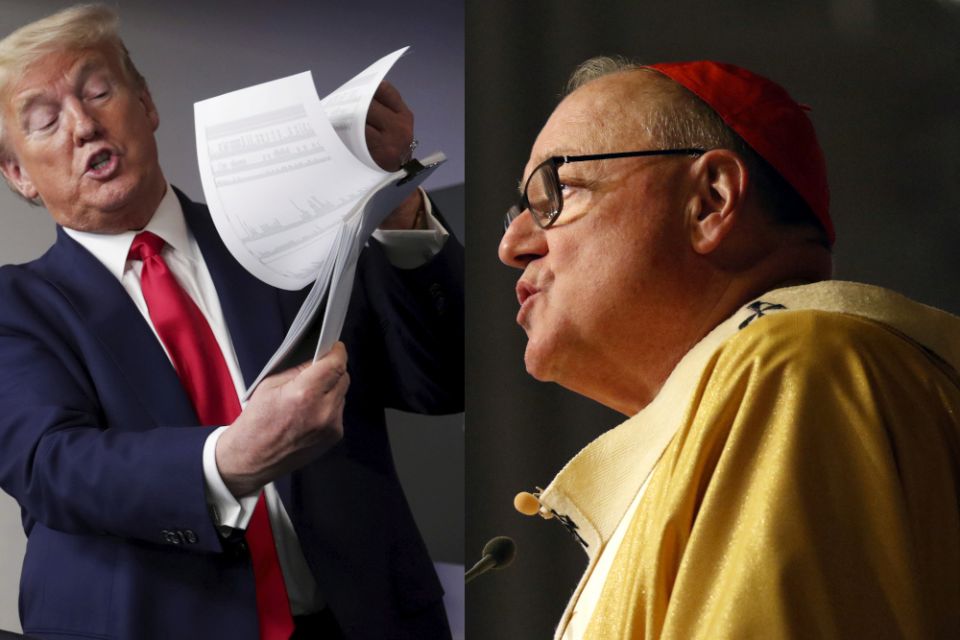
I do not think that New York Cardinal Timothy Dolan is in any danger of being crowned emperor (or, anything else). But I do believe that his public flattery of President Donald Trump from the pulpit of St. Patrick’s Cathedral and on Fox News may prove to be a moment from which American Catholicism cannot turn back.

Smart analysts have interpreted the cardinal’s blandishments as a savvy effort to smooth-talk the president into devoting stimulus funds to help Catholic schools that, no doubt, will struggle in the post-pandemic environment. Maybe that is what the cardinal thinks he is doing. Maybe it even looks smart from one point-of-view. But it seems to me that we have to overlook a lot to see how smart the cardinal is being.

Dolan praised Trump’s sensitivity to the “feelings of the religious community” on Fox News. Think about that.

Cardinal Dolan’s homily praising Donald Trump

Then, think about this. “I think Islam hates us,” or, “The children of Muslim American parents, they’re responsible for a growing number for whatever reason a growing number of terrorist attacks,” or think about what Trump said after the Supreme Court struck down his first travel ban that fulfilled his campaign promise of a “total and complete shutdown of Muslims entering the U.S.” — “Put a commission together. Show me the right way to do it legally.”

Continue reading “Cardinal Dolan’s public flattery of Trump forgets a few things”

NPR: Paris is at a standstill

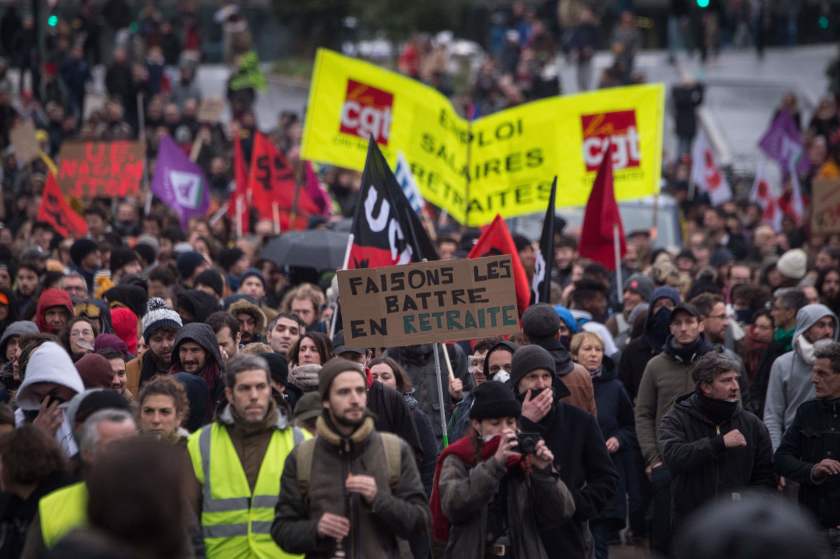
Paris has been brought to a near standstill by a wave of strikes and protest marches aimed at the French government’s plans to restructure the nation’s retirement system.

LULU GARCIA-NAVARRO, HOST:

In Paris, life has ground to a halt. A general strike there is in its 11th day. And there are daily protests, too. Unions are upset about Emmanuel Macron’s changes to the country’s retirement system. And they are threatening to continue striking through Christmas. Here’s NPR’s Eleanor Beardsley.

ELEANOR BEARDSLEY, BYLINE: It’s not the protests that are the problem. If you’re not on the march route, they don’t really affect you. But the transport strike is killing everyone. [ Listen below ]

Les Misérables: Why are the French, who seem to have much, so quick to protest?

Puzzling as it may seem in a country that appears to have so much going for it — fine wines, haute cuisine, high fashion and roughly 1,000 different cheeses — the French are Les Misérables. As author Sylvain Tesson told France Inter radio recently: “France is a paradise inhabited by people who believe they’re in hell.”

Economist Claudia Senik, a professor at the famous Sorbonne University, has studied the French malaise and believes it dates to the 1970s and the end of the “Trente Glorieuses,” the 30 postwar years when France boomed.

“It’s linked to the way the French view the world and their place in it. They have high expectations about the quality of life, freedoms and many values driven by the French Revolution and this sets a high benchmark for satisfaction,” Senik says. “They look back at a golden age when France made the rules of the game, and now we are just another smallish country forced to accept and adapt to rules.”

In her research paper, “The French Unhappiness Puzzle,” Senik found that even when they leave France to live elsewhere in the world, they take their gloominess with them, suggesting it is not France but being French that makes people unhappy.

“I was surprised to discover that since the 1970s the French have been less happy than others in European countries, much less happy than you’d have thought, given their standard of living, lifestyle, life expectancy and wealth,” Senik says. “It’s a problem of culture, not circumstance. It’s the way they feel, their mentality.”

On paper, the French have few reasons to be gloomy: They enjoy free and universal access to an enviable health system ranked first by the World Health Organization, free schools and universities, a maximum 35-hour workweek, six weeks’ annual vacation, paid parental leave and an enviable welfare safety net. Continue reading “Les Misérables: Why are the French, who seem to have much, so quick to protest?”