
Feb 17, 2025
For Zaho de Sagazan, music serves as a relief from sadness. As for Chiharu Shiota, art helps her ward off her fear of death. Writer Matt Haig suffered from panic attacks and depression. And the Swedish choreographer Alexander Ekman explores the power of feelings in his creations. Art is often born in the wake of emotions!
Tag: Music
Anne Sylvestre is no longer here to hit the anthill of patriarchy

Nous sommes encore au mois de juillet, mais aujourd’hui il est question d’une chanteuse dont le moi doute, Anne Sylvestre.
It’s still July, but today we’re talking about a singer whose self doubts, Anne Sylvestre.
It is around her, Anne the sister, the sister of all unruly women, that we drift today. And, no doubt about it, it will be very beautiful. This song dates from a long time ago, from the end of the 70s during which the cause of women had taken a few steps forward. Giant steps, decisive and with no turning back possible. In any case, that is what we believed at the time.
And yet, 45 years later, if a song like ” Frangines ” seems to date back to yesterday, if sisterhood is still a fragile notion, often caricatured by men and even by some slightly masochistic women, it is because there is still work to be done. Unfortunately, Anne Sylvestre is no longer here to hit the anthill of patriarchy, just to make room, since November 30, 2020 when a stroke struck her down when she was due to go back on tour at 86, it is an understatement to say that her voice is missed.
This undulating voice, of a calm power, if we stick to her qualities as a singer, but also this carrying voice, sometimes grumbling, mocking too, which has never ceased, until the last breath, to fight the little cocks, and those who doubt nothing. The bastards too.
LISTEN at source: Anne Sylvestre | France Inter
France Gall’s 1968 & The Death Of Yé-Yé

In this month’s subscriber essay, novelist Richard Milward travels back 55 years to the cobblestone-strewn streets of Paris, the release of France Gall’s album 1968, and discovers how a time of political upheaval had a profound impact on the happy-go-lucky genre of yé-yé
In this month’s subscriber essay, novelist Richard Milward travels back 55 years to the cobblestone-strewn streets of Paris, the release of France Gall’s album 1968, and discovers how a time of political upheaval had a profound impact on the happy-go-lucky genre of yé-yé
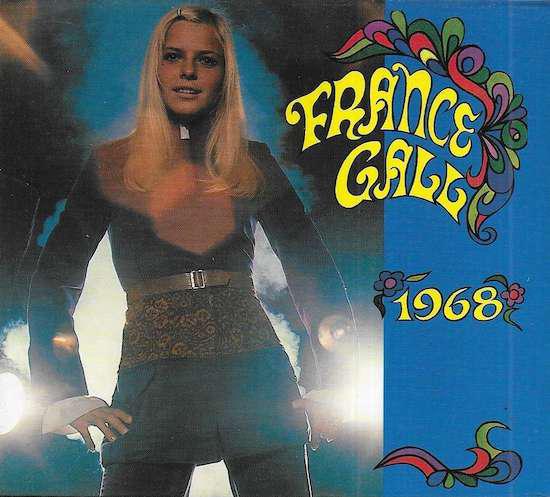
Three weeks before the first cobblestones were thrown in the explosive student revolt in Paris, May 1968, Télévision Suisse Romande broadcast the image of French yé-yé chanteuse France Gall’s small unconscious body carried down the hatch of the Savoie, a paddle steamboat floating on a frosty, overcast Lake Geneva. A strange funeral procession followed her down: a top-hatted illusionist, two muscular dancers dressed in sparkly forest-green bodysuits and white furry gilets, a dour Napoleon lookalike, comic singer Henri Dès in a purple Nehru jacket and pantaloons, and five ballerinas in bejewelled go-go boots and pastel-coloured wigs. A minute later, Gall would be upright again, dancing in the film’s grand psychedelic finale – but, with intense social and political upheaval looming, her mock death would unknowingly mark the symbolic death of yé-yé, the playful bubblegum pop movement that made Gall, Françoise Hardy, Sylvie Vartan, Chantal Goya, Annie Philippe and so many others famous between 1962 and 1968.
Gall’s mock funeral appeared in Gallantly, a 33-minute nautical caper promoting her seventh LP, 1968. Released in the first weeks of that year, the LP’s title and free-flowing flowery artwork seemed to promise 1968 would continue the carefree, loved-up hippy ideals of 1967 – and likewise the music within repeated many of the tropes of the Summer of Love sound: sitar-heavy exotica (‘Chanson Indienne’), chamber pop (‘Toi Que Je Veux’), North African slithering scales (‘Nefertiti’), hyperactive psych (‘Teenie Weenie Boppie’), cartoonish flute-led lounge jazz (‘Les Yeux Bleus’). Lyrically the LP is equally haphazard, taking in the perils of LSD, the pleasures of mini golf, Queen Nefertiti’s fragrant bandages, an insatiable flesh-eating giant, Anglo-Gallic dispute over the Channel Tunnel, the vicious love of a baby shark. While not wholly cohesive, 1968 is held together by Gall’s sweetly emphatic vocals: more than any other yé-yé singer, her sincerity and versatility enabled her to skip from genre to genre without ever tripping into parody or mawkishness. Throughout the mid 1960s, she was the embodiment of youthful optimism, consistently selling hundreds of thousands of records – but, by the time the stones and Molotov cocktails rained down on the Latin Quarter, she was no longer a fixture on French TV, her sales had slumped, her career seemingly irrelevant to this new, politicised youth [ . . . ]
Read Full Article at The Quietus: The Quietus | Features | Subscriber Area | Richard Milward On France Gall’s 1968 & The Death Of Yé-Yé
Sissoko, Segal, Parisien, Peirani: Les Égarés review – an awesome foursome
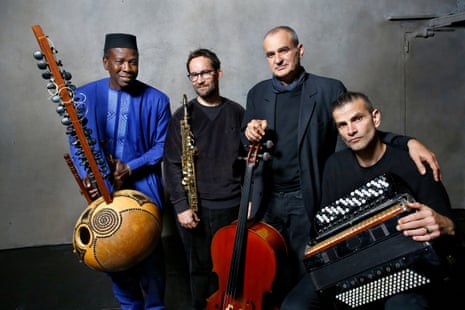
This stellar quartet channel a multitude of influences to irresistible effect
By John Fordham
The French cellist Vincent Segal is one of those peripatetic players who shows up across the musical frontier: on albums by Sting or “barefoot diva” Cesária Évora, on an arthouse film score or a dancefloor remix of Bumcello, the duo he formed with drummer Cyril Atef almost a quarter of a century ago. Segal’s most feted collaboration remains with Malian kora master Ballaké Sissoko on Chamber Music (2009) and Musique de Nuit (2015), where they pulled the traditions of Africa and Europe into a seductive neoclassical fusion.
Here, the pair are joined by accordionist Vincent Peirani and soprano sax player Émile Parisien on a venture that proves just as irresistible, even if its title translates as The Lost. It’s a sprightly, restless set, with Segal’s plucked cello providing a thrumming heartbeat to what is a communal, improvisational approach. There are reflective pieces – Sissoko’s Ta Nyé and Banja bookend the record in flurries of kora – but more typical is the group’s reworking of the late Joe Zawinul’s Orient Express, while on Esperanza the quartet seem to be channelling a drunken Colombian cumbia. Although inflected by various accents – there’s a Balkan feel to Izao, a touch of John Coltrane to Parisien’s sax – this is truly fusion music.
Source: Sissoko Segal Parisien Peirani: Les Égarés review – an awesome foursome | Music | The Guardian
Listen: The Rodolphe Burger festival pays tribute to Rachid Taha

Rodolphe Burger and his group Kat Onoma left their mark on French rock in the 80s and 90s. A fervent defender of the universality of music, in 2001 he created the C’est Dans La Vallée festival, in Sainte-Marie-Aux-Mines in Haut-Rhin.
Crédit Mutuel supported this atypical festival, the 15th edition of which was held from October 19 to 22, 2023, marked by a vibrant tribute to Rachid Taha.
In this exclusive interview, Rodolphe Burger evokes the memory of the singer of Carte de Séjour and presents the Mademoiselle trio, which he forms with Mehdi Haddab and Sofiane Saïdi.
Listen at RIFFX: It’s In The Valley 2023: the Rodolphe Burger festival paid tribute to Rachid Taha – RIFFX
Chanson Du Jour: “It Must Be Him”
Chanson Du Jour 10/17/206 Vikki Carr: “Que sea él” (It Must Be Him)
I’ve always loved the hilariously desperate song “It Must Be Him” performed by Vikki Carr. The song sold over 1 million copies in 1967 and millions more since.
Vikki Carr remains a very under-appreciated vocalist, one who gets unfairly lumped-in with her white bread contemporaries dominating that woeful/golden era of 1960s MOR (Middle of the Road) radio. 
On trips in the Stevenson family station wagon, my dad would play this musical spam on the car radio, punching in the dreaded WLKW button, while we kids in the back seat begged for DJ Joe Thomas playing Beatles, Beach Boys and Motown on WICE. But alas – this was elevator music without doors that open and let you out.
It was in the back seat of the Pontiac Tempest, that I learned Vicki Carr sang ‘grown-up” music that I actually liked. Eventually I saw her perform on TV with Merv, Johnny and Mike, where she was always beautiful, charming, and singing brilliantly. Still later, I became the odd used record customer who purchased both Vikki’s Greatest Hits album AND Moby Grape’s groovy debut (sans “flipping the bird”) while shopping at In Your Ear. Has anyone else ever purchased these two records together? No? Hooray for me.
Born Florencia Bisenta de Casillas-Martinez Cardona before opting for the anglicized stage name, Continue reading “Chanson Du Jour: “It Must Be Him””
 Pas De Merde